


Kermanshah province was reported to have harvested about 1,700 kilograms of saffron from 422 hectares, an average close to 4 kilograms per hectare. The figure fits a longer development path: an earlier report recorded 185 hectares and a three-year target of 1,200 hectares, while also identifying the districts leading that expansion.
These are historical statements from Noorbakhsh Hatami, then head of the provincial Agricultural Jihad organization. The 1,200-hectare number was a plan, not a confirmed present-day area, and the yield should not be read as a guarantee for every farm.
Kermanshah’s 1,700-kilogram saffron harvest
Hatami placed the province’s cultivated saffron area at 422 hectares for the reported season. Of that total, 120 hectares had been added during the year, implying that about 302 hectares were carried over from the previous cultivated base.
At an average saffron yield of 4 kilograms per hectare, 422 hectares would produce approximately 1,688 kilograms. That is consistent with the reported rounded total of 1,700 kilograms. The arithmetic supports the relationship between the two headline figures, but it does not prove that every hectare produced exactly 4 kilograms. New fields may not yet have reached full production, and yields vary by field.
What “4 kilograms per hectare” actually means
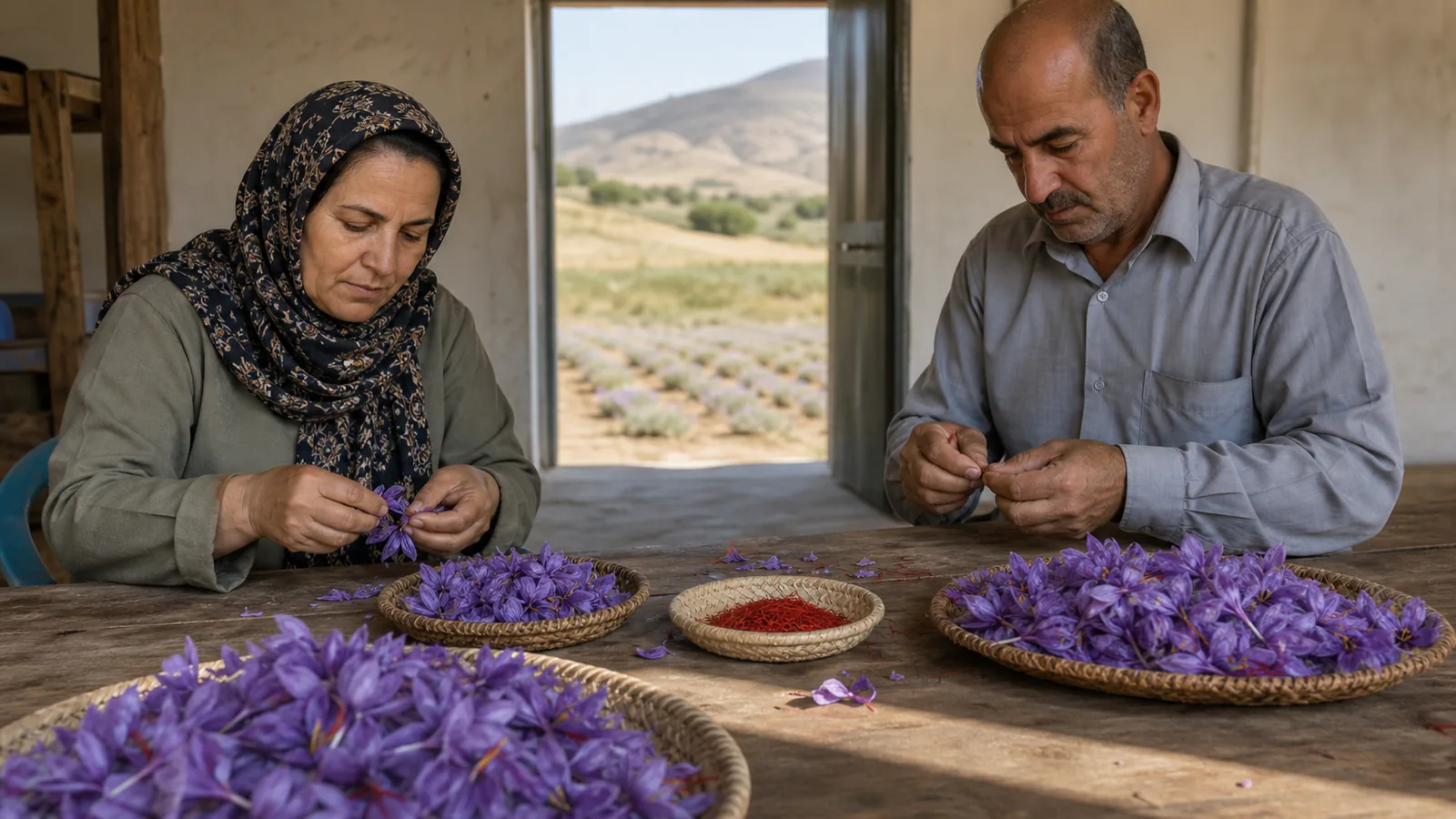
Saffron yield per hectare is the weight of dried red stigmas obtained from a cultivated hectare, not the weight of flowers picked. Thousands of flowers are needed for a small amount of finished spice, and drying removes much of the fresh material’s moisture.
A provincial average also hides a wide range. Corm size and health, field age, planting density, irrigation, soil, weeds, temperature, harvest timing, labor, separation, and drying can all change the final result. The 4-kilogram figure is useful as an attributed benchmark for that Kermanshah season, not as a universal Iranian yield.
Our saffron planting and harvest guide explains the production sequence that sits behind a yield figure.
Where saffron was grown in the province
The 422-hectare report said saffron was cultivated in nearly every Kermanshah county except Qasr-e Shirin and Sarpol-e Zahab. It identified Kermanshah, Dalahu, and Harsin as the leading areas in that later season.
An earlier snapshot gives a more detailed district ranking when the provincial total had reached 185 hectares:
- Kermanshah county: 52 hectares
- Kangavar: 21 hectares
- Songhor: 20 hectares
- Dalahu: 20 hectares
Those district figures and the later 422-hectare total belong to different points in the expansion. They should not be added together. Instead, they show the trajectory from a small cluster toward wider provincial adoption.
The three-year plan to reach 1,200 hectares
Hatami described a three-year program intended to raise Kermanshah’s saffron area to 1,200 hectares. In the earlier year, the area had grown by 96 hectares to reach 185 hectares. The later 422-hectare report showed substantial additional growth, but it did not establish that the 1,200-hectare target had ultimately been reached.
The 422-hectare article also referred to another 100 hectares planned for the following year. That is better understood as a near-term step within the broader expansion effort, not as a separate final target.
| Stage | Reported area or output | Status |
|---|---|---|
| Earlier provincial area | 185 hectares after a 96-hectare increase | Reported result |
| Later provincial area | 422 hectares, including 120 new hectares | Reported result |
| Later harvest | About 1,700 kg at roughly 4 kg/ha | Reported result |
| Following-year addition | 100 hectares | Plan |
| Three-year provincial area | 1,200 hectares | Target, not confirmed outcome |
Employment during the saffron cycle
The expansion plan estimated that one hectare of saffron could generate 200 to 300 person-days of work. “Person-days” is the sensible reading of the translated statement: it measures the combined labor used over a season, not 200 to 300 people working on one hectare every day.
Saffron’s labor demand is concentrated. Flowers open over a short period and are usually picked early, then the stigmas must be separated and dried promptly. That creates seasonal employment, but it also creates a bottleneck. Expanding acreage without enough trained pickers and processing capacity can reduce quality.
Climate fit and production risk
Hatami described saffron as compatible with Kermanshah’s varied climate and referred to a long local history of cultivation. The province’s agricultural scale, land base, and rainfall were presented as strengths. Still, a province with multiple climatic zones cannot be treated as one uniform saffron field.
Site selection matters. Cold tolerance, drainage, summer dormancy, irrigation availability, and harvest weather can differ across Kermanshah. The absence of cultivation in Qasr-e Shirin and Sarpol-e Zahab in the reported season also shows that expansion was selective rather than universal.
Packaging and market access
The later report mentioned an active saffron packaging unit in the province. That is important because acreage alone does not keep value in the producing region. Grading, careful drying, clean storage, accurate weights, packaging, and traceable sales determine whether farmers can move beyond selling an undifferentiated crop.
For Kermanshah, the development story is therefore more than a climb from 185 to 422 hectares. The useful measure is whether yield, labor capacity, processing quality, and buyer access improve together. The reported 1,700 kilograms provide a credible milestone; the 1,200-hectare goal remains a historical ambition that should be checked against newer official data before being described as achieved.

![Exporting Saffron to Turkey + Price Guide [Complete 0 to 100]](https://img.rowhanisaffron.com/20260827003933/saffron-export-turkey-quality-inspection.webp)



