


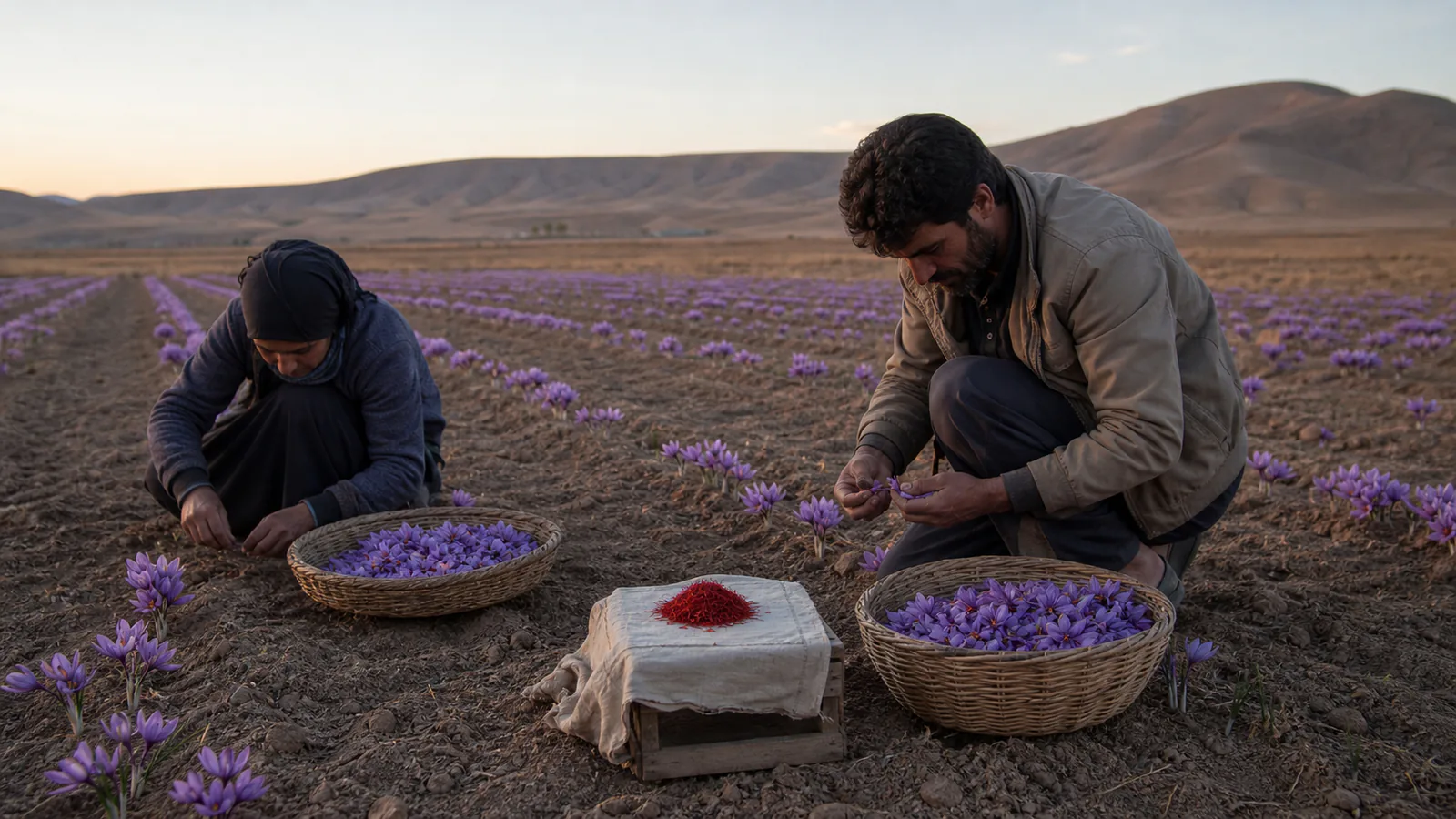
A reported Taybad crop year produced more than 21 tonnes of dried saffron from 6,850 hectares while output fell about 40% from the previous year. The important point is that cultivated area had increased, yet yield still declined after cold weather and poorly timed rainfall. Three older Neishabour reports show the same lesson across different crop years: more hectares do not automatically produce more dried saffron.
The figures below are historical statements preserved from four local agricultural reports. Their WordPress publication dates do not identify the original crop years with enough certainty, so “this year” and “last year” have been replaced with terms such as the reported crop year. The numbers should not be read as current forecasts.
Yield of saffron crop in Taybad has decreased by 40%
Mohammad Miri, identified in the destination report as director of Taybad Agricultural Jihad, said the harvest ended with more than 21 tonnes of dry saffron. He attributed the 40% year-on-year drop to cold near the start of harvest and unfavorable timing or distribution of rainfall.
At the same time, the planted area rose by 650 hectares to 6,850 hectares, described as a 7% increase. Of that total, 6,200 hectares were productive and 650 hectares were new or not yet bearing. The source called the latter “infertile,” but young/non-bearing is the more accurate meaning in this context.
The report gave an average of more than 3 kilograms of dry saffron per hectare. Twenty-one tonnes across all 6,850 planted hectares would average about 3.1 kg/ha; using only the 6,200 productive hectares gives about 3.4 kg/ha. This is why any yield figure should state whether its denominator includes new fields.
What support did Taybad growers receive?
The Taybad account described about 6,000 saffron growers and a harvest running from late October through late November. It said an official buying market opened during harvest and that 15.5 tonnes had been purchased in the previous crop year under a support program.
Agricultural support listed in the report included:
- chemical and micronutrient fertilizer, including a reported 1,000 tonnes distributed in that crop year;
- guidance on newer irrigation methods;
- weed control and protection from livestock grazing; and
- technical recommendations from planting through harvest.
The translation also said “130 people” worked per hectare between planting and harvest. The original unit is not available. Agricultural employment is often reported as person-days, and the number should not be multiplied by hectares as though it represented 130 different permanent workers on every hectare.
The processing problem behind the farmgate result
Miri identified limited local processing and packaging capacity as a serious constraint. According to the report, some Taybad growers had to sell flowers or product to intermediaries at a lower price or send it to other cities for flower separation and cleaning.
That changes how much value stays with the grower. A harvest figure measures dry product; it does not show who performs sorting, testing, packaging and marketing or what share of the final price returns to the farm. FAO’s current work with Iran likewise treats quality integrity, post-harvest handling and value-chain governance as connected issues. Read FAO’s November 2025 saffron value-chain update.
Neishabour: three crop-year snapshots
The three source posts about Neishabour are not duplicate versions of one harvest. They report different areas, output and officials, so their figures belong in separate snapshots. Neishabour and Taybad are both in Khorasan Razavi, but they lie on different sides of Mashhad and should be compared as regional cases, not described as neighboring fields.
Snapshot one: about 8 tonnes from 3,100 hectares
Seyed Gholamreza Nabavi Namaghi, identified as a Neishabour Agricultural Jihad director, reported 3,100 hectares under saffron: 2,800 productive hectares and 300 young hectares. Cultivation was concentrated in central areas, Miyan Jolgeh and Zeberkhan.
The account said the crop year produced about 8 tonnes of dry saffron at an average of 2.8 kg/ha and generated roughly 254 billion rials in gross grower income. Multiplying 2.8 kg by the 2,800 productive hectares produces about 7.8 tonnes, which is consistent with the rounded total.
Support included chemical and micronutrient fertilizer, technical advice, model farms, research on planting and inputs, and heaters for drying saffron. Nabavi Namaghi also said a carefully managed first-year field could yield about 800 grams per hectare. That is a local extension estimate, not a universal guarantee.
The English source printed an employment figure of more than 495,000 “people.” Because the unit is implausible as a distinct-worker headcount for 3,100 hectares and the original wording is unavailable, it is not repeated here as a verified number.
Snapshot two: about 9 tonnes from 2,950 hectares
Another report from Nabavi Namaghi described roughly 9 tonnes of dry saffron from 2,950 hectares, with average yield between 3 and 3.2 kg/ha despite sharply lower rainfall. It counted more than 4,200 saffron growers and estimated gross income at 172 billion rials.
The translated breakdown of productive and young hectares contained digits that did not add up to the stated total, so the 2,950-hectare total is retained without inventing a corrected subdivision. The output and yield are internally coherent: 2,950 hectares at approximately 3–3.2 kg/ha gives about 8.9–9.4 tonnes.
This report again mentioned micronutrient fertilizer, technical guidance, drying heaters and model projects. Its claim that a first-year field could exceed 1 kg/ha differs from the 800-gram estimate in the other snapshot. Field condition, planting date and the report’s rounding may explain the difference; neither should be treated as a promise to every grower.
Snapshot three: about 16 tonnes from 5,900 hectares
A report attributed to Neishabour Agricultural Jihad director Mohammad Ali Farahmandrad described cultivated area rising from 5,700 to 5,900 hectares. The total comprised 5,700 productive hectares and 200 young hectares. The old English page mistakenly printed 5,900,000 hectares; the component figures and headline make clear that 5,900 was intended.
It reported about 16 tonnes of dry saffron at an average 2.8 kg/ha, a roughly 40% production decline, and gross grower income of 56 billion rials. The stated causes included excessive autumn and summer heat, reduced spring rainfall and irrigation that began too early.
The report also printed direct and indirect employment of 114,000 “people.” As with the other large employment figure, the translation does not establish whether this meant individuals, jobs or person-days. It is preserved here as an unresolved source field rather than asserted as a verified headcount.
Why the Neishabour totals do not conflict
Eight, nine and sixteen tonnes can all be accurate descriptions of different crop years. The reported cultivated base changed from roughly 2,950–3,100 hectares in two snapshots to 5,900 hectares in another. Yield stayed in a narrower range of about 2.8–3.2 kg/ha, while productive area and weather differed.
The income figures—254 billion, 172 billion and 56 billion rials—should not be compared as a clean trend. The reports do not provide unambiguous dates, price definitions, inflation adjustments or confirmation that the same share of crop and sales was counted. Preserving each attributed figure is useful; calculating a growth rate from them would be misleading.
What the regional reports say about saffron yield
Yield is more informative than area alone
Planted hectares include young fields that may contribute little in their first year. Productive hectares, dry output and the same crop-year boundary are needed for a fair comparison. An expanding area can coincide with falling total production when heat, cold or water stress reduces flowers per field.
Timing matters as much as total water
Saffron is valued in arid regions for relatively modest water needs, but it is not immune to climate. FAO’s profile of the qanat-based saffron system in Gonabad explains how the crop supports livelihoods under severe water scarcity. The Taybad and Neishabour reports add local examples: heat, cold, rainfall timing and irrigation decisions can alter yield even when planted area grows.
Post-harvest capacity affects farm value
Drying heaters, clean separation, testing and packaging do not increase the number of flowers harvested, but they can reduce loss and preserve quality. Processing close to the farms can also help growers retain more of the product’s value instead of selling quickly to cover a capacity gap.
The accurate conclusion
The historical Taybad report records a 40% fall to more than 21 tonnes despite expansion to 6,850 planted hectares. The Neishabour reports record about 8, 9 and 16 tonnes in separate crop-year snapshots, with average yields clustered around 2.8–3.2 kg/ha. Read together, they show a coherent regional pattern: cultivated area, productive area, weather, field age, agronomic support and post-harvest capacity all shape the final dry-saffron result.
They do not provide a current 2026 production estimate. For any new comparison, the date, geography, productive hectares, dry weight and measurement method must be stated before the percentages are reused.

![Exporting Saffron to Turkey + Price Guide [Complete 0 to 100]](https://img.rowhanisaffron.com/20260827003933/saffron-export-turkey-quality-inspection.webp)



