


Fereydan saffron harvest figures and a separate Neishabour crop-loss report show how differently one season can unfold across Iran’s growing regions. In Fereydan, Isfahan Province, officials expected more than 50 kilograms from 25 hectares. In Neishabour, Khorasan Razavi, meteorological officials attributed an approximately 70% reduction to prolonged summer heat followed by early-November cold and precipitation.
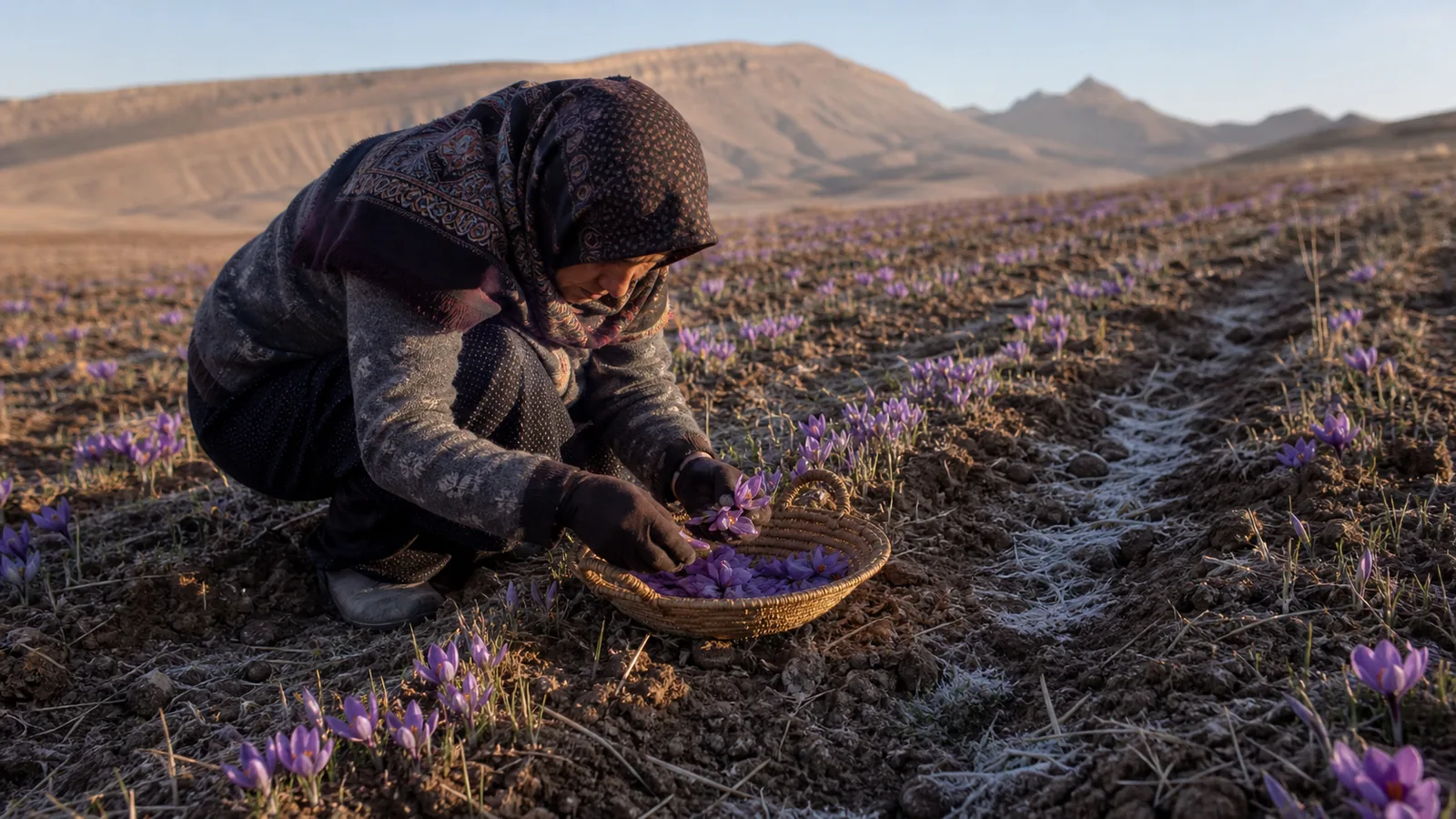
The reports describe historical forecasts and observations, not current field conditions. Their percentages also need care. The Fereydan headline’s “70% increase” does not match the before-and-after acreage implied by its own figures, while Neishabour’s 70% figure refers to a reported reduction in harvest.
Fereydan expected more than 50 kilograms from 25 hectares
Ramin Rostami, identified as the local agricultural authority, said Fereydan had 25 hectares under saffron and expected an average harvest of about 2 kilograms per hectare. Those two figures align: 25 hectares at 2 kg/ha would produce 50 kilograms.
The report valued the expected crop at about 6 billion rials. Dividing that amount by 50 kilograms gives roughly 120 million rials per kilogram, but this is only an implied historical gross value. It is not a current price and does not account for production, labor, drying, grading, or marketing costs.
The old English translation repeatedly calls the location “Frieden.” The established name is Faridan or the local form Fereydan, a county in western Isfahan Province with Daran as its center, as documented by Encyclopaedia Iranica. The existing URL retains the old wording so links and indexing are not disturbed, and “Frieden farms” is preserved here as the phrase readers may have seen in the earlier article.
Why the reported 70% Fereydan increase is unclear
The destination says 17 hectares were added and the final area was 25 hectares. That implies a previous area of 8 hectares. Moving from 8 to 25 hectares is an increase of 17 hectares, or about 212.5% relative to the starting area—not 70%.
Seventeen hectares are 68% of the final 25-hectare total, which may explain how a rounded 70% entered the report. That interpretation is plausible, but it cannot be confirmed without the original agricultural table. The safest record therefore keeps the stated values separate:
- reported final cultivated area: 25 hectares;
- reported addition: 17 hectares;
- implied previous area: 8 hectares; and
- reported “70% increase,” which does not match growth from 8 to 25 hectares.
The article attributes the expansion to saffron’s relatively limited water requirement and its perceived economic feasibility. Those are the official’s reasons for promoting the crop, not proof that every Fereydan field was profitable or protected from water stress.
Neishabour reported a 70% harvest reduction
The source article records the opposite outcome in Neishabour. Mehdi Bloki, head of the city’s meteorological department, said saffron harvest had fallen by about 70%. He identified two weather periods as the main causes considered by local agricultural-meteorology experts.
First came unusually persistent heat in July, August, and September. Bloki said the absolute maximum temperature was about 3°C higher than both the previous year and the 24-year long-term average, with the heat remaining stable for almost a month. He reported greater damage to corms planted closer to the soil surface.
The translated explanation of the plant response is incomplete, so this article does not invent a precise physiological mechanism. It preserves the official observation: sustained heat was associated with damage, and shallow-planted corms were described as particularly vulnerable.
Early-November cold compounded the heat stress
Bloki described a second, smaller weather effect between November 5 and 15: snow, rain, and what the translation calls “surface cold.” The report says this period further reduced the crop. It does not provide field measurements that would separate the contribution of heat, moisture, and cold.
At the time of the bulletin, the department expected a rain-free week with minimum temperatures above zero and called it the best immediate harvest window. That was a short-lived weather forecast, not a calendar recommendation that can be reused in another year.
How the historical weather guidance should be used
Neishabour’s agricultural-meteorology experts advised irrigation in the second half of August during that heat episode to reduce heat stress. The timing belongs to the reported local conditions. Growers should not apply it automatically in a different field or season, because soil moisture, corm depth, temperature forecasts, water quality, and local cultivation practice can change the appropriate decision.
The department also invited farmers to register, through the city’s agricultural insurance fund, for short- and long-range forecasts and crop recommendations. Because the report is historical, growers should confirm the current registration route and service availability with the relevant local office.
What the two regional reports actually establish
Fereydan’s report documents an expansion to 25 hectares and a forecast near 50 kilograms. Neishabour’s report documents a severe reduction attributed to a particular sequence of heat, snow, rain, and surface cold. They are not the same dataset, and the records do not establish that weather caused Fereydan’s area growth or that the two 70% figures are directly comparable.
Read together, they offer a more useful lesson than either headline alone: planted hectares, expected yield, final dried output, and weather damage are different measurements. A credible regional saffron report should name which one changed, show its baseline, label forecasts clearly, and record the crop year before drawing conclusions.

![Exporting Saffron to Turkey + Price Guide [Complete 0 to 100]](https://img.rowhanisaffron.com/20260827003933/saffron-export-turkey-quality-inspection.webp)



