


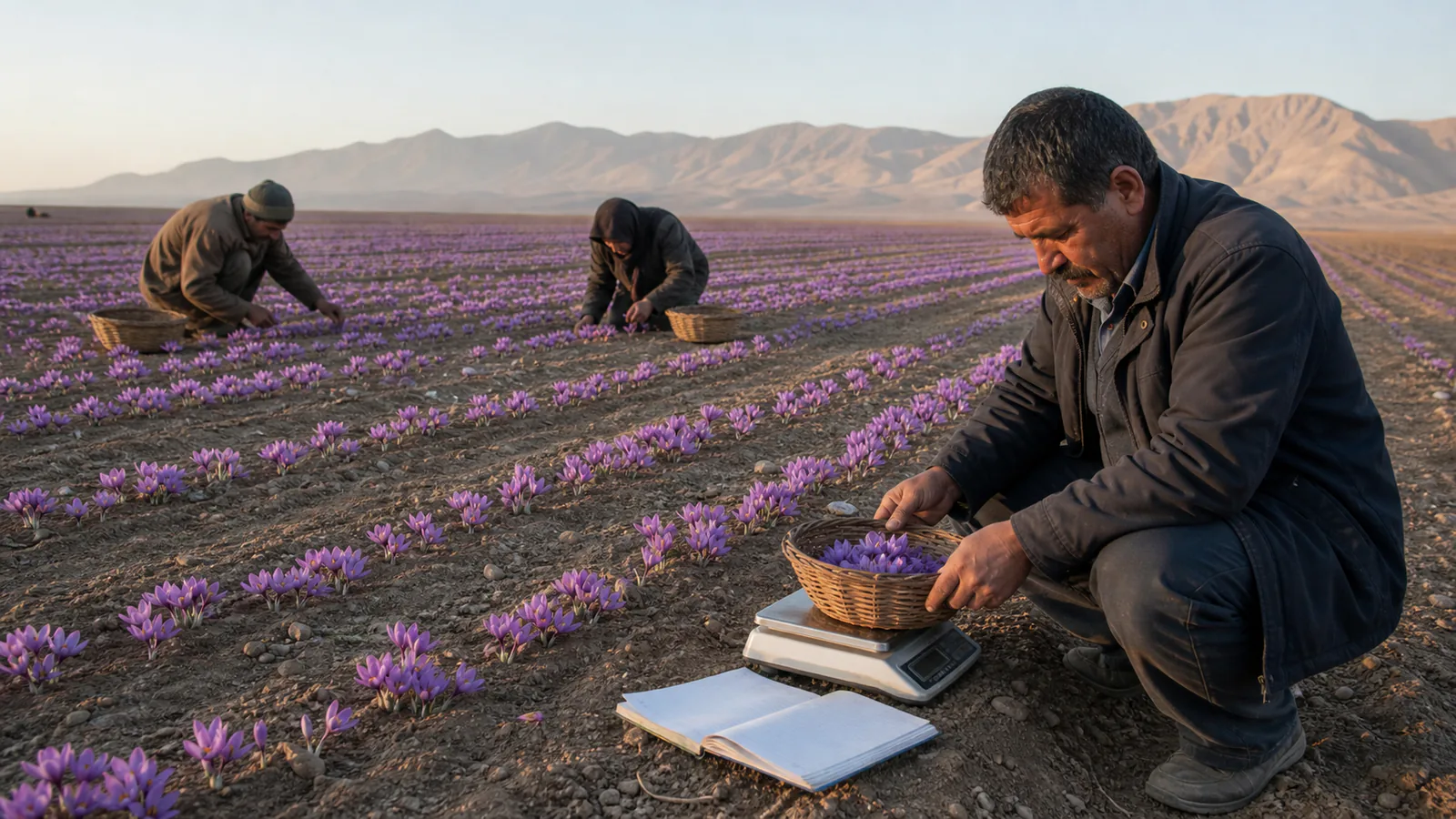
A historical saffron harvest in Estahban, Fars, began across 520 hectares with more than 2,600 kilograms of dried saffron forecast by the end of the roughly month-long season. That implies a little over 5 kg/ha if all 520 hectares were productive and the forecast was met. Reports from Golestan and Ghaen in South Khorasan provide useful scale comparisons, but their figures describe different years, crop stages, and market conditions.
The three accounts should not be combined into one national total. Estahban’s number was a forecast at harvest start, Golestan paired expanding planted area with a prior-year harvest, and the South Khorasan article mixed a province-level headline with Ghaen-specific area, yield, price, and operator data.
What the Estahban harvest report recorded
Ahmad Ranjbar, identified as director of Estahban’s Agricultural Jihad office, said saffron picking had started on 520 hectares. He expected more than 2,600 kilograms of dried saffron from that area.
Dividing 2,600 kilograms by 520 hectares gives exactly 5 kg/ha; because the forecast was “more than” 2,600 kilograms, the implied figure is slightly above five. The article does not say whether all 520 hectares were productive, give field ages, or report a final weight, so this remains a forecast—not a completed city average.
The season was expected to continue for about a month and finish near the end of December. That is a historical window, not a fixed date for future crops. Temperature, elevation, irrigation, corm condition, and field age can shift flowering and labor demand.
Estahban’s scale and ranking claims need a denominator
Ranjbar called Estahban first in Fars Province for saffron area and number of farms and second in Iran. The source does not identify the comparison year, the municipality ranked first nationally, the national dataset, or whether “second” refers to area, farm count, or another measure.
The ranking should therefore remain an attributed historical claim. The 520-hectare area and 2,600-kilogram forecast are the more useful figures because their units are stated and their arithmetic can be checked.
Estahban was described as a high plain about 160 kilometres east of Shiraz, with the city at roughly 1,767 metres above sea level. Elevation may help explain a cool harvest period, but one city elevation does not characterize every farm or prove quality.
Export destinations were reported, not quantified
The Estahban article said saffron was sold in Iran and exported to European countries, Persian Gulf markets, and India. It gives no customs record, shipment year, volume, value, grade, buyer, route, or share attributable to Estahban.
Those destinations show the commercial reach claimed by the official, but they do not prove that every local grower exported directly. Product may move through traders, processors, packers, or another province before export.
A current market account would need lot-level traceability, buyer specifications, laboratory results, shipment documents, paid price, and destination. Without those records, an old export list should not guide production or revenue forecasts.
Quality cannot be established by aroma claims alone
The English source describes Estahban saffron as more fragrant in smell and taste because of soil and altitude. Its wording is circular—it appears to compare Iranian Estahban saffron with saffron “cultivated in Iran”—and no sensory panel or laboratory results are provided.
Regional reputation can justify testing, not replace it. ISO 3632-1:2025 specifies requirements for dried saffron in filament, cut-filament, and powder forms, while ISO 3632-2:2010 specifies test methods. The Estahban report does not identify an applicable standard, sample, lab, or certificate.
A useful quality claim would name the lot, sampling method, moisture basis, test date, laboratory, analytical values, storage conditions, and the standard edition used. It would also separate product form and grade rather than treating an entire region as uniform.
Golestan’s planted area rose from 100 to 120 hectares
Mohammad Bagheri, identified as a deputy horticulture manager in Golestan’s Agricultural Jihad organization, announced a 20% increase in saffron area. The arithmetic supports the statement: moving from 100 hectares to 120 is a 20% rise.
The source associates 120 hectares with the Vamnan region and says 60 hectares had been harvested. Elsewhere, it spells the area Vamsan. The English transliteration is inconsistent, so the two spellings should not be treated as separate production zones without a local geographic reference.
It also says the previous year’s Golestan harvest was about one tonne. The article does not state the productive-area denominator for that tonne, whether it was dried saffron, or whether it came only from the named region. Dividing it by 60 or 120 hectares would therefore create an unsupported yield.
Golestan’s cooperative price was a historical transaction range
A rural cooperative in the Azadshahr area reportedly bought saffron for between five and 6.5 million tomans per kilogram. The source does not give the exact year, grade, moisture, lot size, contract terms, payment timing, or quantity purchased.
The range is useful evidence that a cooperative purchasing channel existed in that snapshot. It is not a current market price and should not be converted or compared with another report unless the date, currency basis, product specification, and transaction terms match.
Golestan’s harvest was said to begin near the end of October. That is earlier than the end-of-December finish described for Estahban and illustrates regional timing differences; it does not prove one region has a longer or more productive season.
Ghaen’s figures explain the 13-tonne headline
The assigned South Khorasan source uses a headline of more than 13 tonnes, while its body focuses on Ghaen. It reports 4,287 hectares in Ghaen, up 23%, and an average of three kilograms and 150 grams of dried saffron per hectare.
The multiplication is internally consistent: 4,287 hectares × 3.15 kg/ha equals about 13,504 kilograms, or 13.5 tonnes. That likely explains the headline and the existing meta description, but the article does not clearly distinguish a completed Ghaen total from a wider South Khorasan provincial total.
The 23% area increase cannot be checked because the previous year’s exact hectares are omitted. An implied prior area would be roughly 3,485 hectares if the percentage is exact, but that value should not be presented as reported data.
Ghaen’s quality, quantity, and price claims have limits
The source calls Ghaen first nationally for saffron quality and second for quantity after Torbat Heydariyeh. It supplies no comparison year, national table, quality method, or organization responsible for the ranking. Like Estahban’s rank, it should remain an attributed historical statement.
Raufifard, identified as Ghaen’s agricultural director, gave prices of 41 million and 34 million rials per kilogram. The English text repeats “saffron” without naming the two grades or forms, so the values cannot safely be assigned to specific quality categories. They are historical prices, not current offers.
The article also records 12,850 people “exploiting” or operating in the saffron sector. That likely refers to growers or beneficiaries, but it is not defined as full-time employment and gives no hours, wages, household count, or duplicate-control method.
How the three regions can be compared safely
Estahban’s implied forecast just above 5 kg/ha and Ghaen’s stated 3.15 kg/ha use area and weight, but they still are not directly comparable. Estahban may use total rather than productive hectares, and its weight was forecast. Ghaen’s report lacks a clear harvest-status sentence and lot-level measurement method.
Golestan’s one-tonne statement lacks an area denominator for the same harvest. Its strongest comparable evidence is area growth from 100 to 120 hectares, not yield.
The finalized account of Yazd’s 3,146-kilogram saffron harvest shows why productive area matters: its stated average and total do not align perfectly even when both numbers are available.
What a current regional report should publish
A useful update would identify the harvest year, final versus forecast status, planted and productive hectares, field-age distribution, dry-weight and moisture method, grade results, and farm count. For prices, it should name product form, grade, buyer type, lot size, transaction date, and whether payment was completed.
Export claims need traceable volume, value, destination, and origin. Employment claims need people, workdays, hours, pay, and whether the count represents households, operators, or seasonal workers.
On the available evidence, Estahban’s report supports a 520-hectare harvest opening and a forecast above 2,600 kilograms. Golestan supports a 20% area expansion and historical cooperative price range. Ghaen supports a large 4,287-hectare production base with arithmetic consistent with about 13.5 tonnes. All remain historical snapshots rather than current forecasts or guaranteed farm results.

![Exporting Saffron to Turkey + Price Guide [Complete 0 to 100]](https://img.rowhanisaffron.com/20260827003933/saffron-export-turkey-quality-inspection.webp)



