


The beginning of saffron harvest in 70 tons in South Khorasan was a provincial forecast tied to 16,807 hectares under cultivation. The same seasonal announcement set out a government support-purchase programme for growers, including four collection centres, historic grade prices and staged payment after laboratory review.
What the 70-ton South Khorasan forecast meant
Gholamreza Ghousi, then head of the South Khorasan Agricultural Jihad Organization, said the province had 16,807 hectares planted with saffron and forecast a harvest of 70 tonnes of dried product.
Dividing the forecast by the reported area gives an implied provincial average of about 4.2 kilograms per hectare. That is a planning figure, not a promise for each grower. Field age, corm size, irrigation, heat, frost, soil, picking and drying can produce wide differences within the same province.
The acreage and tonnage belong to the year of the announcement. They should not be used as current South Khorasan statistics without a newer official survey.
Why a support-purchase programme accompanied harvest
Ghousi said the programme was intended to support farmers and reduce the risk of a sharp price fall as large volumes reached the market together. Four physical purchase centres were designated in Birjand, Qain, Sarayan and Ferdows.
The wider plan offered two routes. Saffron could be introduced through local agricultural offices and delivered to approved commodity-exchange warehouses, or growers could use the physical Rural Cooperative collection process. The old English version preserved only part of that explanation, which made the procedure difficult to follow.
A support programme can provide an additional buyer during harvest, but it does not guarantee that every lot will qualify or that the support price will exceed every private offer. Grade, documentation, delivery dates and the programme’s funding all matter.
How the physical purchase process worked
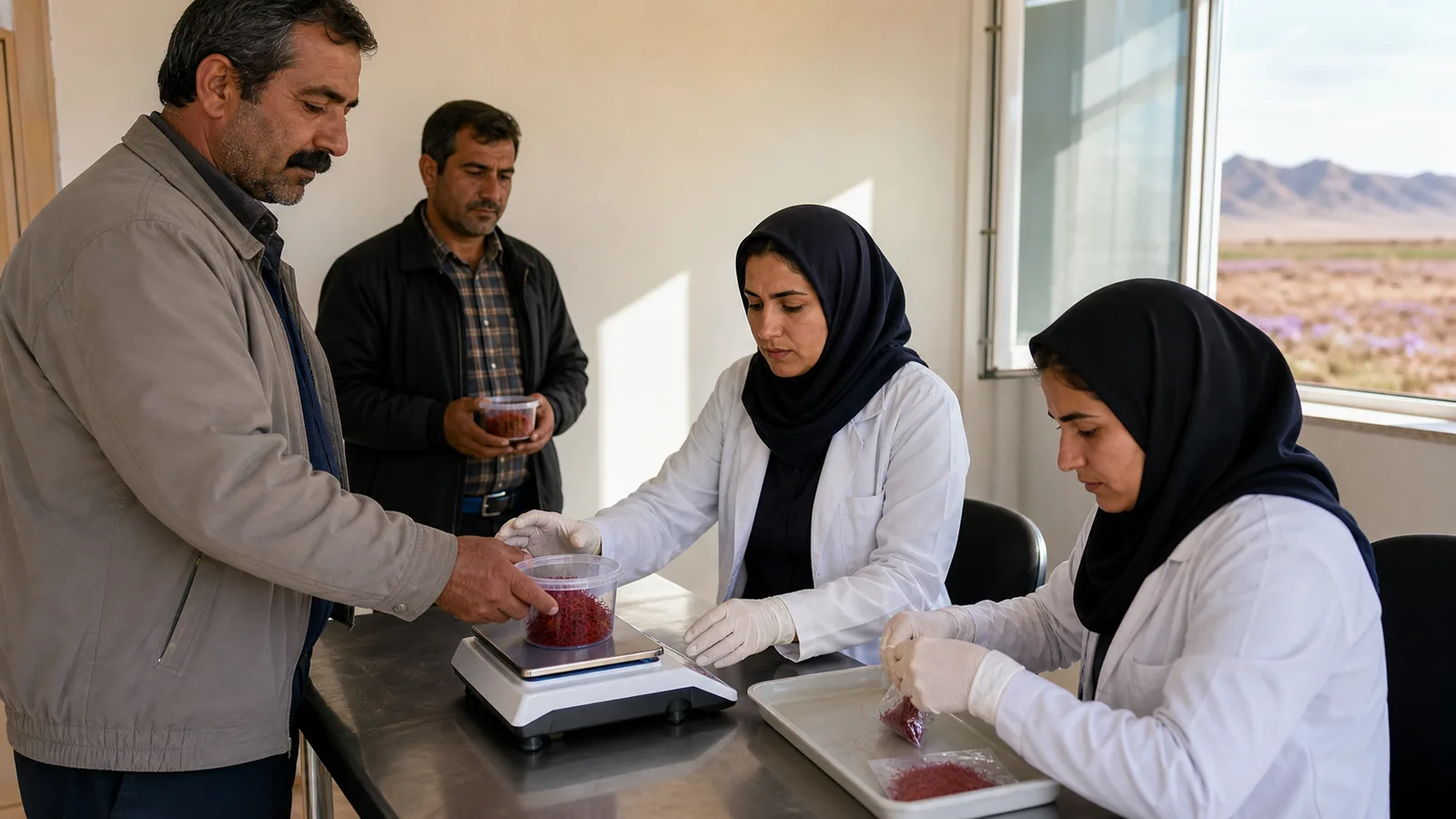
Under the announced physical route, a saffron grower first obtained an introduction from Agricultural Jihad and then delivered the product to a Rural Cooperative purchase centre. Staff performed an initial visual check before the lot went through laboratory assessment.
The payment schedule was 30% in cash at the first stage, with the remaining 70% payable after laboratory results, within a stated period of up to three months. The distinction matters: appearance can reveal visible foreign matter, colour uniformity and obvious defects, but laboratory work is needed for measurements that cannot be confirmed by looking.
The archived notice does not list the exact laboratory methods, sample-sealing procedure, appeal process or what happened if the tested grade differed from the farmer’s expectation. Those details would be essential for judging the programme’s fairness in practice.
The historic Negin and Poushal prices
The announced purchase price was 13 million tomans per kilogram for Negin saffron and 11 million tomans for high-quality Poushal. Purchases were prioritised for South Khorasan growers, with a maximum of 10 kilograms accepted from each farmer.
These are historical programme prices, not today’s saffron market. Currency conditions, crop size, grade definitions and later government policies changed. Publishing the numbers without their time and programme context would be misleading.
The two-million-toman gap between the named grades shows why classification had a direct effect on payment. A sound intake system therefore needed representative sampling, traceable lot numbers and a clear record of the result supplied to the grower.
What later support programmes show
Support arrangements did not remain fixed. An official IANA report from the 2021 programme listed five grades and different prices, with payment financing and a five-day bank deadline. That later scheme cannot be applied retrospectively to the 13-million/11-million-toman notice.
Another IANA follow-up on an earlier South Khorasan purchase recorded full settlement for 2,500 kilograms bought from growers, worth 22.8 billion tomans. It is useful evidence that a programme reached settlement, but it describes a different purchase period.
Putting dated programmes side by side makes one point clear: a farmer must confirm the rules for the active season rather than relying on an old article, even when the old locations and process sound familiar.
What growers needed before choosing a buyer
A support centre was one option, not the whole market. Before delivery, a grower needed to compare the offered grade basis, likely deductions, timing of payment, transport, sampling rights and the price available from private buyers or the commodity exchange.
Good records protect both sides. A delivery receipt should identify the farmer, net weight, provisional grade, sample or seal number, centre, date and payment terms. The final laboratory result should be tied to the same lot.
The 10-kilogram ceiling also shaped who could use the programme. It limited exposure to large individual deliveries and spread purchasing capacity among provincial growers, but a farmer producing more than the cap still needed another route for the balance.
Reading the old announcement safely
The South Khorasan notice is valuable because it joins production and market policy in one picture: 16,807 cultivated hectares, a 70-tonne forecast, four regional centres, laboratory-linked payment, two named grades and a per-grower limit.
Its weakness was time. Prices and administrative procedures age quickly, while the original English translation omitted part of the process. The safest use of the article is historical: it explains how that harvest was expected to enter a support system. It is not a current invitation to deliver saffron, a current price list or proof that the same centres are operating under the same terms today.

![Exporting Saffron to Turkey + Price Guide [Complete 0 to 100]](https://img.rowhanisaffron.com/20260827003933/saffron-export-turkey-quality-inspection.webp)



