


East Azerbaijan expected a 30% improvement in saffron production performance in 2020, when the province had about 350 hectares under the crop. The announcement was a forecast, not a claim that every farm produced 30% more.
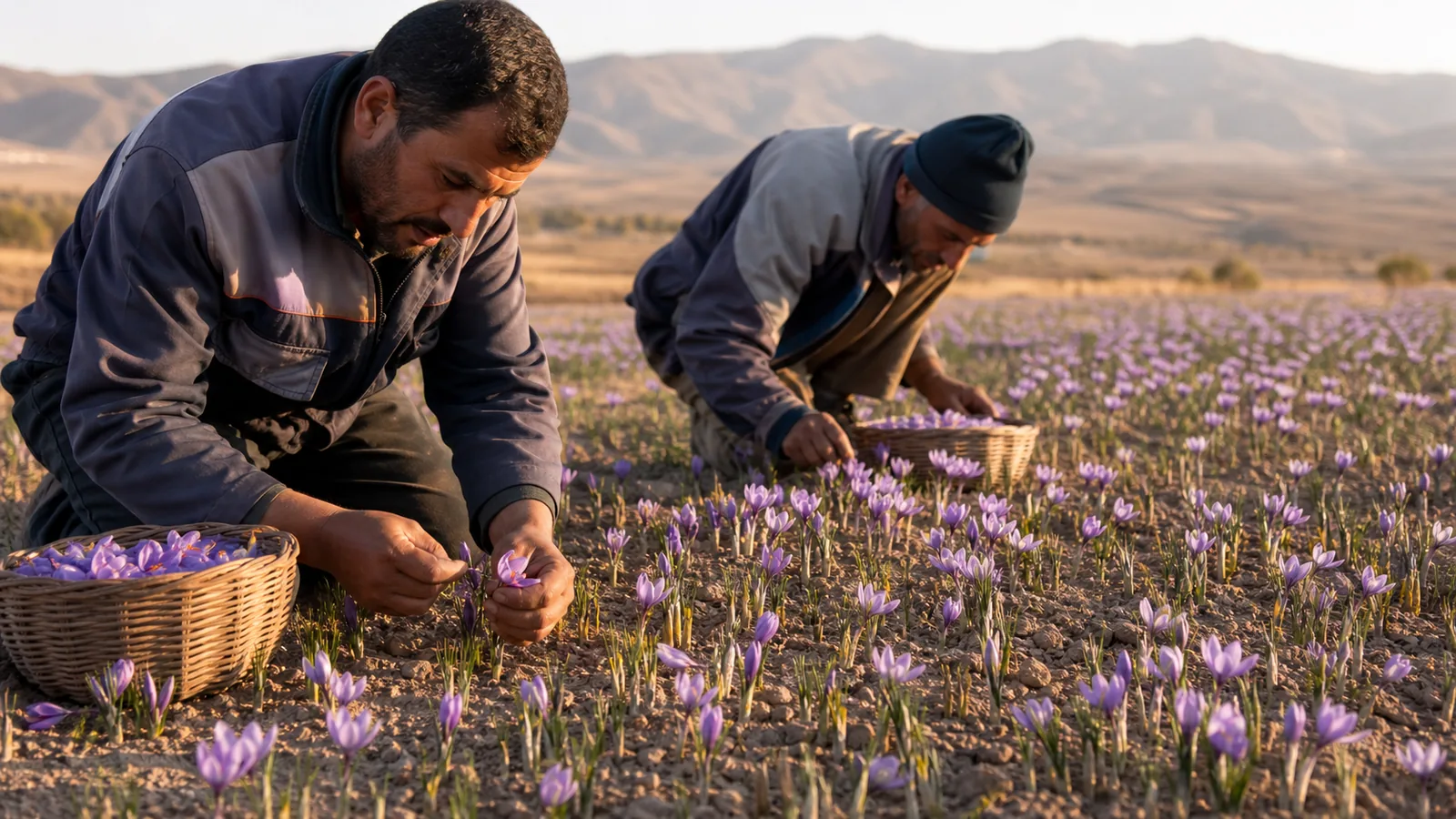
What the 30% increase referred to
Ali Rokh Afrooz, then deputy for crop-production improvement at the East Azerbaijan Agricultural Jihad Organization, gave the figures during a visit to saffron fields in Bonab-e Jadid, Marand County. He said the cultivated area had grown by nearly 20% from the previous year, while production performance was expected to rise by close to 30%.
Those percentages describe two different measures. Cultivated area tells us how much land was planted; production performance reflects the amount of dried saffron expected from that land. Keeping the distinction matters because a larger crop can come from more hectares, a better yield per hectare, or both.
The original November 2020 report from Iran’s Agricultural News Agency forecast more than 1,400 kilograms of dried saffron for the province. It put the average East Azerbaijan saffron yield at 4 kilograms per hectare, compared with a stated national average of 3.4 kilograms. Leading farms were said to exceed 8 kilograms per hectare.
Marand led saffron cultivation in East Azerbaijan
The report identified Marand, Azarshahr and Shabestar as the province’s principal saffron-growing counties. Marand ranked first at the time, with 195 hectares and expected production of more than 800 kilograms. That works out to a little over 4.1 kilograms per hectare, broadly consistent with the provincial average given in the same announcement.
Agriculture in Marand County, East Azerbaijan, has continued to include saffron since that snapshot. Later figures should not be folded into the 2020 totals, however. They belong to different crop years and show how quickly acreage and output can change.
For example, a separate 2024 provincial update reported more than 425 hectares across East Azerbaijan and 240 hectares in Marand. It also used a different provincial yield figure. These later numbers are useful as a new snapshot, not as a correction silently applied to the older announcement.
Why saffron suited the province’s crop plan
Groundwater pressure was central to the 2020 discussion. Provincial planners wanted economically viable crops whose irrigation schedule placed less demand on water during the busiest periods for other crops. Saffron was included in that crop pattern because much of its irrigation falls in the cooler part of the year.
That does not mean saffron needs no water or will succeed anywhere in the province. The original statement linked the season’s expected performance to favourable weather and noted that heavy snow and severe cold during harvest could reduce output. Field condition, corm quality, crop age, soil, irrigation and harvest timing can all influence the final yield. An average saffron yield in kilograms per hectare is therefore a regional benchmark, not a promise to an individual grower.
How the 2020 harvest figures fit together
The numbers in the announcement form a reasonably consistent picture:
- about 350 hectares were under saffron across East Azerbaijan;
- the provincial average was reported at 4 kilograms of dried saffron per hectare;
- total dried production was forecast above 1,400 kilograms;
- Marand accounted for 195 hectares and more than 800 kilograms; and
- the province represented roughly 0.3% of Iran’s stated saffron area at the time.
Multiplying 350 hectares by 4 kilograms per hectare gives 1,400 kilograms, which explains the production forecast. It also shows why the headline’s 30% refers to improved performance compared with the preceding season rather than 30% of national production.
A historical saffron price, not today’s market
The same report quoted fresh saffron flowers at 160,000 to 170,000 tomans and bulk dried saffron at 12 to 13 million tomans per kilogram. These were stated 2020 harvest-season prices. They should not be used as a current saffron price in Azerbaijan or elsewhere: currency conditions, grade, moisture, lot size, sales channel and crop year all affect what a buyer pays.
The announcement also described pressure on growers when much of Iran’s crop reached the market at once. It suggested that waiting could improve the price, but that was the official’s market opinion, not a guarantee. Storage, cash flow, quality control and future demand all carry risk. A farmer deciding when to sell needs current offers and contract terms rather than an old seasonal prediction.
Processing and exports were part of the plan
Rokh Afrooz said the Rural Cooperative Organization intended to become more involved in processing and marketing, including exchange-based trade and export. The concern was not simply how much saffron could be grown. Separating stigmas promptly, drying them consistently, protecting the product from moisture and contamination, grading it accurately and using suitable packaging all determine how much of the harvested value reaches the market.
The report was published during the disruption caused by COVID-19. It said formal customs trade and passenger-carried exports had weakened, making the timing and route to market more difficult. That context explains the emphasis on organized processing and sales; it should not be read as a description of today’s export conditions.
What remains useful in the announcement
The enduring lesson is the relationship between acreage, yield and market readiness. East Azerbaijan expanded saffron as part of a changing crop pattern, but the value of that expansion depended on weather, careful production and a workable route from farm to buyer.
For anyone comparing saffron cultivation in East Azerbaijan or Marand, the 350-hectare area, 4-kilogram average yield, 1,400-kilogram forecast and historical prices belong together as a dated 2020 record. Later provincial statistics can show the direction of growth, but they should always be labelled with their own year.

![Exporting Saffron to Turkey + Price Guide [Complete 0 to 100]](https://img.rowhanisaffron.com/20260827003933/saffron-export-turkey-quality-inspection.webp)



