


Harvesting more than 10 thousand kilograms of saffron from Gonabad farms was the headline result of a seasonal cooperative report. It recorded 10,500 kilograms of dried saffron from 3,500 hectares, alongside a purchase programme intended to collect, test and grade farmers’ crops.
What the Gonabad harvest figures mean
Mohammad Mehdi Rezazadeh, then head of the Gonabad Rural Cooperative Office, reported a harvest of 10,500 kilograms. Divided across the stated 3,500 hectares, that is an average of three kilograms of dried saffron per hectare.
These are historic figures for the season described in the announcement. They are not a current forecast or a permanent measure of Gonabad’s output. Saffron yield changes with corm size and density, field age, irrigation, frost, heat, disease and the efficiency of flower collection and drying.
The word “harvest” also needs a clear unit. The report refers to finished dried saffron, not fresh flowers. Each flower contributes only three red stigmas, and most of its fresh weight does not become spice.
How the agreed purchase programme worked
Rezazadeh said Gonabad was one of ten agreed-purchase centres. The local purchasing period was scheduled to begin in mid-November and continue through the end of December.
An agreed purchase centre gives growers a defined place to present a crop, have it evaluated and receive an offer under the programme’s terms. The old English version alternates between “agreed” and “guaranteed” purchase. Those terms are not automatically the same, and the archived notice does not include a contract that would establish a legal price guarantee.
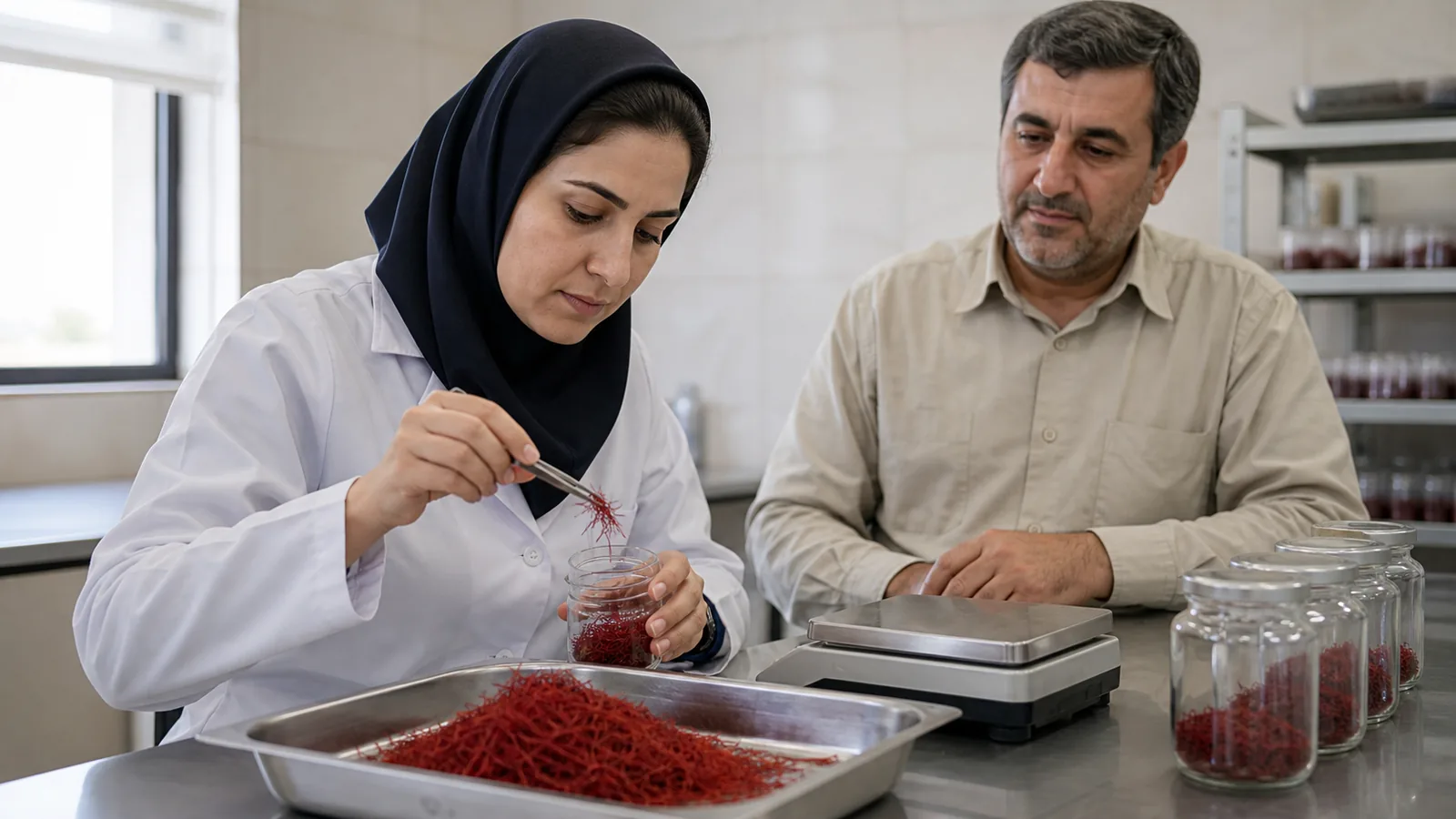
The cooperative reported that saffron presented at the centre was tested, analysed and evaluated before purchase. That step matters because two lots with the same weight can differ in colour strength, aroma, bitterness, moisture, foreign matter and cleanliness.
Why farmers with small lots had to combine them
The centre accepted consignments of more than one kilogram. Farmers producing less were asked to combine their saffron with other growers and submit an aggregated lot, because storing and organising many small consignments was difficult.
Aggregation can make transport, testing and warehouse handling more efficient. It also needs careful records. Every contributor should know how much saffron entered the combined lot, what grade and test result it received, the agreed price, any deductions and how payment will be divided.
Mixing lots can also hide differences. A poorly dried or contaminated portion may affect otherwise clean saffron, while a high-quality lot can lose its separate identity. Growers need a shared standard before combining material, not after the test result arrives.
The reported saffron prices and payment timing
The announcement listed three prices per kilogram: 44 million rials for the grade translated as ordinary “straw” saffron, 49 million rials for high-quality “straw,” and 54 million rials for the grade translated as “jewel.” These appear to be English renderings of Iranian market-grade names, but the report does not provide enough laboratory specifications to equate them safely with a current commercial label.
Those prices belonged to that purchase period. They should never be read as today’s Gonabad saffron price; currency conditions and the saffron market have changed since the report was issued.
The translated payment sentence is incomplete. It says 40% of the price was paid at the beginning and refers to another payment three months after the purchase date. It does not state the remaining percentage clearly enough to promise a precise schedule. A farmer using any purchase programme should rely on the written contract and receipt rather than an archived news summary.
What “high quality” should mean
The Rural Cooperative Office said Gonabad saffron fell within high standard and quality categories. That is a positive report, but a quality category should be tied to a test method and sample, not assumed from place of origin alone.
International saffron assessment looks beyond appearance. A peer-reviewed overview of analytical methods for saffron quality explains the role of ISO 3632 measurements and additional techniques used to assess colour-related crocins, picrocrocin, safranal and possible adulteration.
For a purchase centre, useful documentation includes the sample identity, moisture and foreign-matter checks, test method, grade, net accepted weight and the connection between grade and price. A redder-looking handful is not enough on its own.
Gonabad’s wider saffron context
Saffron has a long agricultural history in Gonabad, supported by farming knowledge adapted to a dry landscape. Our account of 700 years of saffron planting in Gonabad places seasonal production reports within that longer local story.
The 10,500-kilogram announcement adds a different view. It shows what happens after flowers leave the field: growers need a route to market, small lots have to be organised, grades affect offers, and delayed payment can matter as much as the headline harvest total.
Read in that context, the report is not a live price list. It is a record of one Gonabad harvest and its cooperative buying arrangements: 10,500 kilograms from 3,500 hectares, a mid-November-to-December collection period, laboratory evaluation, a one-kilogram lot threshold and three stated historic price bands.

![Exporting Saffron to Turkey + Price Guide [Complete 0 to 100]](https://img.rowhanisaffron.com/20260827003933/saffron-export-turkey-quality-inspection.webp)



