


Saffron planting in Gonabad has a history of 700 years, according to a 2020 account from the city’s agricultural authority. The report also shows why a long tradition alone was not enough: water limits, changing weather and labour-intensive harvesting were already shaping how farmers could improve their crop.
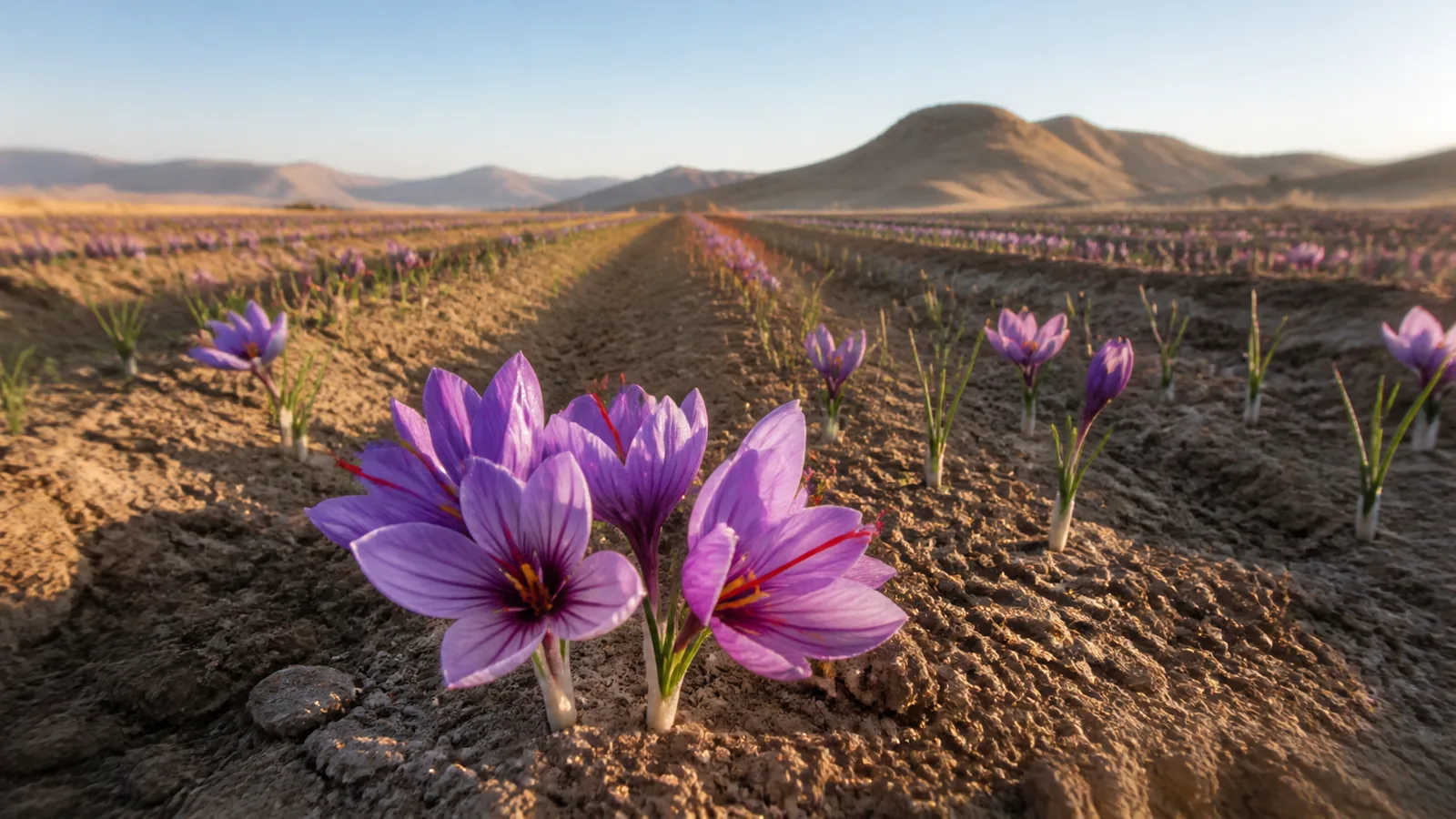
A 700-year history of saffron cultivation
Alireza Hosseinzadeh, then director of Gonabad Agricultural Jihad, described saffron cultivation in Gonabad as a practice with roughly seven centuries of history. His comments were reported in June 2020, so the acreage, prices and harvest estimates below belong to that period rather than the present season.
That distinction matters. The figures offer a useful snapshot of Gonabad’s saffron economy, but they should not be read as current market statistics.
Why Gonabad could not simply plant more saffron
At the time of the report, Gonabad had about 3,500 hectares under saffron. Hosseinzadeh said expanding that area was not a realistic route to growth, so the local priority was to raise output and quality from land already being farmed.
Training in plant nutrition and farm management was part of that effort. Average yield was reported at 4 to 4.5 kilograms of dried saffron per hectare, leaving room for better field practices without extending cultivation into unsuitable or water-stressed land.
The people behind the harvest
The report estimated that around 7,000 households and agricultural operators took part in Gonabad’s saffron sector. It also put year-round employment connected with the crop at about 1,000 jobs, alongside the much larger demand for seasonal labour during flowering and processing.
Saffron flowers have to be picked promptly and their red stigmas separated soon afterwards. In Gonabad, both gathering and cleaning were still described as largely traditional, making skilled local labour central to the harvest.
Rain, cold and help from neighbouring communities
The season covered by the report brought heavy rain and cold weather. Hosseinzadeh said local residents helped farmers collect flowers before quality was lost. Gonabad workers also cleaned flowers brought from Zaveh, Torbat-e Jam, Taybad and Torbat-e Heydarieh.
That regional movement of flowers and labour shows that saffron production does not end at the farm boundary. Picking, transport and stigma separation have to work together within a short window.
What the 2020 harvest forecast meant
For the 3,500 hectares then under cultivation, the report forecast about 12 tonnes of dried saffron from approximately 1,000 tonnes of flowers. These were forward-looking estimates, not a final audited harvest result.
The comparison also explains the intensity of saffron processing. A very large volume of fresh flowers produces a comparatively small quantity of dried stigmas, and delays during that conversion can affect the finished spice.
Prices and the support-purchase programme
Hosseinzadeh said saffron prices had fallen sharply before that harvest season. A government support-purchase programme was introduced, and he credited it with reversing part of the decline.
This was a description of a specific market intervention in 2020, not a promise that the same programme or price effect applies today. Anyone making a current planting or sales decision should use current market and agricultural information.
Gonabad’s continuing challenge
The lasting point in the report is the difference between heritage and productivity. Gonabad’s long history in saffron cultivation gives farmers deep practical knowledge, yet climate pressure, limited land, traditional processing and uneven access to technical training can still restrict quality and yield.
For the city, improvement was therefore framed less as planting more hectares and more as managing existing farms carefully, protecting the harvest window and strengthening the work that turns fresh flowers into clean, dried saffron.

![Exporting Saffron to Turkey + Price Guide [Complete 0 to 100]](https://img.rowhanisaffron.com/20260827003933/saffron-export-turkey-quality-inspection.webp)



