


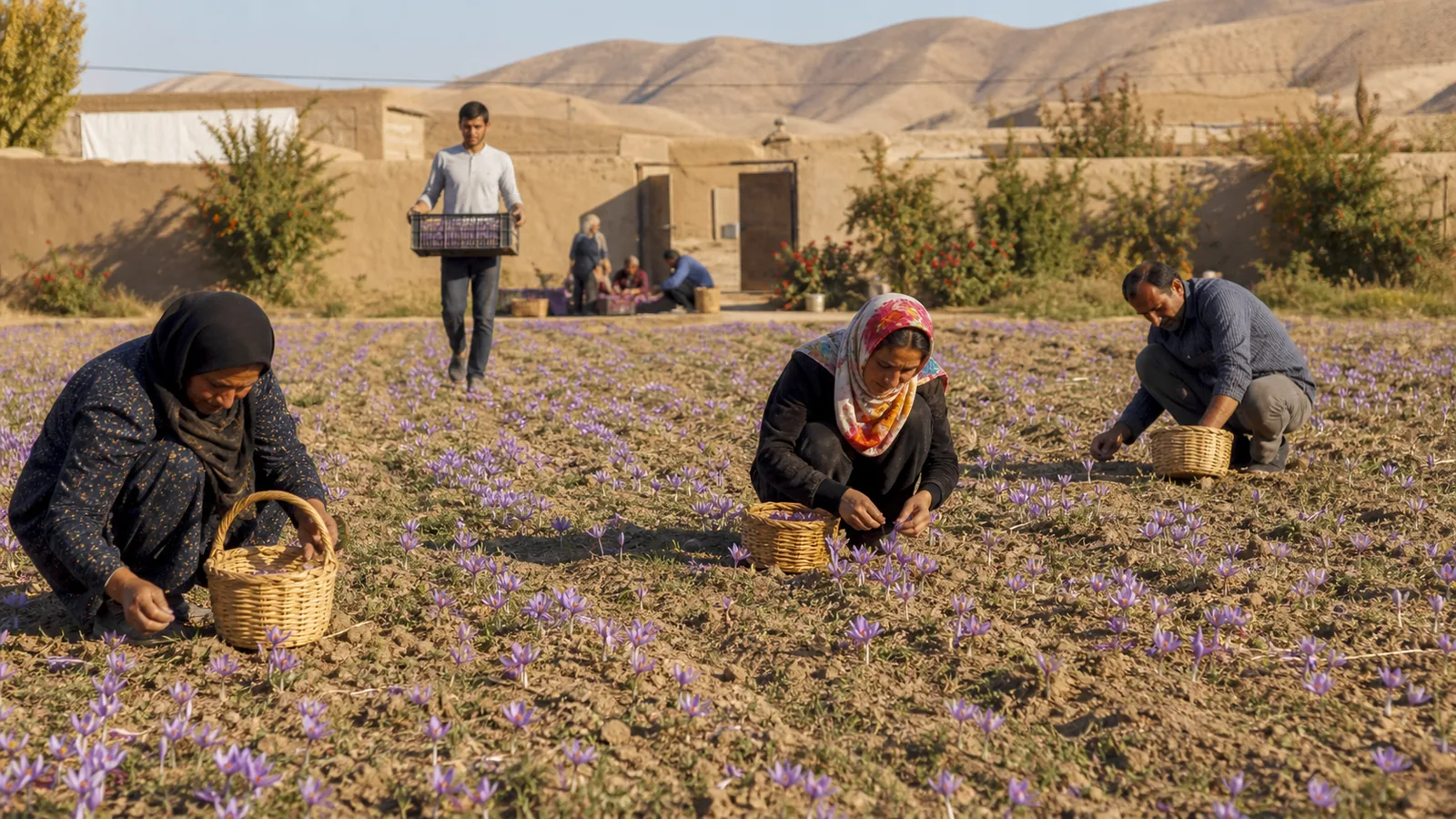
The beginning of saffron harvest from 110 hectares of farms in Kashan city brought pickers into fields across the county, with Alavi village accounting for about 50 hectares. This article preserves the original seasonal announcement while correcting two damaged figures in its old English translation.
What the Kashan harvest announcement covered
Hossein Mazloumi, then director of Kashan Agricultural Jihad, announced the start of harvesting on 110 hectares. He identified Alavi as the largest saffron-producing village in the Kashan area, with roughly 50 hectares under the crop.
That means Alavi represented about 45% of the acreage in the report. The remaining area was distributed elsewhere in the county. The announcement did not provide a village-by-village breakdown, so the 110 hectares should not be described as one continuous farm or assigned entirely to Alavi.
The figures belong to a particular harvest period. Acreage and output can change as growers establish new fields, lift old corms or respond to water and market conditions.
Correcting the impossible flower conversion
The old English page says that 2.5 kilograms of saffron were obtained from each kilogram of saffron flowers. That is physically impossible: the dried stigmas are only a small part of the fresh flower and cannot weigh two and a half times the starting material.
The sentence was almost certainly damaged in translation, but the recovered source wording is not available, so it should not be silently converted into another claim. A separate IANA report on 110 hectares in Kashan later recorded more than 650 kilograms of dried saffron and an average of about six kilograms per hectare.
That later outcome is a credible point of context, not proof of what the mistranslated 2.5 figure originally meant. It should not be used to invent a flower weight or to imply that every Kashan field yielded six kilograms.
When the fields were harvested
A second translation error says the harvest began at the end of October and continued until the end of October. The coherent local window is from late October through late November. Flowering varies with elevation, temperature and the timing of irrigation, so neighbouring fields do not necessarily peak on the same morning.
During those weeks, pickers return as new flowers open. The blooms need gentle handling, followed by prompt separation of the red stigmas and controlled drying. Delays or contamination can undo careful field work even when the crop itself is sound.
The announcement estimated that each hectare provided work for five people. It did not define whether these were unique workers, seasonal roles or a conversion from person-days. The figure should remain an employment estimate rather than being presented as five permanent full-time jobs per hectare.
Why saffron fields can remain for several years
Mazloumi said saffron could flower for up to seven years after planting and that it reproduced through its underground planting material. The English version calls this an onion; the botanical term is a corm.
Saffron is sterile and does not produce a normal seed crop, so growers propagate it by lifting and replanting daughter corms. FAO’s Crocus sativus crop profile describes it as a perennial whose corms may remain in the field for multiple years.
Seven years is possible in some systems, but it is not automatically the best interval for every plot. Crowding, smaller daughter corms, weeds, disease pressure and falling yield may justify earlier lifting. The decision should follow field performance and corm health rather than a fixed calendar alone.
From flower to culinary saffron
The spice comes from the flower’s crimson stigmas, often with a controlled amount of the yellow-to-red style depending on the grade. They are separated and dried, concentrating saffron’s colour, aroma and flavour into a light finished product.
That labour explains why saffron is commonly described as the world’s most expensive spice by weight. The phrase is a market description, not a stable price quote. Grade, origin, testing, packaging, harvest year and transaction size all affect what a buyer pays.
Iran has long been the dominant producer, and Kashan’s crop forms a small part of that wider industry. The archived page claimed a fixed global share above 90%; because production changes by year and source, the useful fact here is Kashan’s measured acreage and local output rather than an undated worldwide percentage.
Alavi village within Kashan’s farm economy
With about 50 hectares, Alavi was the centre of the county’s saffron area in the original report. A concentrated local crop can make harvest labour, shared processing knowledge and routes to buyers easier to organise. It can also expose growers to the same weather event or market shift at once.
Quality after picking matters as much as acreage. Clean separation areas, suitable dryers, moisture control and protective packaging help a village sell a consistent product. The later IANA account also noted sales into Isfahan, Qom and Tehran and argued that local packing capacity could add value.
Those market references describe the period of that report. They are not a current buyer list, guaranteed price or confirmation that a particular packing facility is operating today.
Kashan’s cultural setting
The old article moved from saffron into the city’s identity, calling Kashan Dar al-Momenin and associating it with roses, historic houses and carpets. Those references are relevant because local agriculture, craft and tourism overlap: rosewater and saffron are both closely tied to the region’s seasonal work and food culture.
The archaeological name is Sialk, not “Silk,” and Fin Garden is not the “Garden of Finland.” UNESCO’s current profile of Kashan as a Creative City of Architecture highlights Fin Garden, the Tabatabaei and Borujerdi houses, the bazaar and the city’s climate-responsive urban fabric.
The archived report also cited more than 1,700 historical monuments and 333 nationally registered properties. Register totals can change, so those remain period-specific local figures. What does not need exaggeration is the connection: the 110-hectare saffron harvest took place in a county where farming, architecture, rose traditions and carpet-making all contribute to the same regional identity.
Read with its errors repaired, the announcement records a clear agricultural moment: 110 hectares entering harvest, about 50 hectares centred on Alavi, a late-October-to-late-November work period and a perennial crop maintained through corms. Those details are more valuable than an impossible conversion or a tourism name lost in translation.

![Exporting Saffron to Turkey + Price Guide [Complete 0 to 100]](https://img.rowhanisaffron.com/20260827003933/saffron-export-turkey-quality-inspection.webp)



