


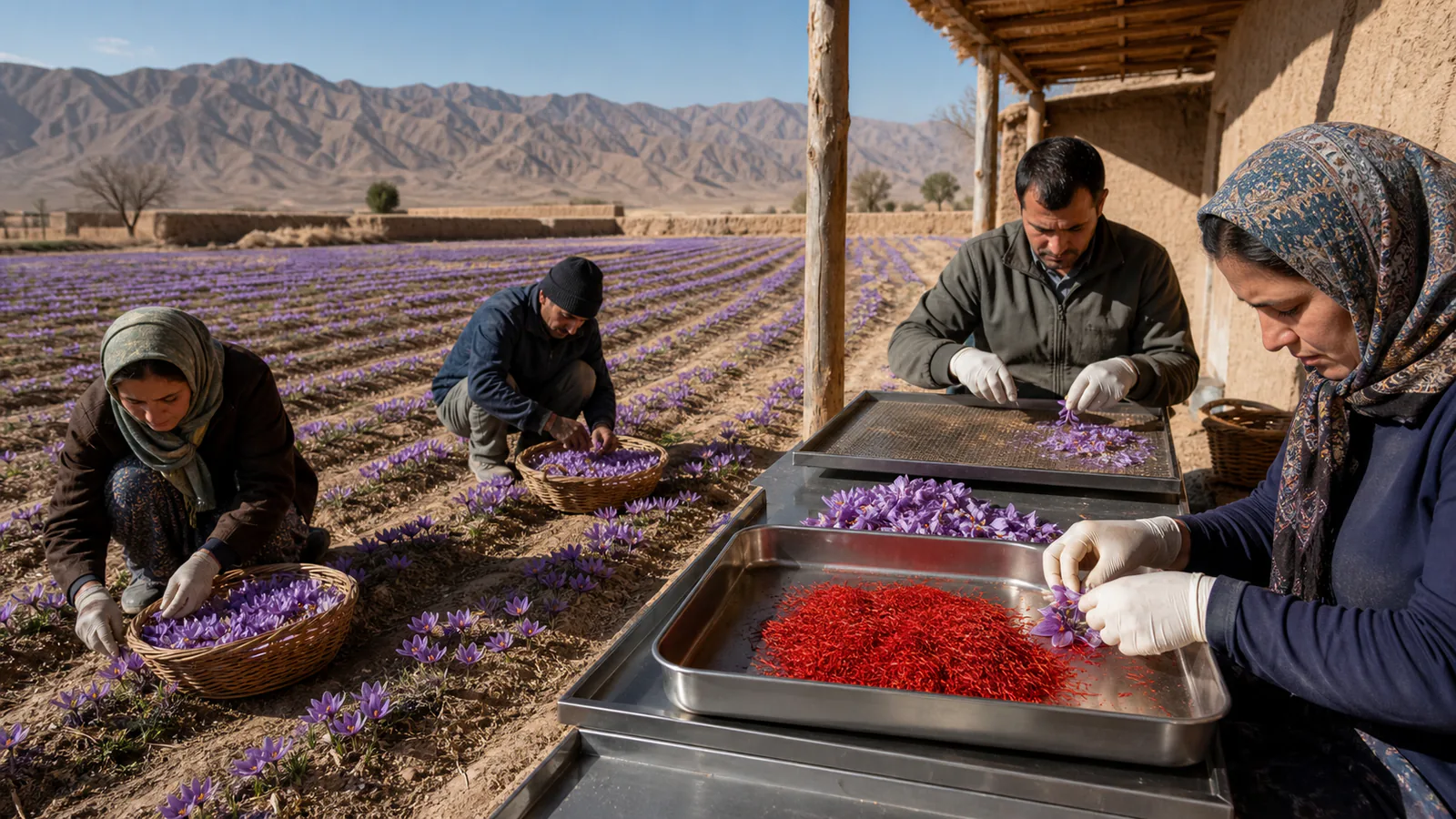
A historical saffron harvest in Yazd province was reported at 3,146 kilograms of dried saffron from 663 productive hectares, within 909 hectares planted overall. The same provincial account placed Bahabad first among the listed Yazd counties at 418 hectares. An earlier Bahabad report forecast 1.5 tonnes from 250 hectares and described the local harvest calendar, production areas, and processing constraints.
These are snapshots from different reporting periods, not figures that can be added together. The provincial total was described as a completed harvest; Bahabad’s 1.5-tonne number was a forecast. Changes in planted area, productive area, field age, and administrative reporting make the distinction important.
What Yazd’s 3,146 kg saffron harvest established
Akbar Sheikh Alishahi, identified as horticulture director of Yazd’s Agricultural Jihad Organization, said growers harvested three tonnes and 146 kilograms of dried saffron in the reported year. He described that as 346 kilograms above a comparison year that the English source names as 2009.
The chronology is unclear because the article repeatedly says “last year” without giving an unambiguous harvest year. The 346-kilogram increase should therefore remain a statement from the historical report, not a current trend or a calculation that can be independently reproduced.
Yazd had 909 planted hectares, of which 663 were described as productive. The report stated an average of four kilograms per hectare and said some farms reached six. Dividing the reported 3,146-kilogram total by 663 productive hectares gives about 4.74 kg/ha, so the published total and stated average do not match exactly. Rounding, partial-area timing, or a different denominator may explain the gap, but the source does not say which.
Where the province’s saffron area was located
The provincial breakdown assigned 418 hectares to Bahabad, 112 to Abarkooh, 109 to Taft, 77 to Bafgh, 75 to Mehriz, and eight to Yazd city. Those named areas total 799 hectares, leaving 110 of the reported 909 hectares in counties the article does not identify.
Bahabad alone represented about 46% of the provincial planted total in that snapshot. The source does not provide productive area or dry output for each county, so planted hectares cannot be used to infer each county’s share of the 3,146 kilograms.
Alishahi called Yazd the country’s sixth-producing province and attributed good quality to local climate and soil. No national comparison table, year, laboratory method, or batch results accompany either claim. They should be read as attributed official statements rather than verified current rankings or quality findings.
Bahabad’s earlier 1.5-tonne forecast
A separate report from Bahabad’s agricultural director forecast 1.5 tonnes from 250 hectares. If both numbers refer to productive land and dried saffron, the implied result would be six kilograms per hectare. The article never confirms the final harvested weight, drying basis, or productive share, so six kg/ha remains an implied forecast rather than a measured outcome.
The 250-hectare Bahabad figure also differs sharply from the later provincial account’s 418 hectares. The most plausible reading is that the reports describe different stages of expansion, but neither gives enough dated detail to calculate the growth rate. They should not be forced into a single season.
The Bahabad source calls the city the province’s second-largest producer after Tabas. Because it does not provide the reference year, production table, or administrative basis, that ranking is preserved only as a historical statement from the source. It is not evidence of Bahabad’s current position.
Bahabad’s harvest window and production areas
The local report said saffron picking began in November as temperatures cooled and continued through the first half of December. The broader Yazd account placed the provincial start in the second half of November, with work in some areas continuing to the end of December depending on weather.
Those windows overlap and reflect local variation. They are not a calendar promise for a future year: elevation, temperature, irrigation, field age, and corm condition can shift flowering and the daily picking workload.
Bahabad’s main production was associated with the central district and the Asfij and Benistan rural districts. The source also says cultivation first began in a village it spells Banestan before spreading elsewhere. The two English spellings may reflect transliteration or separate places; the article does not provide coordinates, so they should not be silently combined.
Water claims need a measured baseline
One sentence in the English Bahabad source calls saffron “water-loving,” while the surrounding policy context treats it as an option for dry regions. That wording is internally inconsistent and should not guide irrigation.
FAO’s account of the qanat-based saffron system in Gonabad says saffron does not require large quantities of water and describes it as adapted to severe water scarcity. That is useful context, but it does not quantify water use or savings on a Yazd farm.
A credible Yazd comparison would record water volume per hectare and per kilogram of saleable dried saffron, the irrigation source, rainfall, prior crop, energy used for pumping, and total cultivated area before and after conversion. “Less water” is comparative; it does not mean no irrigation or guaranteed basin-level savings.
The same care applies to the finalized report on the Anar and Mehriz saffron harvests, where water replacement was a policy goal rather than a measured outcome.
Quality needs batch evidence, not regional reputation
Both historical sources praise local saffron quality, mentioning taste, colour, and an excellent rank. Neither gives a batch certificate, sampling procedure, moisture basis, adulteration test, or analytical values. The claim cannot be applied to every grower or lot.
ISO 3632-1:2025 specifies requirements for dried saffron in filament, cut-filament, and powder form. A useful commercial record should identify the applicable standard and edition, the tested lot and sample, the laboratory, test date, moisture and other required results, storage history, and traceable certificate.
Climate and soil can influence a crop, but they do not replace post-harvest control. Flowers still need timely picking, clean stigma separation, controlled drying, protected storage, and testing before a buyer can judge a batch.
Traditional methods and missing processing capacity
The Bahabad director identified traditional planting and harvesting and the lack of “conversion industries” as problems. In practical terms, the source points to a gap between growing flowers and consistently preparing, testing, packaging, or marketing a saleable product. It does not identify which facilities were absent, their required capacity, or the losses attributed to the gap.
Improvement should start with measured bottlenecks. A local plan would need flower volume by day, time from picking to separation, drying capacity, hygiene controls, storage conditions, lot traceability, test turnaround, rejected product, buyer specifications, capital cost, and realistic utilization outside the short harvest period.
A new facility is not automatically the answer. Shared equipment, trained service providers, cooperative collection, or contracted testing may be more appropriate where volumes are dispersed. The decision depends on throughput, quality failures, transport time, and economics that neither article supplies.
Employment and field longevity require follow-up
The provincial report associated each hectare with one direct job and said more than 4,000 farming families participated in saffron production. It does not define full-time equivalence, workdays, wages, household dependence, or whether the one-job estimate applies to planted or productive land.
It also describes saffron as yielding for seven years and says corms should then be replaced. Seven years may have been the local program rule of thumb, but renewal should follow field performance, corm health, disease pressure, density, soil condition, and economics rather than a universal birthday. A three-season field experiment found that field age interacted with corm size and planting density, illustrating why age alone cannot determine yield.
For both employment and longevity, a useful update would track the same farms over time: productive area, dry yield and grade, labor hours and pay, corm condition, water, costs, and sale receipts. That would show whether expanding area translated into durable income.
How to read the Yazd and Bahabad figures
The safest conclusion is specific. Yazd’s historical provincial report recorded 3,146 kilograms of dried saffron, 909 planted hectares, and 663 productive hectares. Bahabad was the largest named area at 418 hectares. An earlier local report forecast 1.5 tonnes from 250 hectares and documented a November-to-mid-December harvest, key rural districts, and concerns about traditional practices and processing capacity.
The articles do not establish today’s planted area, final Bahabad output, current national rank, present prices, or current support programs. A future saffron harvest in Yazd province should be judged from dated final weights, productive-area denominators, laboratory-backed quality, water records, and farm economics—not by carrying old forecasts forward.

![Exporting Saffron to Turkey + Price Guide [Complete 0 to 100]](https://img.rowhanisaffron.com/20260827003933/saffron-export-turkey-quality-inspection.webp)



