


Khorasan Razavi has long held the highest position in Iranian saffron production and, by scale, one of the most important positions in the world. A historical statement by Reza Jamshidi put the province at 61,000 cultivated hectares and about 200 tonnes a year while setting out the practical problems behind those headline numbers.
What “the highest position” means
The original report called Khorasan Razavi the first province in Iran and the leading saffron-producing province worldwide. That wording describes total cultivated area and production, not a permanent quality ranking for every farm or every lot.
Scale and quality are different questions. A large producing region can contain exceptional, average and weak lots. Buyers still need to assess origin, harvest handling, drying, storage, grade and test results rather than treating a provincial statistic as a guarantee.
The historical 61,000-hectare and 200-tonne snapshot
Jamshidi’s statement recorded approximately 61,000 hectares under saffron cultivation in Khorasan Razavi and annual production of around 200 tonnes. Dividing those figures gives about 3.28 kilograms of dried saffron per hectare.
The old English text says “3.1 grams” per hectare, but that unit is plainly inconsistent with both the stated area and output. The intended figure was almost certainly about 3.1 kilograms per hectare. Correcting the unit preserves the meaning without repeating a thousand-fold error.
Later evidence shows why these numbers need a date. An official 2017 provincial report described about 82,000 hectares and 260 tonnes of dried saffron in Khorasan Razavi. It also reported roughly 130,000 people working in provincial saffron cultivation. Those later figures do not invalidate Jamshidi’s snapshot; they belong to a different period.
Iran and Khorasan’s share of world production
Jamshidi said Iran produced about 96 percent of the world’s saffron at the time and that Khorasan Razavi and South Khorasan together accounted for more than 90 percent of Iran’s crop. He also associated about 550,000 livelihoods with the wider saffron sector.
All three values should be treated as historical estimates. They may use different definitions of farmers, workers, households and indirect employment. They should not be added to later provincial workforce figures or presented as a current census.
Iran remains the global production leader. In November 2025, FAO placed its share at about 85 to 90 percent of world saffron production and described Khorasan Razavi and South Khorasan as central to the livelihoods of hundreds of thousands of smallholders. The newer range is the better choice for present context; Jamshidi’s 96 percent belongs to his earlier report.
Agriculture’s role in provincial employment
The surviving translation says agriculture represented 24 percent of employment in Khorasan Razavi and 13 percent of the province’s total economic activity. The first sentence is malformed in the source, so these percentages are retained as Jamshidi’s reported figures rather than independently reconstructed measures.
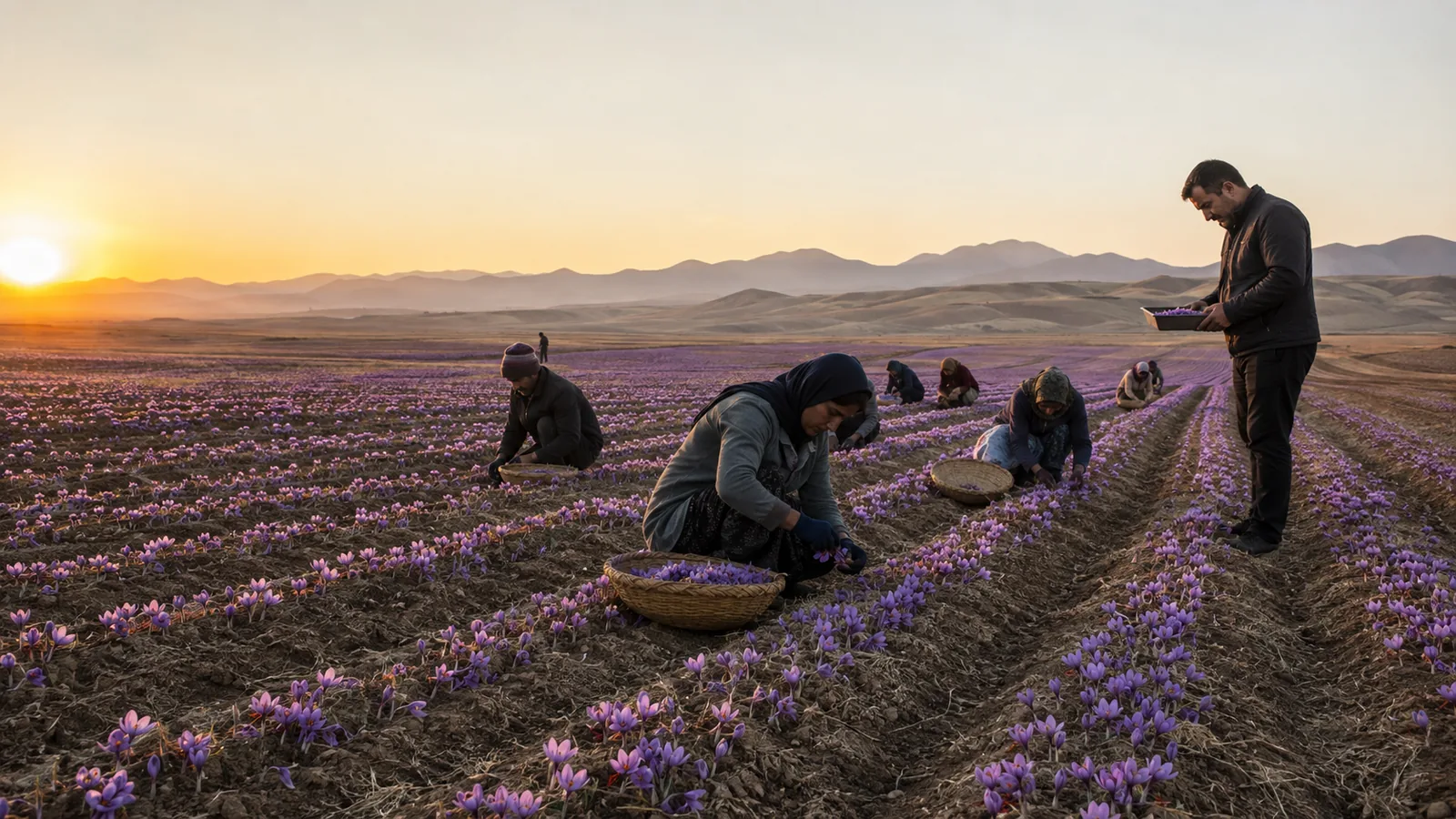
They still explain why saffron policy matters locally. The crop connects seasonal field work with corm production, flower collection, stigma separation, drying, grading, testing, packaging, transport and trade. Changes in the market can therefore reach well beyond the farm gate.
Small and fragmented saffron farms
Jamshidi identified traditional cultivation and fragmented holdings as structural challenges. Many fields were said to be smaller than one hectare. Small plots can preserve detailed family knowledge, but they can also make shared equipment, uniform records, irrigation investment and coordinated marketing harder to organise.
The practical response is not to dismiss smallholders. Cooperatives and service providers can pool drying facilities, testing, storage, training or market access while each farmer retains control of the crop. Any arrangement needs transparent grading and payment rules so quality improvements return value to growers.
Insurance and production risk
Insurance for saffron was another concern in the historical statement. Saffron fields face drought, temperature stress, disease, corm damage and uncertain flowering, while the brief harvest window creates labour risk. A useful insurance product must reflect the crop’s multi-year field cycle and define loss assessment clearly.
Farm records strengthen both risk management and commercial traceability. Planting dates, corm source, irrigation, field treatments, harvest volumes and drying batches help distinguish a production problem from a post-harvest one.
Research, packaging and working capital
Jamshidi also listed insufficient research findings, weak packaging capacity and limited working capital among the obstacles to development. These problems are connected. A processor may know that careful drying and protective packaging improve a lot, yet lack the finance or validated procedures to apply them consistently.
Research creates value when recommendations reach growers in a usable form and results can be checked under local conditions. Packaging should protect saffron from moisture, light, contamination and tampering; it should not be used to disguise weak material or unsupported origin claims.
Bulk exports, promotion and retained value
The report criticised inadequate promotion and the reliance on bulk exports. Selling in bulk is not automatically poor practice, but it can leave grading, branding and a larger share of the final margin to businesses elsewhere. The better question is which format gives a producer reliable payment for verified quality.
Modern export development depends on more than advertising. Representative sampling, food-safety controls, traceability, honest labelling, consistent specifications and dependable delivery give buyers reasons to return. Promotion works best when those foundations are already in place.
The role of the National Saffron Council
Jamshidi made the remarks during an election meeting for the National Saffron Council’s board at the Mashhad Chamber of Commerce. He called for national authorities and members of parliament to help remove obstacles, while saying the Khorasan Razavi governorate would support the council within the law.
That support statement is historical and should not be read as a current programme or funding promise. Its lasting point is that growers, processors, exporters, researchers and government bodies need a shared framework when production problems cross institutional boundaries.
Reading Khorasan Razavi’s leadership accurately
Khorasan Razavi’s production scale is real, but every number on this page has a scope. The 61,000 hectares, 200 tonnes, corrected 3.1-kilogram yield, 96 percent world share, combined Khorasan share and 550,000 livelihoods belong to Jamshidi’s earlier statement. The 82,000 hectares and 260 tonnes belong to a dated 2017 report, while FAO’s 85–90 percent is a 2025 national estimate.
Keeping those periods separate makes the article more useful. It preserves the historical account of the province’s leading position and the obstacles identified at the time, without presenting old production, employment or trade figures as if they described today’s saffron economy.

![Exporting Saffron to Turkey + Price Guide [Complete 0 to 100]](https://img.rowhanisaffron.com/20260827003933/saffron-export-turkey-quality-inspection.webp)



