


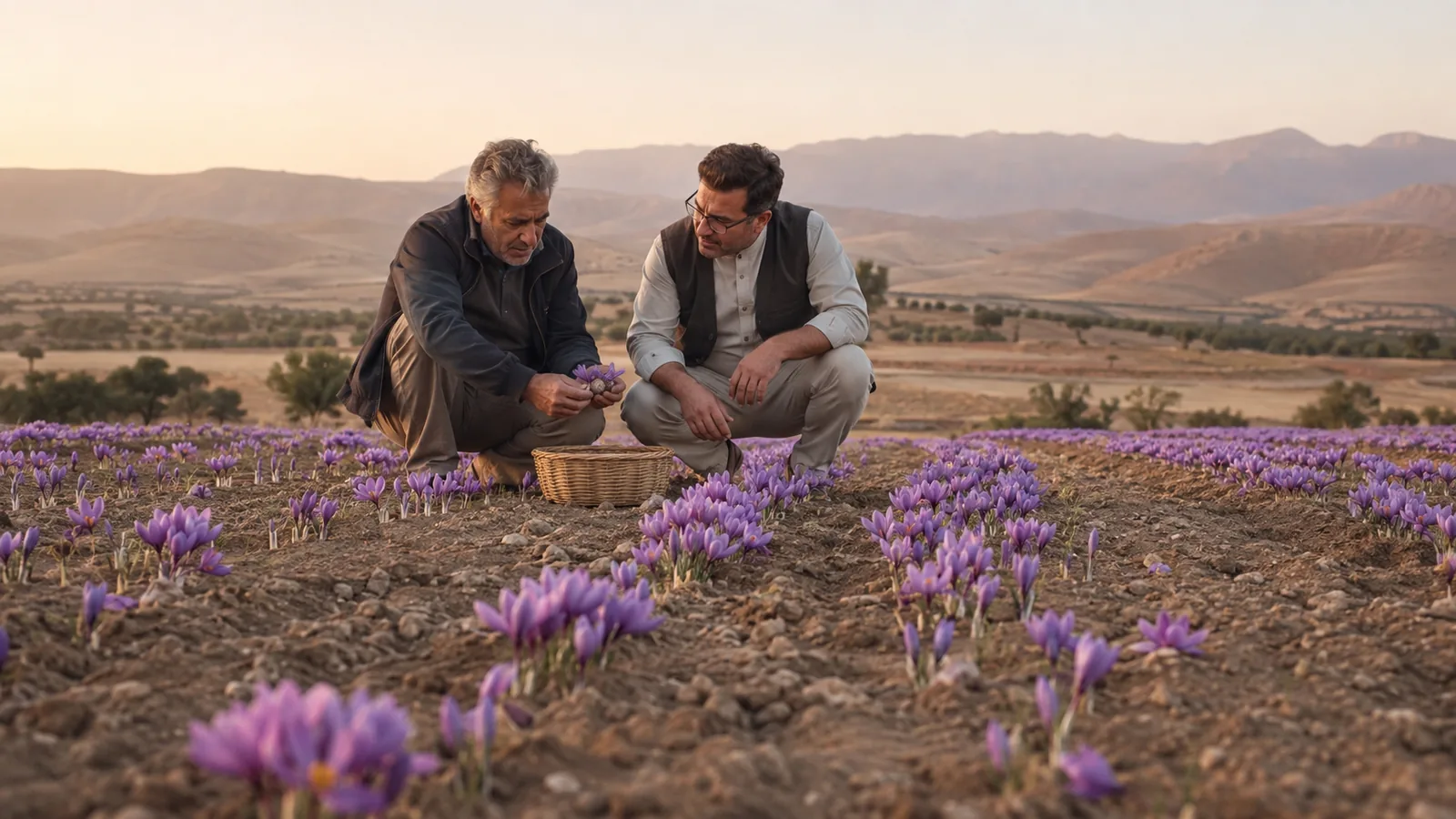
A historical agricultural report forecast more than 3.7 tonnes of saffron production in Fars Province, with Estahban supplying over 90 percent of the provincial crop. The figures describe an earlier expansion programme, not Fars’s output today, but they capture how Estahban emerged as the province’s main saffron-growing centre.
What the 3.7-tonne figure means
The original headline’s “3 and 7 tenths” means 3.7 tonnes, or 3,700 kilograms. In the body, this was presented as expected production for “this year.” The publication does not preserve the referenced crop year clearly enough to treat 3.7 tonnes as a final harvest result.
That distinction matters. A forecast is based on planted area, expected yield and conditions known before harvest. Weather, flowering, labour availability, picking time and drying losses can change the amount of finished saffron. The figure is therefore best read as a historical estimate attributed to the provincial agricultural authority.
Estahban’s place in Fars saffron production
The report identified Estahban as the centre of saffron production in Fars Province and assigned it more than 90 percent of the provincial total. It linked that concentration to local growing conditions. Estahban’s dry climate and farming experience can suit saffron’s seasonal cycle, although performance still varies by field, corm quality, water management and weather.
Later official reporting confirms that Estahban remains an important saffron district in Fars. In 2023, the county agricultural director reported 2,185 kilograms of dried saffron from 552 bearing hectares. That dated result should not be substituted into the older article as though both reports described the same season.
The historical national ranking
Kherad, identified in the original report as head of the Fars Agricultural Jihad Organization, said Fars ranked fifth among Iran’s saffron-producing provinces at the time. He expected an expansion plan in the Iranian year 1392 to move the province into third place.
Iranian year 1392 ran across parts of 2013 and 2014 in the Gregorian calendar. The claim was a target for that programme, not proof that Fars ultimately achieved or retained third place. Provincial rankings depend on the year, the definition of harvested output and whether figures are forecasts or final records.
A 60-hectare expansion plan
The same report said 60 hectares had been allocated that year to expand saffron cultivation, an increase of about 15 percent over the previous year. If both percentages used the same measurement basis, that implies roughly 52 hectares in the preceding period. The latter figure is a calculation, not a number stated by Kherad.
Expansion can mean newly planted land rather than fully productive land. Saffron fields develop over several seasons, so additional hectares do not translate immediately into an equal rise in dried spice. Bearing area, field age and yield should be reported separately when comparing one harvest with another.
Why the programme promoted mechanisation
Kherad listed mechanised cultivation among the measures intended to develop the sector. In practice, machinery can help with land preparation, row formation or other repetitive field operations. Flower picking and stigma separation remain delicate, time-sensitive jobs that depend heavily on skilled labour.
Mechanisation is useful only when it fits the soil, bed layout and corm depth. A tool that saves time in one field can cause compaction or damage planting material in another. Growers need to judge equipment by the condition of the field and the quality of the resulting crop, not by speed alone.
New markets and price balance
The historical plan also called for access to new markets, a better balance between domestic and export prices, and greater participation in saffron cultivation. These are connected goals. A larger crop is more valuable to growers when grading, drying, storage, traceability and sales channels protect its quality after harvest.
Market access does not come from production volume alone. Buyers need consistent lots, accurate origin information and suitable packaging. Reliable testing and transparent commercial terms matter more than broad claims about quality or export potential.
Water use and present-day development
Saffron is often considered where irrigation water is constrained because its irrigation calendar differs from many summer crops. “Low water requirement” should not be mistaken for “no water requirement.” Establishment, flowering and corm development still depend on timely management suited to local soil and rainfall.
An official 2024 Estahban update recorded 562 hectares of saffron, including 546 bearing hectares, and described modern irrigation as an active priority. It also warned that drought, heat stress and inadequate rainfall can reduce corm weight. Those current details give useful context without converting the old 3.7-tonne forecast into a present statistic.
How to read the figures responsibly
The durable point is that Estahban already dominated saffron production in Fars when the report was written, while provincial officials were trying to expand acreage and improve cultivation and marketing. The 3.7-tonne figure, fifth-place ranking, proposed move to third and 60-hectare allocation all belong to that historical programme.
For a current production or purchasing decision, use a dated harvest report that separates planted area, bearing area, expected output and final dried-saffron production. For historical context, this page preserves the original figures while making clear which were forecasts, which were targets and which can be checked against later official records.

![Exporting Saffron to Turkey + Price Guide [Complete 0 to 100]](https://img.rowhanisaffron.com/20260827003933/saffron-export-turkey-quality-inspection.webp)



