


A historical statement attributed to Nasser Tavakoli said Khorasan Razavi produced 77% of Iranian saffron while holding 78% of the country’s saffron area. The figures form a coherent old snapshot, but the report does not name its crop year, so they should not be presented as today’s provincial shares.
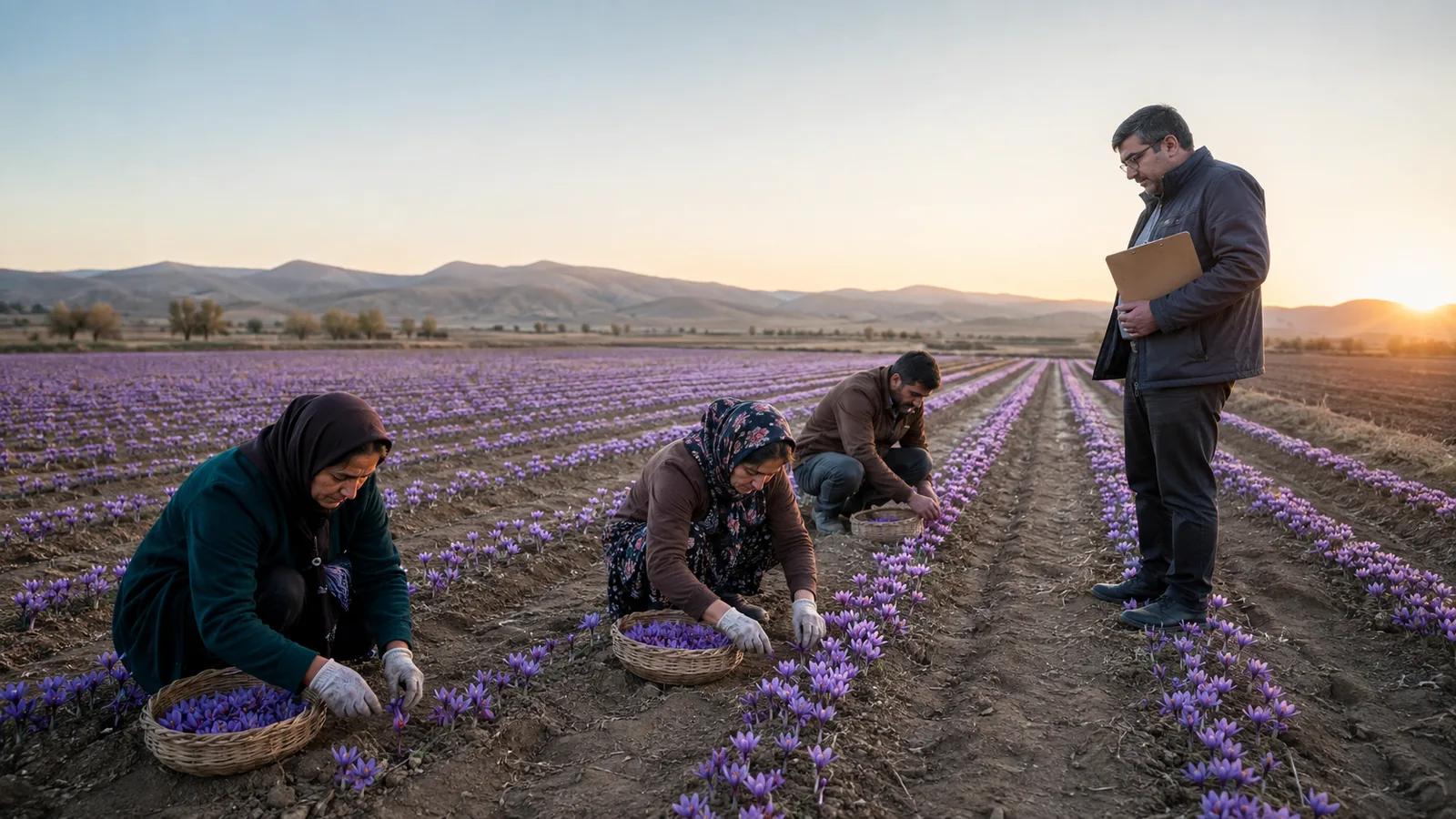
What the 77% figure describes
The headline gives Khorasan Razavi 77 percent of Iranian saffron production. The surviving body begins after the province’s output figure, so it does not state the corresponding tonnage directly. If the title used the same 254-ton national total later in the report, 77 percent would equal about 196 tonnes. That is a transparent calculation, not a recovered quotation.
Khorasan Province is sometimes used loosely in English, but the report distinguishes Khorasan Razavi, South Khorasan and North Khorasan. They are separate provinces and their figures should not be combined under one label without saying so.
South Khorasan ranked second
Nasser Tavakoli said South Khorasan produced 47 tonnes, or about 18 percent of the national crop, and ranked second among Iranian producers. On a 254-ton denominator, 47 tonnes is approximately 18.5 percent, which is consistent with a rounded 18 percent.
He grouped Yazd, North Khorasan, Fars, Isfahan and Kerman at roughly 10 tonnes, or 4 percent. Other provinces were assigned the remaining 1 percent. The categories add to 100 percent after rounding: 77 + 18 + 4 + 1.
Where the 73,119 cultivated hectares were located
Tavakoli, described as Deputy Minister for Plant Production in the Ministry of Agriculture Jihad, placed Iran’s saffron area at 73,119 hectares. He divided it as follows:
- Khorasan Razavi: 57,275 hectares, reported as 78%;
- South Khorasan: 12,990 hectares, reported as 18%;
- Yazd, North Khorasan, Fars, Isfahan and Kerman: 2,290 hectares, reported as 3%; and
- other provinces: about 1%.
The three stated hectare figures total 72,555, leaving 564 hectares before the national total is reached. That remainder is about 0.8 percent, so “about one percent” is arithmetically reasonable. The rounded displayed shares slightly exceed 100 percent, which is normal when each category is rounded separately.
Production share versus land share
Khorasan Razavi’s reported 77 percent of output was close to its 78 percent of area. On the assumed 196-ton provincial output, the implied average would be roughly 3.4 kg per hectare. The report’s 47 tonnes over 12,990 hectares for South Khorasan implies about 3.6 kg per hectare.
These calculations help test internal consistency, but they are not field-level yield records. New and non-bearing plots, weather, corm density, irrigation, field age, disease, harvest timing and drying affect average output.
The expected 290-ton harvest
Tavakoli expected Iran to produce 290 tonnes in “this year” for domestic and foreign markets, with Khorasan Razavi again providing the main share. Because the publication does not preserve the referenced year, this remains a historical forecast rather than a final harvest result.
Compared with the stated 254 tonnes, 290 tonnes would have represented an increase of about 14 percent. Confirming whether that happened would require the final production release for the same crop year and a consistent definition of dried saffron.
Iran’s reported world share at the time
The report called Iran the world’s largest saffron producer, with 254 tonnes out of a 274-ton global crop in the preceding year. That division equals about 92.7 percent, close to its stated 92 percent for Iran and 8 percent for all other countries.
World shares change. In November 2025, FAO described Iran as producing about 85–90 percent of global saffron in its report on Iranian saffron quality and value-chain development. The newer estimate still identifies Iran as the global leader; it should not be mixed with Tavakoli’s undated 254/274-ton snapshot.
Later historical data show why dates matter
An official 2017 Iranian agricultural report on Khorasan Razavi saffron described about 82,000 hectares and 260 tonnes in that province, along with 187 tonnes of provincial exports in the previous Iranian year.
Those figures are not replacements for Tavakoli’s statistics because they belong to a later, identified period. They demonstrate that provincial acreage and output grew and that an undated percentage can quickly become misleading when detached from its source year.
Why Khorasan Razavi has such a large role
The province combines generations of field knowledge with extensive corm beds, a suitable dry-climate production cycle, concentrated harvest labour, processing businesses and trade routes centred on Mashhad and other saffron districts. Scale is not only a matter of climate; it is also an established production and market system.
A large share creates responsibility as well as influence. Clean harvest, controlled drying, representative testing, lot traceability and truthful origin claims affect the reputation of Iranian saffron far beyond one field.
What this page says about suppliers
This is a production-statistics article, not a directory of Iran saffron suppliers. The Tavakoli saffron reference on this page is to Nasser Tavakoli’s agricultural statement; it does not identify a shop, brand or seller in Mashhad.
A commercial buyer should verify a supplier through current business identity, lot records, origin documentation, testing and contract terms. A government official’s surname or a provincial statistic is not evidence that a retailer is connected to the report.
How to quote these numbers accurately
The safest wording is: an undated historical statement attributed to Nasser Tavakoli reported Khorasan Razavi at 77 percent of Iran’s saffron output and 78 percent of its cultivated area, with South Khorasan second. Then give the underlying figures and make clear that the 290 tonnes was a forecast.
Do not call 77 percent the current share without a new crop-year release. Do not add the 254-ton actual and 290-ton forecast, and do not compare either directly with the later 82,000-hectare provincial report as if all figures came from one season.
The durable conclusion
The historical numbers support the headline’s central point: Khorasan Razavi dominated Iranian saffron production in the reported period. The acreage distribution, tonnage and world-total arithmetic are broadly internally consistent, despite normal rounding and the missing opening sentence.
The missing date is the decisive limitation. The article is valuable as a snapshot of how production was distributed, while current sourcing or policy decisions require a dated statistical release rather than a percentage carried forward unchanged.

![Exporting Saffron to Turkey + Price Guide [Complete 0 to 100]](https://img.rowhanisaffron.com/20260827003933/saffron-export-turkey-quality-inspection.webp)



