


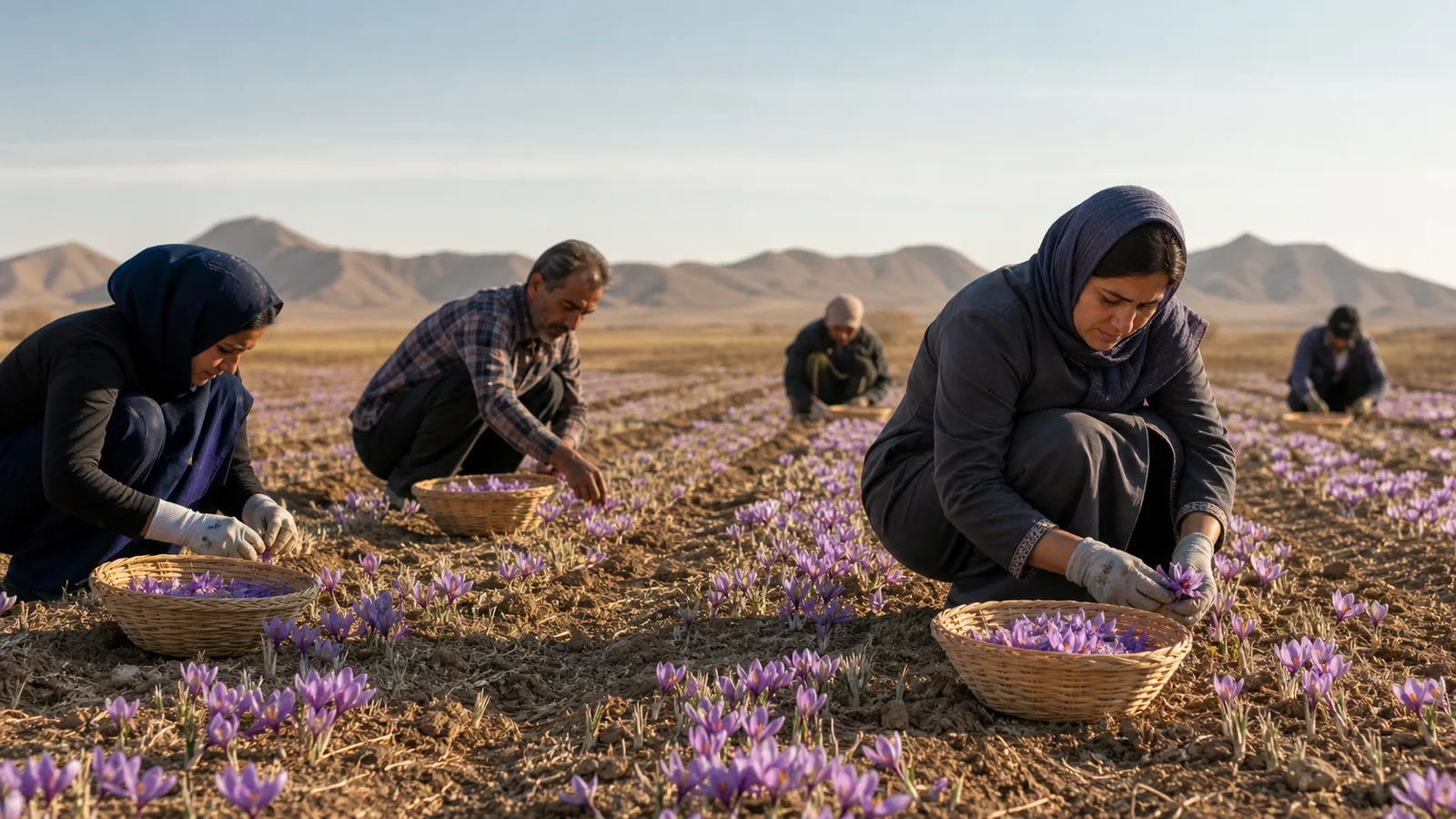
Bahabad saffron growers were reported to be preparing to harvest more than 1,200 kilograms of dry saffron from 250 hectares. The estimate, attributed to the county’s agricultural authority, is a useful historical snapshot of saffron’s place in this dry part of Yazd Province. It should not be read as a current production total without a crop year and a newer official release.
What the 1,200-kilogram estimate said
Akbar Rahmatian, identified in the original report as director of the local Jihad Agriculture office, said Bahabad farmers expected to collect more than 1,200 kilograms of dry saffron from about 250 hectares. The report also described Bahabad as Yazd Province’s leading saffron-producing county at that time.
Those figures imply a simple average of about 4.8 kilograms per hectare. The same account separately quoted an average yield of 5.5 kilograms per hectare, which would equal 1,375 kilograms across 250 hectares. Because the two calculations do not match, both original figures are preserved here as reported rather than combined into a false precision.
Bahabad’s reported saffron calendar
The account placed the beginning of planting in early October and the main harvest in November. It also said flower collection could start in the second half of November and continue until the end of December. These statements may reflect fields at different elevations, an imprecise translation or a broad county-wide window.
A saffron calendar is local and seasonal. Corm condition, planting date, elevation, temperature and the timing of the first irrigation all affect emergence and flowering. Growers therefore need to use observations from their own fields and current advice from the local agricultural service rather than treat an old news date as a fixed annual instruction.
Why saffron is important in a dry county
Bahabad’s dry climate and established farm knowledge help explain the interest in saffron. The crop is often described as low-water because its seasonal pattern can require less irrigation than many alternative crops. That does not mean it needs no water. Flowering, leaf growth and daughter-corm development can all be weakened by poor timing, inadequate moisture or waterlogged soil.
The original official also referred to suitable local soils and encouraged farmers considering expansion to consult agricultural centres before planting. That remains sensible. A field decision should start with drainage, salinity, soil analysis, healthy corms, water availability, labour for the harvest peak and a realistic route to drying and sale.
Our guide to increasing Iranian saffron production explains how those field measurements fit together. Expanding the planted area is only useful when the farm can protect dry yield, quality and income.
What the figures do—and do not—show
A county total is not a quality grade and it does not reveal every grower’s result. Mature and newly planted fields have different yield potential. A useful production record would separate bearing area from newly established area and report dry stigma weight, lot quality, irrigation water, labour, crop losses and farm-gate value.
Later Iranian agricultural reporting provides some corroborating context. In May 2020, the Iranian Agricultural News Agency reported annual Bahabad production of about 1.5 tonnes while covering the county’s cumin harvest. That later figure does not prove the precise crop year or arithmetic in the 1,200-kilogram account, but it supports the broader point that saffron was a significant Bahabad crop rather than a passing trial.
Keep health claims separate from a harvest report
The earlier version attached broad claims about cholesterol, blood pressure, body fat and mood to the production announcement. A harvest estimate is not evidence that saffron prevents or treats those conditions. Health effects depend on the preparation, dose, population and quality of the clinical evidence, so those claims should be assessed in a dedicated, properly sourced health article—not presented as reasons to plant the crop.
How to interpret the Bahabad harvest today
The durable value of this report is its local record: Bahabad growers, a stated 250 hectares, an expected dry harvest above 1,200 kilograms, a short collection season and official interest in further cultivation. Its numbers belong to the period in which they were announced. Anyone needing a current Bahabad total should obtain the latest crop-year data from Yazd’s agricultural authority and check whether the figure refers to planted area, bearing area, forecast output or verified dry saffron.
Source and methodology note
- Iranian Agricultural News Agency: Bahabad crop report, 28 May 2020
- The 1,200-kilogram, 250-hectare and 5.5-kilogram-per-hectare statements come from the historical report preserved in this post. The article labels their arithmetic conflict instead of silently changing either claim.

![Exporting Saffron to Turkey + Price Guide [Complete 0 to 100]](https://img.rowhanisaffron.com/20260827003933/saffron-export-turkey-quality-inspection.webp)



