


Iran can increase saffron production most safely by closing yield and quality gaps in existing fields before expanding acreage. The practical levers are healthy large corms, a well-drained site, locally tested planting depth and density, irrigation matched to soil and climate, evidence-based nutrition, weed and pest management, rapid harvest, and careful drying. More hectares or a greenhouse headline does not guarantee more marketable saffron.
Measure the yield gap before choosing a solution
A production plan should separate total output from yield per bearing hectare. Output can rise because more land is planted even when each field performs poorly. For an existing farm, record the bearing area, field age, corm density, flowers per square metre, dry stigma yield, quality results, irrigation water and production cost.
Compare similar fields rather than combining newly planted and mature stands. The first flowering seasons, peak years and an ageing crowded field do not have the same yield potential. Once the weak stage is identified, investment can target it instead of applying the same remedy everywhere.
The previous description called saffron a crop of the “tropics.” That is misleading. Saffron is grown across contrasting environments, including Iran’s dry regions, and the corm’s seasonal cycle includes winter cold and summer dormancy. A warm, dry setting with little rain may describe a production area, but it does not remove the need to manage frost exposure, drainage, irrigation and local weather.
1. Start with healthy, appropriately sized corms
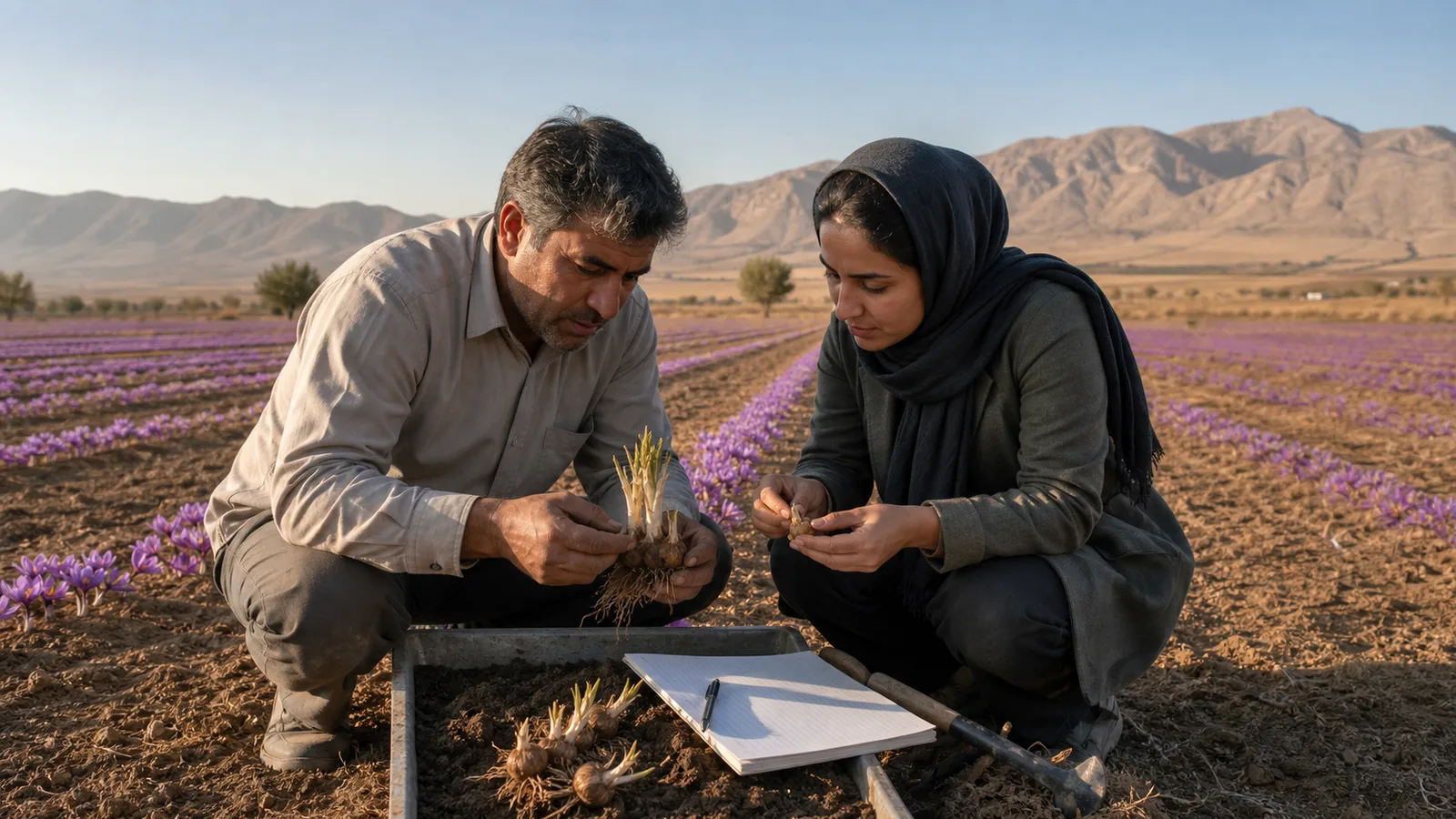
“Saffron onions” are corms. Their health and size influence establishment, flowering and the replacement corms that carry the field into later seasons. Reject soft, damaged or visibly diseased material. Keep lots traceable, inspect them before planting and avoid moving corms from fields with an unresolved pest or disease problem.
Research has repeatedly found corm size important, but bigger is not a substitute for health. The correct planting rate also depends on corm size, field life, row system, cost and whether mechanical operations are planned.
Corms can survive dormancy and cold better than a superficial description of a delicate bulb suggests, but “cold-resistant” and “low-water crop” are not instructions. Planting depth, soil moisture and local minimum temperatures still determine whether a lot establishes safely.
2. Choose soil for drainage and root-zone function
The former article said saffron soil should be a sand-clay mixture “free of nutrients.” That is incorrect. Saffron needs a functioning, fertile root zone, but it is vulnerable to waterlogging and indiscriminate fertilisation. Loam or sandy-loam conditions are often suitable because they balance water holding with drainage; local soil structure, salinity and calcium also matter.
The old pH advice appeared as “between 7 and 98,” an obvious translation or typing error. Do not manage a field from a generic number. Test pH, electrical conductivity, organic matter and available nutrients, then have a local agronomist interpret the results.
3. Set planting time, depth and density locally
There is no single date or depth for all of Iran. Planting must allow the corms to establish before the local flowering cycle while avoiding unsuitable heat or wet soil. Depth affects temperature, moisture, daughter-corm development and the ease of field operations. Density affects early yield, corm competition and how quickly the stand becomes crowded.
The previous article described leaves appearing after two to three weeks, irrigation in mid-October and harvest by the end of November. Those dates can describe one locality or season, but elevation and climate shift the calendar. Use local phenology and weather, not a nationwide fixed schedule.
4. Manage irrigation as a timed input
Saffron usually requires less summer irrigation than many crops, yet the timing and amount of water during active growth are critical. Soil texture, rooting depth, rainfall, salinity, temperature and field age all change the requirement. Research in Iran has shown that irrigation interval and method can affect flower yield, corm development and water-use efficiency.
Both extremes can cause losses. Prolonged saturation favours corm rot and some pests; severe deficit at a critical stage can reduce flowering or replacement-corm growth. The older rule that summer water inevitably causes mites is too absolute: some Iranian experiments found a response to carefully timed summer irrigation. Such an intervention should be locally tested, not copied blindly.
5. Feed the crop from tests, not a calendar alone
Base fertiliser and organic amendments on soil and, where useful, plant analysis. Keep records of material, nutrient content, rate and date. More fertiliser does not necessarily mean more flowers, and poorly handled manure can create hygiene, weed or salinity problems.
Leaves continue feeding new corms after flowering, so post-harvest leaf health matters. Nutrition, irrigation and weed decisions in that period can influence the next season. Our saffron farm nutrition guide explains how to turn soil results and field stage into a programme.
6. Keep weeds, pests and diseases below damaging levels
Monitor fields rather than treating by habit. Map weak patches, examine corms and identify the pest, pathogen, weed or water problem before choosing a response. Clean tools and traceable corms reduce movement between fields. Weed control protects water, light and nutrients, but cultivation must avoid injuring shallow leaves and corms.
7. Renew fields from evidence, not a fixed age
Traditional Iranian saffron fields may remain in place for five to seven years or longer. As daughter corms multiply, competition and crowding can eventually reduce flower yield and make harvesting or weed control harder. Renewal should be triggered by measured decline, corm condition and economics rather than the calendar alone.
Long field life does not automatically produce higher-quality saffron, and soil cultivation is not inherently superior to every protected system. Quality is determined by the crop and post-harvest lot, not by calling one method “traditional” or “modern.”
8. Harvest early and move flowers quickly
Picking usually begins early in the morning, often before flowers are fully open, because cool conditions help protect the delicate material and simplify handling. “Before 9 a.m.” can be a useful local target, but temperature and sunrise vary. The operational goal is a rapid, clean harvest before heat, crushing or wilting damages the flowers.
Harvest and stigma separation are still labour-intensive on many farms, so labour availability and hand-picking cost belong in the production plan. Separation and drying capacity must match the peak. A field that produces more flowers can still deliver less high-grade saffron if the crop waits in sacks or piles.
9. Improve drying, grading and storage
Production should be measured as marketable dry saffron, not flowers or fresh stigmas. Standardise separation, dryer loading, temperature, time, final moisture, packaging and lot identity. Protect the dry spice from light, air, moisture and foreign odours. Laboratory testing and traceability help convert agronomic yield into a reliable sale.
10. Treat greenhouse and soilless systems as specific technologies
Protected, hydroponic or soilless saffron systems can offer control over space and flowering conditions, and research has compared soil, tunnel and hydroponic treatments. They do not make climate irrelevant, eliminate pests or guarantee a 30% increase. Corm multiplication, energy, equipment, labour, disease control, repeated cycles and the economics of producing dry spice all have to be counted.
Tiered racks can use floor area differently and a system without field tillage may change soil-preparation and drainage costs. Controlled moisture, light and ventilation can also make handling more repeatable and corms easier to inspect. None of that means the crop can be grown profitably in any region or climate, that hygiene automatically prevents pests, or that corm access makes disease control simple.
A greenhouse can be valuable for a defined purpose—such as controlled research, flower forcing or planting-material management—when its design, training, equipment and full production cycle have been validated. The natural climate of Khorasan cannot simply be “reconstructed” by adding a building. Protected production should not be promoted as a universal replacement for Iranian field cultivation or as proof of higher quality.
A practical improvement cycle
- Record the baseline by field and stand age.
- Identify the largest proven yield or quality constraint.
- Test one change on a small comparable area.
- Measure flowers, dry stigma, quality, water, labour and cost.
- Repeat across more than one season before scaling.
- Expand only when net income and quality improve without shifting unacceptable risk to soil or water.
Iranian saffron production will be stronger when improvement is measured in reliable dry yield, consistent quality, water productivity and grower income. Healthy corms and sound field management remain the foundation; technology earns its place when field evidence shows that it improves those outcomes.
Sources
- FAO AGRIS: irrigation and soil texture effects on saffron flower and corm yield, 2020
- FAO AGRIS: corm weight and density under soil, hydroponic and tunnel cultivation
- FAO AGRIS: saffron yield and quality under different irrigation methods, 2020
- FAO AGRIS: local and scientific saffron agronomy knowledge in Sarayan

![Exporting Saffron to Turkey + Price Guide [Complete 0 to 100]](https://img.rowhanisaffron.com/20260827003933/saffron-export-turkey-quality-inspection.webp)



