


The working year of saffron farmers in Iran is quiet for long stretches and intensely busy at harvest. Soil and corm preparation begin months before the first purple flower appears, while the brief autumn bloom brings families, neighbours and hired crews into the fields and processing rooms.
A farming calendar built around one short bloom
There is no single date for every Iranian saffron farm. Altitude, temperature, rainfall, irrigation access and local practice shift the calendar. In practical terms, Iran saffron cultivation follows a familiar saffron stage sequence: prepare the field, plant healthy corms during dormancy, manage weeds and water, pick the autumn flowers, separate and dry the stigmas, then care for the leaves and daughter corms that support a later crop.
For saffron growers, that cycle is part of a living rural system. The FAO profile of qanat-based saffron farming in Gonabad describes cultivation as a mixture of inherited knowledge, careful water use and family work in an arid landscape. It also notes the prominent role women take during the season.
Preparing the field and selecting corms
Traditional saffron cultivation in Iran often starts with ploughing and adding well-decomposed organic matter before planting. The exact timing can fall in autumn, winter or the following warm season depending on the previous crop and the region. What matters is a clean, well-drained bed with no compacted layer that traps water around the corms.
Growers lift or buy dormant corms during the warm months, commonly around June or July in Iranian practice, and keep them cool, dry and ventilated until planting. Healthy corms are firm and free from soft rot, deep wounds and visible mould. They are planting stems rather than true bulbs, although farmers and sellers often call them saffron bulbs or onions.
On a small plot, a farmer may open planting holes or furrows with a shovel or hoe. Larger holdings can use a mechanized corm planter. Depth and spacing need to suit the soil, equipment and local winter and summer conditions; a universal measurement copied from another climate can cause poor emergence or crowding. After the corms are placed, soil is returned and levelled so there is good soil contact without crushing the planting material.
The waiting months still involve work
A newly planted field may appear inactive until the first autumn irrigation and growth, but the farmer is watching soil condition, weeds and irrigation readiness. On an established farm, weeds compete with saffron and make a short harvest harder. They may be removed during the summer rest period and again around or after flowering, using hand tools, a hoe, an Iranian plough, a cultivator or other equipment suitable for the row spacing.
Work has to be shallow and controlled near the corm zone. Aggressive cultivation can slice corms or disturb new growth. Farmers also repair channels and check that irrigation reaches the field evenly rather than collecting in low spots.
Iran saffron harvest season in Khorasan autumn
The phrase “Iran saffron harvest season Khorasan autumn” describes a real but variable window. Flowering often falls in October and November, and many farms experience their busiest run during November. The concentrated harvest on an individual field may last roughly 10 to 25 days, but temperature and elevation can make it shorter, longer, earlier or later.
A saffron flower remains useful for only a few days, so crews cannot postpone peak picking. The University of Vermont’s practical guidance on harvesting saffron flowers recommends picking in the morning, when flowers are elongated and beginning to open. In hot regions, work may start before sunrise to avoid heat and prolonged sun exposure. If flowers are wet with rain or heavy dew, however, waiting until they are dry can be safer for handling and quality than obeying the clock.
What a saffron harvester does in the field
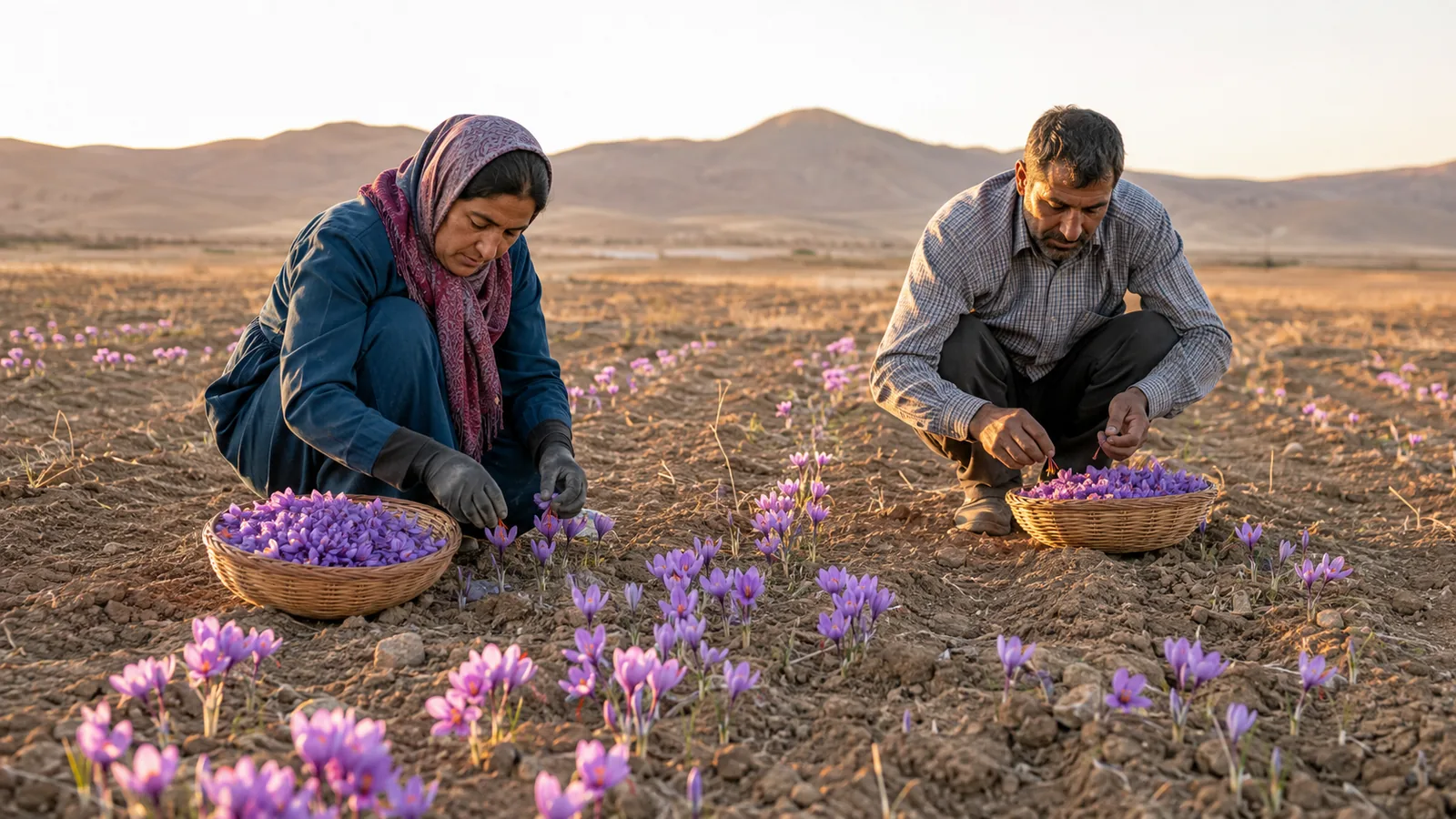
At peak bloom, a saffron harvester moves row by row, bends close to the soil and removes fresh flowers without pulling the leaves. The flowers go into clean, shallow baskets or trays rather than deep piles that crush and heat the lower layers. The repetitive posture is demanding, and the harvest cannot easily be spread across the year.
This is when an Iran saffron farm feels most communal. A household that managed much of the season with a small team may suddenly need many hands. Picking is followed immediately by transport and separation, so field and indoor crews have to keep pace with one another.
Can a saffron harvesting machine replace hand picking?
A saffron harvesting machine is not a single established design. Researchers have tested portable cutters, vacuum-assisted pickers and other mechanical systems. An Iranian mechanization study indexed by FAO AGRIS evaluated several flower-harvesting and processing machines, showing that working prototypes exist.
That does not mean mechanized flower harvest is standard on every farm or automatically faster after all losses are counted. Saffron flowers are low, delicate and easily mixed with soil or leaves. Machine suitability depends on field uniformity, row layout, flower stage, weather, labour cost, collection cleanliness and the quality required by the buyer. A planter or cultivator can be mechanized even where flower picking remains largely manual.
Separating the stigmas is a second harvest
Picking the flower is only the first half of harvest day. Indoors, workers open each flower and separate the three red stigmas from the yellow stamens and purple petals. This can be done by hand or with flower-cutting and cleaning equipment, but the finished lot still needs inspection because stray plant material lowers purity.
Fresh flowers should be processed promptly. Clean surfaces, hand hygiene, shallow holding trays and protection from dust and moisture matter. The stigmas then need controlled drying rather than an arbitrary high heat, followed by cooling and storage in clean, food-safe containers. A careful grower records the lot, field and processing date so later testing and sales remain traceable.
After harvest, the crop is not finished
The leaves left in the field continue photosynthesis and help build daughter corms for the next cycle. They should not be removed while green simply because the flowers are gone. Irrigation, weeding and nutrition after harvest depend on local conditions, but the farmer’s attention shifts from today’s stigmas to the health of next year’s planting stock.
Once the foliage naturally yellows and dries, the corms enter dormancy. Established beds can remain in place for several years, although crowding, disease, declining performance or the need for new planting stock eventually leads to lifting, sorting and replanting.
Greenhouse, hydroponic and aeroponic systems
Controlled-environment saffron cultivation is more involved than putting corms in a tank of water or placing them on wooden shelves under a fogger. A hydroponic system supplies water and nutrients through a defined substrate or solution. An aeroponic system exposes roots to a controlled mist. Both require management of temperature, humidity, airflow, sanitation, light, nutrient concentration and the corm’s full growth cycle.
Controlled-environment saffron research indexed by FAO AGRIS used perlite or volcanic rock, a measured nutrient solution and 24 weeks of observation; it was not a simple water-forcing recipe. Corm size strongly affected flowering and daughter-corm production.
Real greenhouse tools may include racks or growing vessels, humidifiers, foggers or misters, timers, hygrometers, thermometers, coolers and heaters. Equipment does not remove the farmer’s role. It replaces some field risks with energy, hygiene, monitoring and capital costs, and a commercial plan still needs a sound route for maintaining or renewing corms.
The people behind saffron production in Iran
Saffron cultivation in Iran supports a chain far wider than the person who owns the field. Corm suppliers, irrigation workers, growers, seasonal pickers, stigma separators, dryers, laboratories, cooperatives, packers and traders all influence the final product.
In 2025, FAO described saffron cultivation as deeply rooted in the rural traditions of Khorasan Razavi and South Khorasan and supporting hundreds of thousands of smallholders. Its report on saffron quality and value-chain training in Iran emphasized production practice, post-harvest handling, safety, traceability and modern market access. Those links explain why a harvest problem does not remain only in the field.
A whole year contained in one thread
The visible celebration is the purple bloom, but the life of saffron farmers in Iran is shaped by the months on either side of it. Field preparation, corm care, restrained irrigation and weeding create the crop; quick, clean picking and separation protect it; drying, storage and traceability decide what reaches the customer.
Seen from cultivation to harvest, every saffron stage asks for a different skill. The best result comes when those stages work as one continuous chain rather than treating the November flower as the only part that matters.

![Exporting Saffron to Turkey + Price Guide [Complete 0 to 100]](https://img.rowhanisaffron.com/20260827003933/saffron-export-turkey-quality-inspection.webp)



