


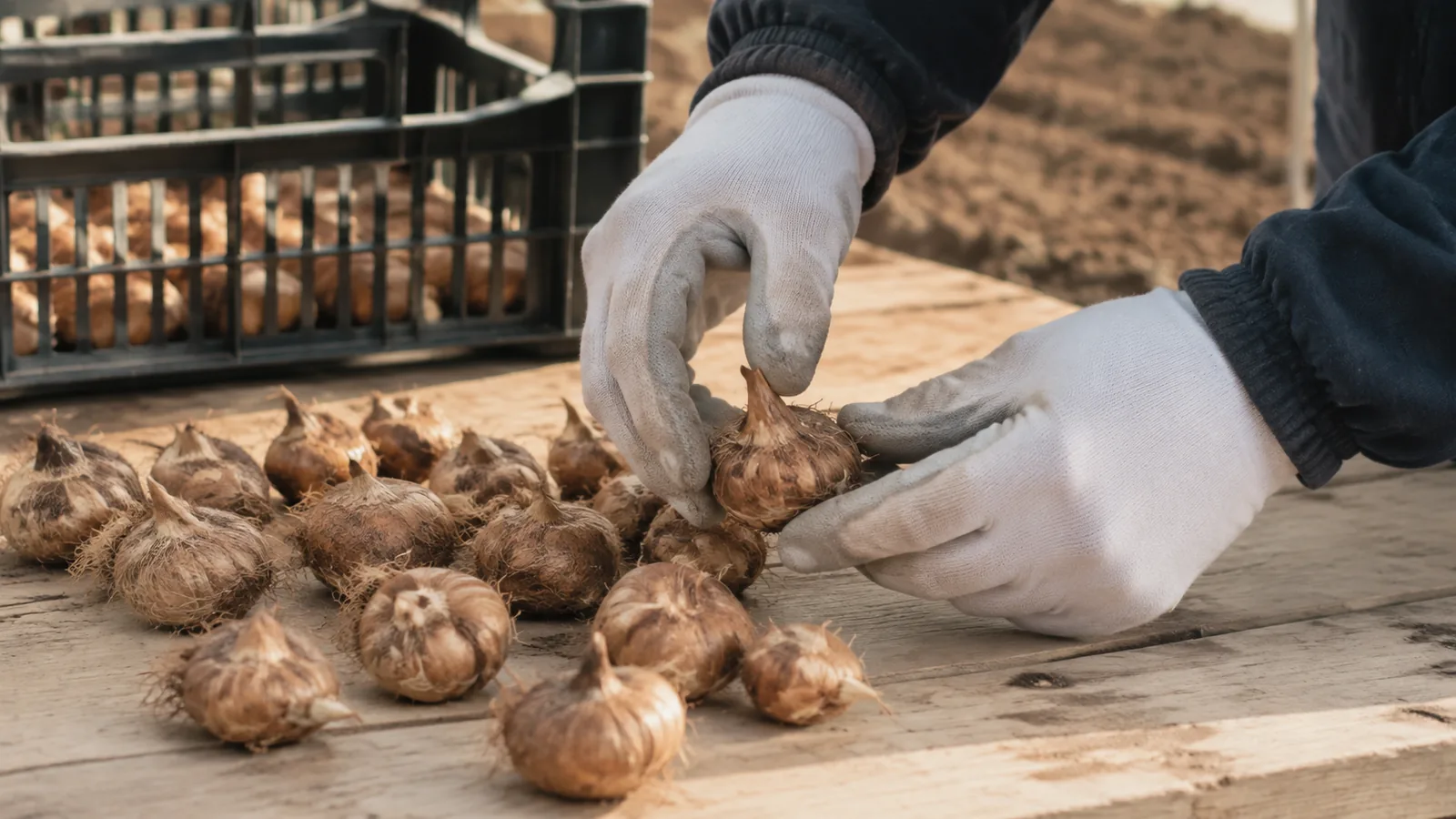
A saffron onion is the underground corm used to grow saffron, not a true onion or seed. Sellers sometimes describe a corm as “modified” or “treated,” but those words do not guarantee that it is healthy, disease-free or more productive; the condition of the corm and the details of any treatment matter far more.
What is a saffron onion?
The familiar phrase saffron onion is a trade and farming name for the corm of Crocus sativus. A corm is a short, solid underground stem that stores energy and carries buds. It is different from a layered true bulb, even though the two can look similar from the outside.
Saffron does not normally produce usable seed. It is a sterile triploid plant and is propagated vegetatively: a mother corm flowers, forms daughter corms and eventually gives way to them. Penn State Extension’s guide to the saffron crocus and its corms explains this distinction clearly. Terms such as saffron “seed,” “cream” or “mastic” may appear in translated sales material, but they should not be taken as separate planting materials.
What does “modified saffron” mean?
“Modified saffron onion” is not a precise scientific grade. Depending on the seller, it may mean that corms have been sorted by size, cleaned, inspected, propagated from selected stock or treated before sale. Those are different processes, with different purposes.
Ask the supplier to replace the word “modified” with facts. Useful answers include the corm’s origin, size or weight grade, harvest season, storage conditions, inspection method and whether a plant-protection product was used. If there was a treatment, the supplier should be able to name the active ingredient, its registration for that use, the application date and the safety instructions.
A higher price alone does not show that one batch will establish better. Nor does treatment make every corm free of bacteria, fungi, decay, bruising or wounds. No responsible seller can promise flawless growth after planting.
How to recognize a healthy saffron corm
A sound corm should feel firm rather than soft or watery. Its outer brown, fibrous covering—the tunic—should be reasonably intact, and the body beneath it is normally pale. Shape varies from rounded to oval or ovoid, so shape by itself is a poor test of quality.
Inspect the whole batch in good light. Set aside any corm with:
- soft, sunken or blackened areas;
- visible mould, wet decay or an unpleasant odour;
- deep cuts, crushed tissue or extensive bruising;
- unusual shrivelling that suggests severe moisture loss; or
- insect damage or suspicious discoloration beneath a loose tunic.
Do not cut into good planting corms merely to inspect their colour. A wound can open a route for infection. Where disease is suspected across a commercial lot, diagnosis and local crop-protection advice are safer than guessing from appearance.
What the brown tunic actually does
The dry fibres wrapped around a saffron onion form a protective layer. They help shield the living tissue from abrasion and some environmental stress during handling and dormancy. The old claim that this “straw” absorbs and stores moisture for the corm is too simple. A wet tunic in poorly drained conditions does not protect a crop; persistent moisture can encourage rot.
Handle the tunic gently during sorting. Loose remnants can be cleared away for inspection, but stripping every corm bare creates unnecessary damage and removes physical protection.
Does a saffron corm need fungicide treatment?
Not automatically. The University of Vermont’s saffron program advises in its answers to common saffron-growing questions that corms from a reputable supplier generally should not need a pre-plant fungicide treatment and that corms with black or soft spots should be discarded.
A pesticide or fungicide is not a “harmless toxin.” Whether a treatment is appropriate depends on the diagnosed problem, local registrations, crop label, dose, handling controls and site. Farmers should use only products legally registered for saffron or the applicable crop category in their location, exactly as the label directs. An unexplained coating is a reason to ask questions, not evidence of quality.
Why corm size and condition affect flowering
The mother corm supplies stored reserves for establishment and early growth. Larger, sound corms commonly carry more flowering potential than very small ones, although size cannot compensate for rot, poor storage or unsuitable field conditions. Research indexed by FAO AGRIS on saffron corm size and management reports corm size as an important influence on replacement-corm production and flower yield.
This does not mean that the final saffron quality is completely dependent on the planting corm. Genetics and corm health matter, but drainage, climate, planting depth and density, irrigation, nutrition, disease pressure, harvest timing, drying and storage also shape yield and stigma quality.
Soil, rain and heat still determine success
A carefully selected saffron onion can still fail in waterlogged soil. Saffron generally needs a well-drained site; prolonged wetness raises the risk of corm decay. Heavy rain is a concern when the soil cannot drain, not simply because rain touches the field.
Heat risk also depends on season, planting depth, soil and local climate. Growers should prepare the site and planting calendar for their region rather than relying on a universal depth or irrigation schedule. Where commercial acreage is involved, a soil assessment and advice from a local agronomist are worthwhile before buying the corms.
Questions to ask before buying saffron onions
- Is this definitely Crocus sativus, and where was the planting stock produced?
- When were the corms lifted, and how have they been stored?
- What size or weight grade is being supplied?
- How was the lot inspected for rot, mould, wounds and pests?
- Does “modified” mean selected, cleaned, graded or chemically treated?
- If treated, what product was used, and is the original label available?
Check a representative sample on delivery and keep lots traceable. If many corms are soft, damaged or inconsistent with the agreed grade, document the condition before planting and speak to the supplier.
The practical choice
Choose a firm, clean, appropriately sized saffron onion from a supplier who can explain exactly what was done to the lot. Treat “modified” as a description that needs clarification, not as a promise. Healthy planting stock is valuable capital, but careful soil preparation, drainage and crop management are what allow that capital to perform.

![Exporting Saffron to Turkey + Price Guide [Complete 0 to 100]](https://img.rowhanisaffron.com/20260827003933/saffron-export-turkey-quality-inspection.webp)



