A sound saffron farm nutrition programme starts with soil, water, crop stage and field history—not a universal monthly fertilizer recipe. It is a systematic and scientific decision process: supply nutrients the crop can use, protect soil structure and salinity, support daughter-corm development, and produce reliable dry stigma yield. Product names and litres per hectare only become meaningful after the product analysis and the field’s needs are known.
What a saffron farm nutrition programme must answer
Before buying an input, write down the decision it is meant to improve. Is the field low in an available nutrient? Is salinity restricting uptake? Are weak daughter corms limiting next year’s flowering? Is poor drainage being mistaken for a nutrient shortage? A programme should state the problem, evidence, material, nutrient analysis, rate, timing, placement and result to measure.
Saffron is perennial. The visible flower is only one stage in a longer cycle. Leaves that remain after harvest help supply the daughter corms, which become the next season’s planting material. A plan focused only on the flowering month can miss the part of the season that builds future yield.
1. Establish the field baseline
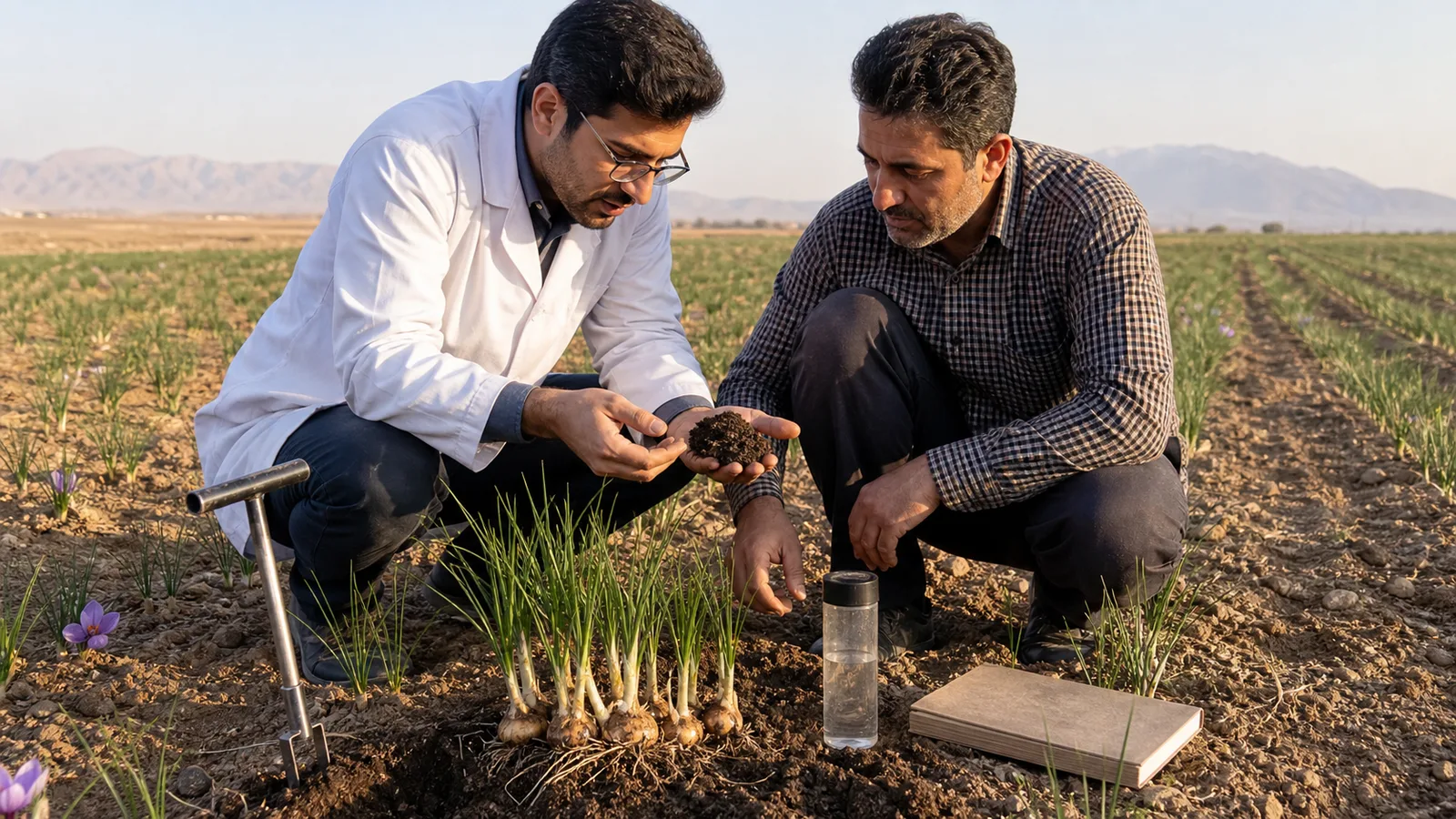
Sample comparable management zones separately. A composite sample that mixes a wet hollow, a saline edge and a productive centre can hide the problem in all three. Record sampling depth and location so the result can be repeated.
- Soil: texture, pH, electrical conductivity, organic matter and locally relevant available nutrients.
- Water: salinity, sodium hazard and any ions that constrain soil or crop management.
- Crop: field age, corm size and health, plant density, leaf condition, weak patches and previous dry stigma yield.
- History: manure, compost and fertilizer analyses and rates, irrigation dates, previous crops and any pest or disease diagnosis.
A qualified local agronomist or laboratory should interpret these results. Visual symptoms alone are unreliable because water stress, root damage, disease, salinity and nutrient imbalance can look similar.
2. Convert products into nutrient amounts
“Five litres of liquid fertilizer” is not a nutrient rate. The actual supply depends on density and the percentage or concentration of nitrogen, phosphorus, potassium, calcium, sulfur and micronutrients in that product. Two products sold under the same general name can deliver very different amounts.
For every input, keep the label and lot number. Calculate how much of each nutrient reaches one hectare, then compare that with the soil test, crop stage, previous applications and the product’s legal directions. This prevents accidental duplication when several blends contain the same element.
3. Build the programme around saffron’s cycle
Before planting or before the first seasonal irrigation
Correct drainage, compaction and salinity constraints before expecting fertilizer to solve them. If organic matter is needed, use a mature, analysed material whose salinity, nutrient content and hygiene are understood. Incorporate it at a time and depth appropriate to the field system without injuring established corms.
The former programme prescribed 600–800 kg per hectare of an unspecified granular organic product in August. Without the product analysis, soil result, field age and placement method, that range cannot be evaluated or safely generalized. August may suit one local production calendar; phenology and irrigation timing should define the operation elsewhere.
First irrigation and emergence
The first irrigation can influence emergence and flowering, so fertilizer must not compromise water quality or place a concentrated salt load near the corm. Check product compatibility before injecting or mixing inputs, and calibrate the irrigation system so distribution is known.
An earlier September recipe called for 2–5 litres per hectare of “liquid sulfur” and said it would disinfect soil, prevent fungal disease, supply potassium, improve photosynthesis and raise resistance to drought and salinity. One unidentified product cannot support all of those claims. Sulfur products differ, sulfur does not contain potassium unless the formulation adds it, and disease control requires diagnosis and an approved treatment—not the word “disinfect.” Use a sulfur-containing input only for a demonstrated purpose, with its composition and label directions checked.
Vegetative growth after flowering
Protect healthy leaf area while daughter corms develop. Use field observations and, where locally validated, tissue analysis to decide whether a correction is needed. Avoid routine foliar mixtures that can scorch leaves or combine incompatible products. Record leaf response and daughter-corm size rather than judging success from greener colour alone.
The previous October instruction specified 10–15 litres of liquid humic acid per hectare with the second irrigation and promised a large increase in sprouting. Trials in Iran have studied humic acid under defined irrigation, soil and product conditions, but they do not make that volume universal. Humic products vary in active content, and they do not replace required nutrients or correct poor drainage.
Late-season corm filling and dormancy
Do not end the nutrition record when flowers are harvested. Leaves continue supporting replacement corms until senescence. At the same time, late inputs that the crop cannot use may be wasted or add salinity. Decisions should follow crop stage and evidence, not the month alone.
The former December step prescribed 1.5–2 litres per hectare of liquid calcium with a final irrigation to prepare corms for the next year. Calcium may be relevant where analysis and soil conditions show a need, but a generic liquid volume says nothing about the calcium supplied. Calcium also will not correct every corm problem. Verify the formulation, compatibility, target and locally appropriate irrigation before use.
4. Balance organic, biological and mineral sources
Field research shows that saffron can respond to nutrient management, yet results depend on the site and the rest of the system. Iranian studies have examined compost, manure, chemical fertilizers, biological inputs, planting density and irrigation together. A treatment that performed well in one trial is evidence to test locally, not a recipe to copy without its soil, climate, crop age and control treatment.
Organic amendments can improve soil organic carbon and physical properties, but their nutrient release is variable. Unanalysed or immature material can introduce salts, weeds or hygiene problems. Mineral fertilizers provide measurable nutrients but can be wasteful or damaging when the element, timing or rate is wrong. Integrated management means accounting for all sources rather than applying one of each.
5. Use a small on-farm comparison
Where a new material is justified, test it on a representative strip beside an untreated or current-practice comparison. Keep corm size, planting density, irrigation and harvest handling as similar as possible. Repeat beyond one season when the decision affects daughter corms or long-term soil condition.
Measure outcomes that matter: flower count, dry stigma yield, daughter-corm number and weight, laboratory quality where available, irrigation water, labour, input cost and net return. A product that increases foliage but not marketable saffron or healthy corms has not necessarily improved the farm.
Saffron nutrition software and record keeping
Saffron nutrition software can help organize a programme, but it cannot diagnose the field from a crop name and calendar. A useful system should store each management zone, laboratory report, product analysis, nutrient calculation, application date, irrigation, weather, crop stage, observation, harvest result and cost. A well-designed spreadsheet can do the same job for a small farm.
Software recommendations should remain reviewable. The user must be able to see the assumptions, units and source data and override a schedule when field conditions change. Automatic reminders are helpful; automatic fertilizer prescriptions without local evidence are not.
A practical decision sequence
- Map field zones and diagnose the main constraint.
- Test soil and water with methods appropriate to the region.
- Review field age, corm health, density, irrigation and past inputs.
- Set a measurable yield, corm, quality or soil objective.
- Choose the nutrient source and calculate the actual nutrient amount.
- Check legality, label, compatibility, placement and crop stage.
- Trial uncertain changes on a comparable strip.
- Record dry yield, quality, corm response, water, cost and any damage.
- Adjust the next cycle from results, not from a copied calendar.
A comprehensive saffron farm nutrition programme is therefore a controlled decision process. The calendar helps organize work, but tests, crop stage and measured results decide what belongs in it.
Sources
- Industrial Crops and Products: integrated nutrient management, soil characteristics and saffron biomass
- Agricultural Water Management: saffron nutrient and irrigation management trial in Mashhad
- Chemosphere: organic, biological and chemical fertilizer field trial in Gonabad
- FAO AGRIS: macronutrient concentrations in perennial South Khorasan saffron fields