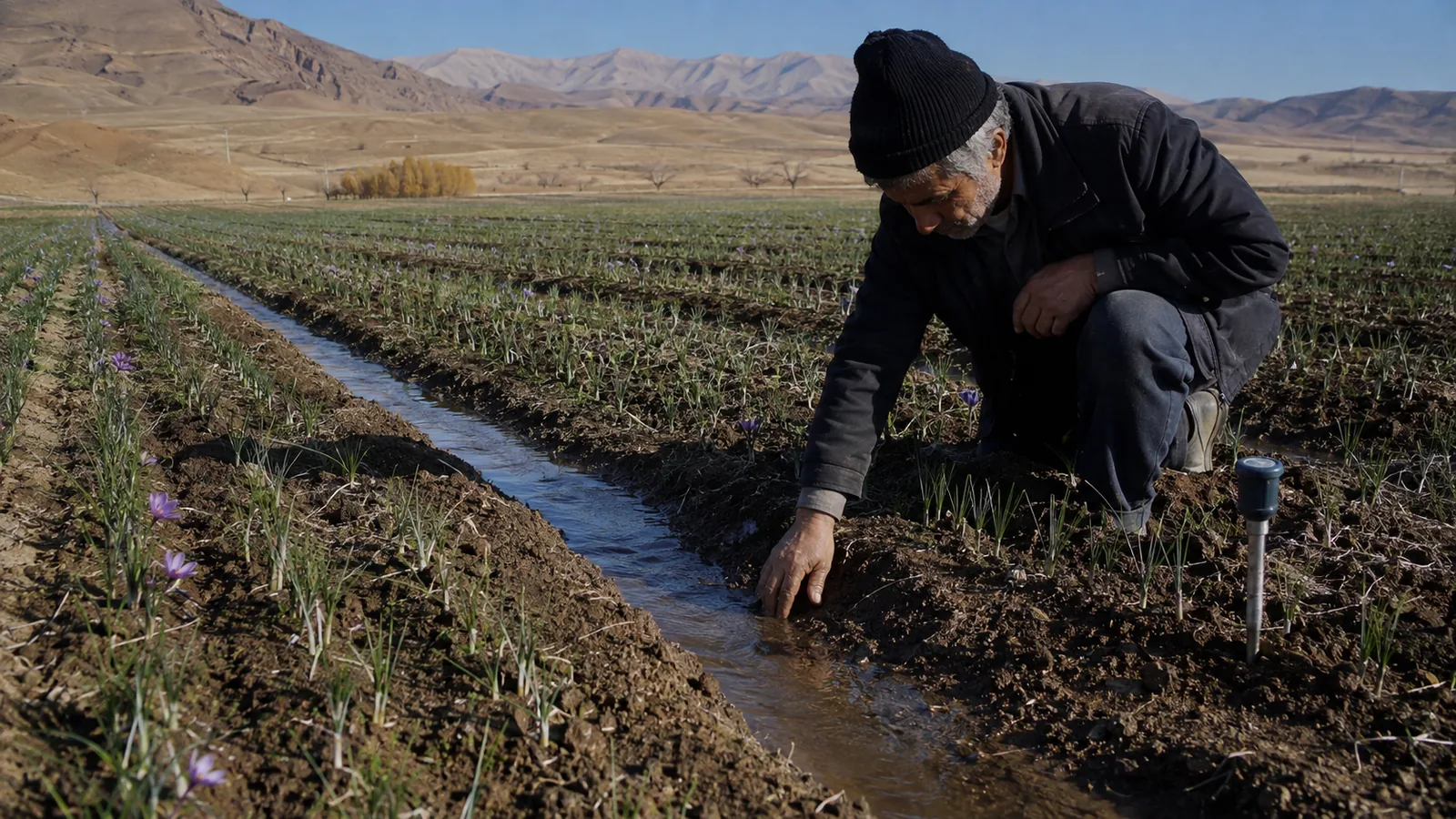
Zajaab irrigation is the post-flowering watering used in many Iranian saffron systems after the main flower harvest. This saffron irrigation stage supports the plant as its leaves expand and new replacement corms develop. The idea is important, but the date, water depth and fertiliser programme must be matched to the field rather than copied from a universal recipe.
What is Zajaab irrigation?
The spelling Zajaab is an English transliteration of a local Persian farming term, and spellings vary. In practical use it usually refers to the second irrigation of the saffron season: the watering that follows flower picking and the emergence of green leaves. It is also described as post-harvest or “reproduction” water because the crop is moving from flowering into vegetative growth and daughter-corm development.
Some traditional explanations compare the field after flowering with a mother recovering after childbirth. The comparison is a cultural way of describing replenishment, not a botanical mechanism. Saffron has not finished its season when the red stigmas are harvested. Its leaves continue photosynthesising through the cooler months, and the corms below ground remain active.
Why the post-harvest stage matters
The harvested stigma is only one part of the crop cycle. After flowering, the leaves manufacture carbohydrates that support replacement corms. Those corms carry the potential for flowers in later seasons. Severe water stress, poor drainage, nutrient imbalance or early loss of healthy foliage can therefore affect more than the field’s appearance.
Research reviewed by the International Society for Horticultural Science found that irrigation dates influence saffron dry matter and daughter-corm weight. The meta-analysis of Iranian and international saffron studies also found meaningful effects from nutrient management, but it does not justify applying the same fertiliser rate to every soil.
When should Zajaab irrigation take place?
In many Khorasan schedules, the first autumn irrigation is timed to initiate growth and flowering. Zajaab follows after the flowers have been harvested, often four to five weeks after that first watering. Late November or early December may be appropriate in some districts, but calendar dates shift with altitude, temperature, first-irrigation date, rainfall, soil and cultivar.
Use the crop and soil as the guide. Flowering should be finishing, green leaves should be present, and the root zone should be ready for water rather than already saturated. A forecast of substantial rain can change the decision. In a warm district, the same stage may arrive later than it does in a colder upland field.
How much water does Zajaab require?
The original advice to wet only the top layer is too simple. Saffron corms and active roots sit below the surface, so a token surface sprinkling may not reach them. At the other extreme, prolonged saturation reduces soil oxygen and can encourage corm disease. The aim is to restore useful moisture through the active root zone without waterlogging it.
The amount needed depends on soil texture and the moisture already present. Sandy soil drains quickly; a heavy soil holds water longer. Field slope, irrigation method and bed shape also affect distribution. A soil-moisture check before watering is more reliable than assuming the previous irrigation still supplies enough water several weeks later.
Research from the University of Birjand has tested irrigation management together with soil texture because the two cannot be separated. The study record in FAO AGRIS on saffron flower and corm yield is a useful reminder that a schedule proven in one soil is not automatically transferable to another.
Does Zajaab always include urea?
No. Urea supplies nitrogen, and nitrogen supports leaf growth and protein formation, but “Zajaab” describes the irrigation stage, not a mandatory fertiliser product. Applying urea by habit can waste money, increase nutrient loss and push excessive vegetative growth where nitrogen is already adequate.
Start with a soil test, field history and a realistic yield target. Consider nutrients already supplied by well-managed organic matter or earlier fertiliser. If a qualified local agronomist recommends nitrogen, calculate the product rate from the required nutrient rate and apply it evenly using a method suited to the irrigation system. Do not place concentrated urea directly against saffron corms.
A field trial indexed by FAO AGRIS examined both soil and foliar nutrient treatments in an established six-year-old saffron field. Its nutrient-and-corm-growth study illustrates why response must be measured rather than assumed: treatment level, field age and existing fertility all matter.
A field checklist before post-harvest irrigation
- Confirm the crop stage: the main flower harvest is complete and leaves are actively growing.
- Check soil moisture: inspect below the dry-looking surface rather than judging by colour alone.
- Review the weather: avoid irrigating immediately before rain that would leave the root zone saturated.
- Inspect drainage: clear blocked furrows or outlets so low areas do not remain flooded.
- Base nutrition on evidence: use a soil test and local recommendation before adding urea or a compound fertiliser.
- Record the operation: note date, water duration, rainfall, product and rate so later yield can be interpreted.
What comes after Zajaab?
Zajaab is one point in a longer irrigation sequence. Depending on winter rainfall and local practice, later waterings may follow at intervals during vegetative growth. Some systems irrigate after weeding or nutrient application and again near the end of the active season. Others need fewer events because rainfall contributes more.
Healthy green leaves should be protected while they remain active. Cutting, grazing or damaging them early reduces the time available to support daughter corms. As temperatures rise and foliage naturally yellows, irrigation decisions change because the plant is approaching dormancy.
Common Zajaab mistakes
- Using a fixed calendar date without checking flowering stage, soil or weather.
- Giving only a superficial wetting that never reaches the active root zone.
- Flooding heavy or poorly drained ground.
- Treating urea as compulsory, regardless of soil-test results.
- Applying fertiliser unevenly or leaving granules concentrated beside corms.
- Assuming one successful season proves the schedule is right under different rainfall.
The role of Zajaab in saffron cultivation
Zajaab irrigation matters because saffron cultivation continues after the flowers leave the field. Timely moisture can support leaves and replacement corms, while appropriate nutrition can correct a demonstrated shortage. Neither more water nor more nitrogen guarantees a larger crop.
The safest approach is stage-based and field-specific: inspect moisture, drainage and weather; test the soil before fertilising; irrigate the effective root zone without saturation; and keep records. That turns a traditional post-harvest practice into a decision that protects both the current plants and the following saffron harvest.