


A historical agricultural report described a 20% increase in the area under saffron cultivation in Fars, with 460 hectares allocated to the crop. It identified Estahban as the province’s production centre and recorded plans to improve corm quality, field methods and output.
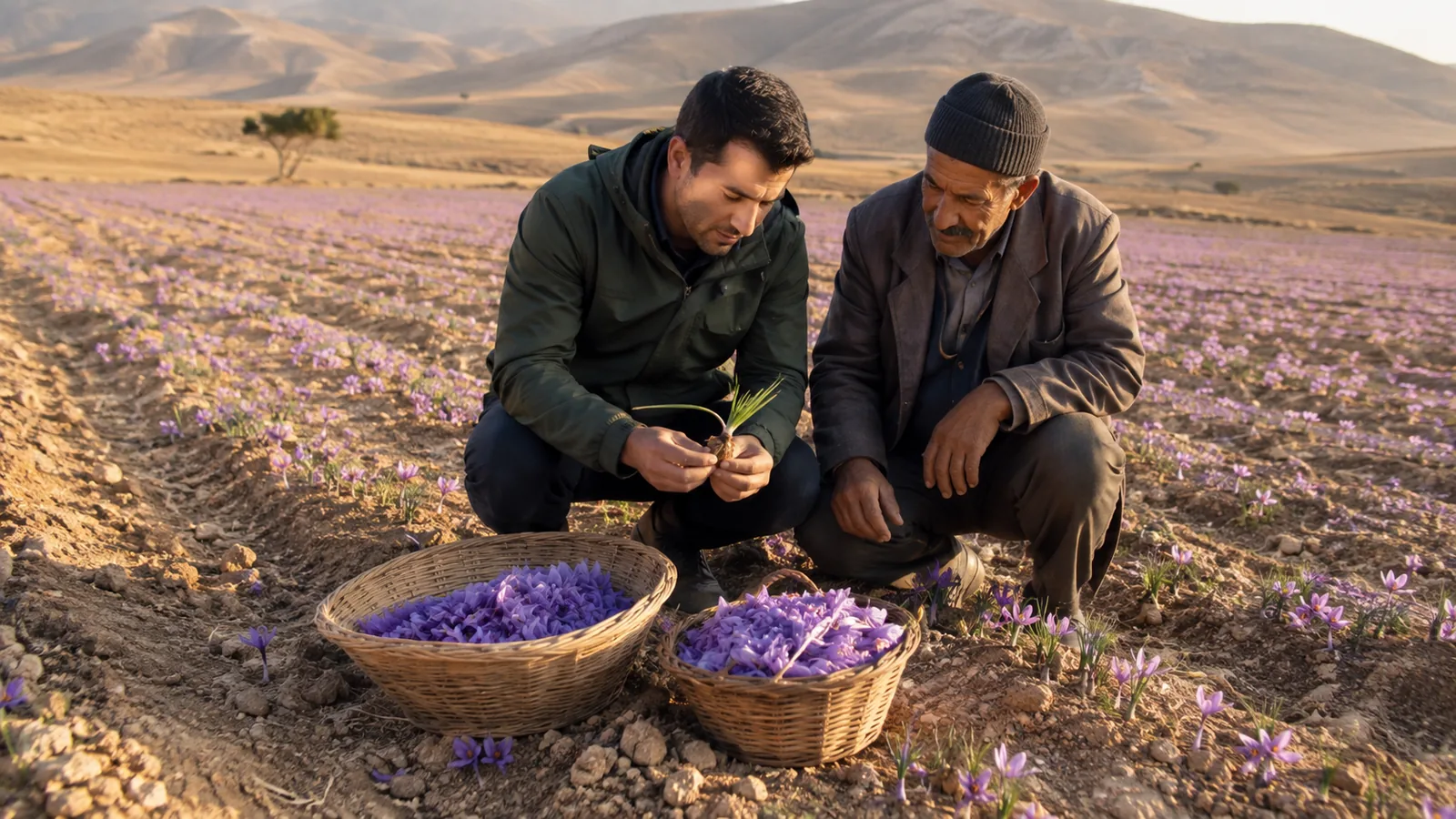
What the 20% increase means
The report’s central figure is 460 hectares of saffron in Fars Province. If the stated 20 percent increase and the 460-hectare total use the same baseline, the earlier area would have been about 383 hectares. That calculation helps explain the title, although the source does not provide its own starting-area figure.
This is a dated account rather than a current provincial census. The figures should therefore be read as a snapshot of the expansion programme described by the Director of Horticulture at the Fars Agricultural Jihad Organization, identified in the original translation as Engineer Sharifi.
Fars among Iran’s saffron-producing provinces
Sharifi placed Fars among Iran’s five leading saffron-producing provinces at the time. That position is notable because the country’s best-known saffron belt lies farther northeast, while production in Fars reflects a distinct southern growing environment.
The province-wide number also covers several local farming areas rather than one continuous field. Estahban, Bavanat, Abadeh, Eghlid and Sepidan were named as the principal saffron-producing cities or counties in the report.
Why Estahban was singled out
Estahban was described as the production centre for saffron cultivation in Fars. Its elevation, cold winter period and established farming knowledge gave growers a base from which cultivation could expand, though local water availability and individual field conditions still affect results.
Later official reporting supports Estahban’s continuing importance. In 2023, the county agricultural authority reported 560 hectares of saffron farms, including 552 bearing hectares. Those later figures provide context; they do not replace the historical 460-hectare figure for Fars used in this article’s title.
Reported yield per hectare
The surviving English text contains a damaged sentence saying that yield “increased by 3 to 2 percent,” followed by a separate reference to 4.5 to 5.5 kilograms in Estahban. In agricultural context, the first phrase appears more likely to describe a provincial yield of 2 to 3 kilograms per hectare than a percentage increase. The wording is too unclear to present that interpretation as a confirmed quotation.
The Estahban range is internally understandable as dried saffron yield per hectare. It also fits the report’s broader point that the county was performing above the provincial norm. Weather, bed age, corm condition and the area counted as bearing can all change the average from one season to another.
The 2.3-ton production forecast
Sharifi expected production to reach 2 tonnes and 300 kilograms. Dividing that forecast by all 460 hectares gives an average of 5 kilograms per hectare, but this does not prove that every hectare was mature or that the area and output figures were measured on precisely the same basis.
For that reason, the safest reading is to retain the reported forecast without forcing it to reconcile with the damaged yield sentence. A reliable production comparison needs bearing area, harvest year and final dried weight, none of which is fully specified in the original report.
Research on planting methods and saffron corms
The old translation refers to improving “types of onions.” Saffron is not propagated from culinary onions; the intended term is almost certainly corms. Healthy, suitably sized corms and a planting layout adapted to the field influence stand establishment and the performance of later harvests.
The research projects mentioned in the report were intended to change planting practices and improve the planting material used by growers. That is a more durable route to better production than treating acreage alone as proof of success.
Water use still requires local planning
Saffron is often selected where its irrigation calendar suits local water constraints, but it is not a crop that succeeds without water. Timing, soil drainage and rainfall remain important, especially as new beds establish and as flowers emerge.
Current official reporting from Estahban continues to connect saffron farming with drought conditions. A later county update recorded an average of 3.5 kilograms of dried stigmas per hectare across 560 hectares during continuing drought. It is another dated snapshot, not a universal yield promise.
Markets named in the original report
The report said saffron from Estahban was exported to China, Germany, England and countries around the Persian Gulf. These were markets named by the official at that time, not a claim that every Fars producer had direct access to each destination.
Export potential depends on more than production volume. Consistent drying, clean handling, traceability, laboratory specifications and packaging all influence whether a particular lot is suitable for a buyer and whether its regional identity is preserved in trade.
What expansion changes for growers
A larger cultivated area creates more work during a short flowering period. Picking, stigma separation and drying must keep pace with the crop, or quality can deteriorate before the saffron reaches storage. Expansion therefore needs trained labour and enough clean processing capacity alongside new planting.
It also increases the importance of keeping field records. Separating newly planted hectares from bearing beds, recording dried output and documenting inputs makes future yield claims easier to interpret and gives growers a sounder basis for improving their own fields.
How to read the historical Fars figures
The clearest conclusion is that the report documented an expansion to 460 hectares and described this as a 20% increase in saffron cultivation in Fars. It named Estahban as the centre of production, listed four other producing areas and forecast 2.3 tonnes of output.
The malformed 2-to-3 figure is preserved as an uncertainty rather than silently converted into a firm statistic. Later official records show that Estahban remained a substantial saffron area, while the original title, places, people and production figures retain their value as a historical account of Fars Province.

![Exporting Saffron to Turkey + Price Guide [Complete 0 to 100]](https://img.rowhanisaffron.com/20260827003933/saffron-export-turkey-quality-inspection.webp)



