


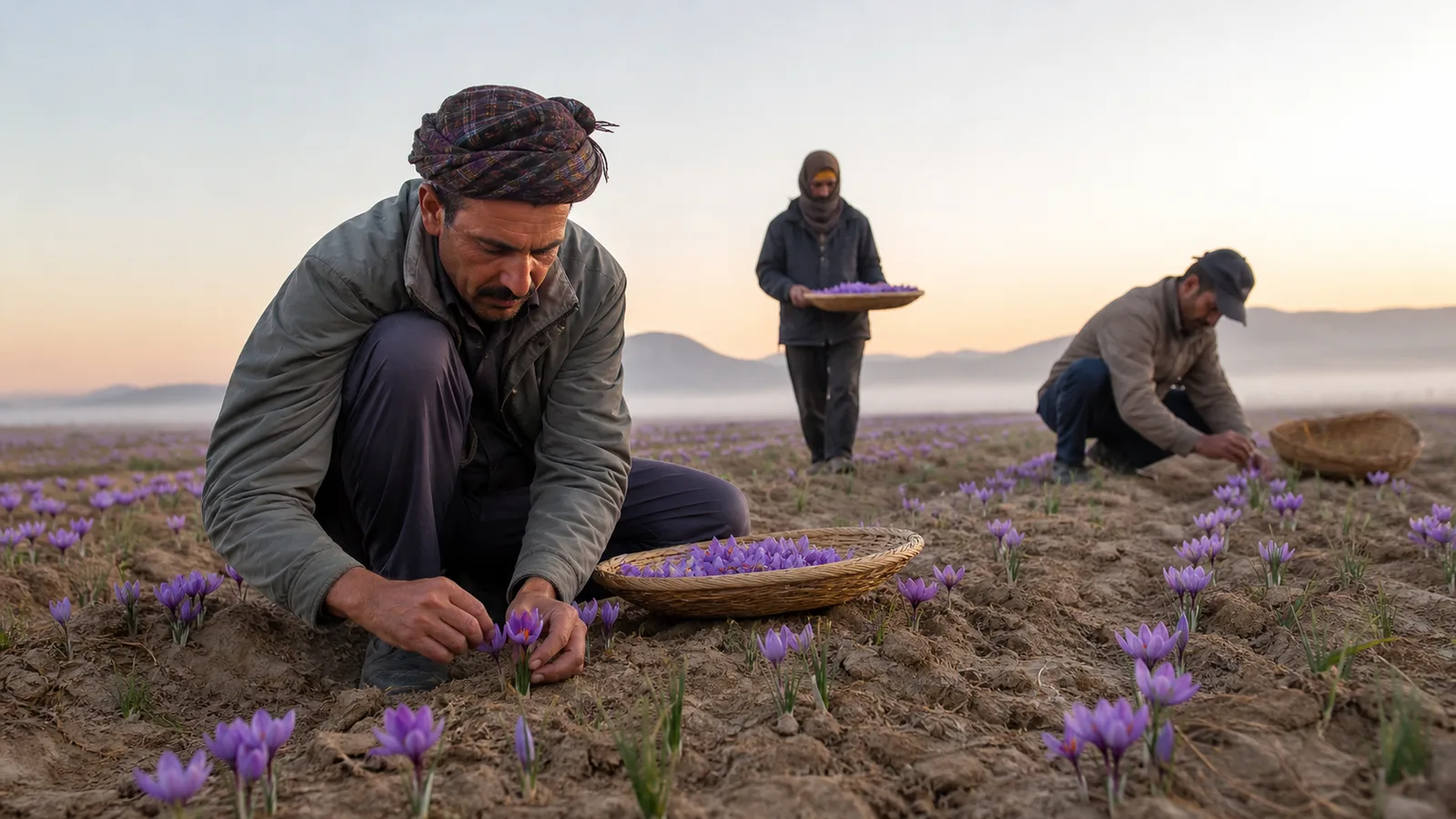
These saffron harvest photos in Mashhad show the part of saffron production that no machine has made ordinary: people moving through a field of purple flowers, lifting each bloom by hand and taking it quickly to the next stage. The harvest is beautiful, but it is also a race against time. Flowers arrive in a short autumn flush, and their red stigmas must be separated and dried with care.
The original 2018 post was a ten-image gallery with one translated sentence about employment for rural women. It gave no explanation of what the photographs showed. This photo-led guide adds that missing context: where Mashhad fits within the saffron region, why the work begins early, what happens after picking and why handling matters to the finished spice.
What a saffron harvest near Mashhad looks like
Mashhad is the capital of Razavi Khorasan, the centre of Iran’s largest saffron-growing belt. An Iranian agriculture-ministry table submitted to the Codex Committee reported 69,407 hectares of saffron in Razavi Khorasan in 2014–2015, far more than any other province in that dataset. The figures are historical, but they explain why Mashhad is so closely associated with saffron buying, processing and trade.
Fields are not bright purple all year. Saffron corms remain underground, produce narrow leaves and flower for a short period in autumn. At harvest, small violet blooms appear close to the soil. Workers bend or crouch along the rows, pick intact flowers and place them in light baskets or containers that will not crush the crop.
A 2025 FAO visit to saffron farms and processing units around Mashhad documented both traditional hand harvesting and modern post-harvest operations. The field visit took place in Fariman County, southeast of Mashhad, at the beginning of the harvest season.
Why the flowers are picked early
Harvest crews commonly begin early in the morning, while flowers are still fresh and before stronger sun encourages wilting. FAO’s technical overview of saffron production describes a four-to-six-week harvest period, with an individual plant flowering for only about fifteen days. It recommends picking intact flowers early and starting stigma removal and drying on the same day.
Timing is not only about appearance. A flower left in the field can open fully, collect dust or suffer weather and handling damage. A flower piled too deeply after picking can warm, compress and deteriorate. The photograph therefore captures the first link in a chain; prompt transport and clean handling still have to follow.
From purple flower to red saffron threads
Each Crocus sativus flower carries three red stigmas. Those are the threads sold as saffron. The purple petals and yellow stamens are not the spice.
After flowers reach a clean working area, processors open them and separate the stigmas. The red portion may be kept with more or less of the pale style depending on the intended grade. The material is then dried under controlled conditions. Drying reduces moisture and stabilises the spice, but excessive heat or poor airflow can weaken its aroma, colour and flavour.
That large difference between a basket of flowers and a small amount of dried saffron explains much of the crop’s labour cost. The value is not created by rarity alone; it also reflects repeated hand work at harvest and separation, followed by quality-sensitive drying and storage.
The role of women and family labour
The single sentence in the old gallery said saffron could support rural women and girls. “Entertainment” was a poor translation and understated the work. In Khorasan’s family farming systems, women have long participated in cultivation, flower gathering, stigma separation and household organisation during the intense harvest period.
FAO’s page on the qanat-based saffron system of Gonabad, also in Razavi Khorasan, describes women working alongside their families across cultivation stages and taking a particularly visible role during harvest. The income and conditions are not uniform from one farm to another, so a photograph should not be used to claim that every worker receives the same economic benefit. It does show why labour availability is central to bringing in a short, concentrated crop.
What careful post-harvest work protects
Once the flowers leave the field, cleanliness and traceability become as important as speed. A well-run operation keeps flowers away from soil and dirty surfaces, separates damaged or foreign material, records the lot, dries stigmas evenly and protects the finished saffron from moisture, light and contamination.
FAO’s current Iran saffron project focuses on authenticity, standardisation, quality control and post-harvest practice. The Codex standard for dried saffron covers identity, quality, contaminants, hygiene and labelling. These checks connect what happens in the field to the product a customer finally opens.
What harvest photographs cannot prove
A vivid field and a full basket do not prove the dry yield, grade, origin or laboratory quality of the saffron. Those require records and testing. Nor can photographs establish that every flower pictured came from Mashhad unless the original photographer’s location and caption are available.
The old gallery was attributed in the post to Tasnim and Donya-e-Eqtesad, but it did not preserve individual captions or enough provenance to verify each scene. The new lead image is a representative editorial image, not a claim to document one named farm or worker. The processes it depicts—hand picking, quick collection and careful handling—are supported by the FAO sources linked above.
What the scene does communicate clearly is scale. Finished saffron begins as thousands of delicate flowers and many hours of concentrated work. Around Mashhad and across Razavi Khorasan, harvest time brings field labour, family knowledge and post-harvest quality control together within a few demanding weeks.
Sources reviewed: FAO’s October 2025 Mashhad/Fariman field report; FAO’s technical overview of Iranian saffron harvesting; FAO’s Globally Important Agricultural Heritage System profile for Gonabad; and Iran’s 2017 Codex submission using Ministry of Agriculture-Jahad production data.

![Exporting Saffron to Turkey + Price Guide [Complete 0 to 100]](https://img.rowhanisaffron.com/20260827003933/saffron-export-turkey-quality-inspection.webp)



