


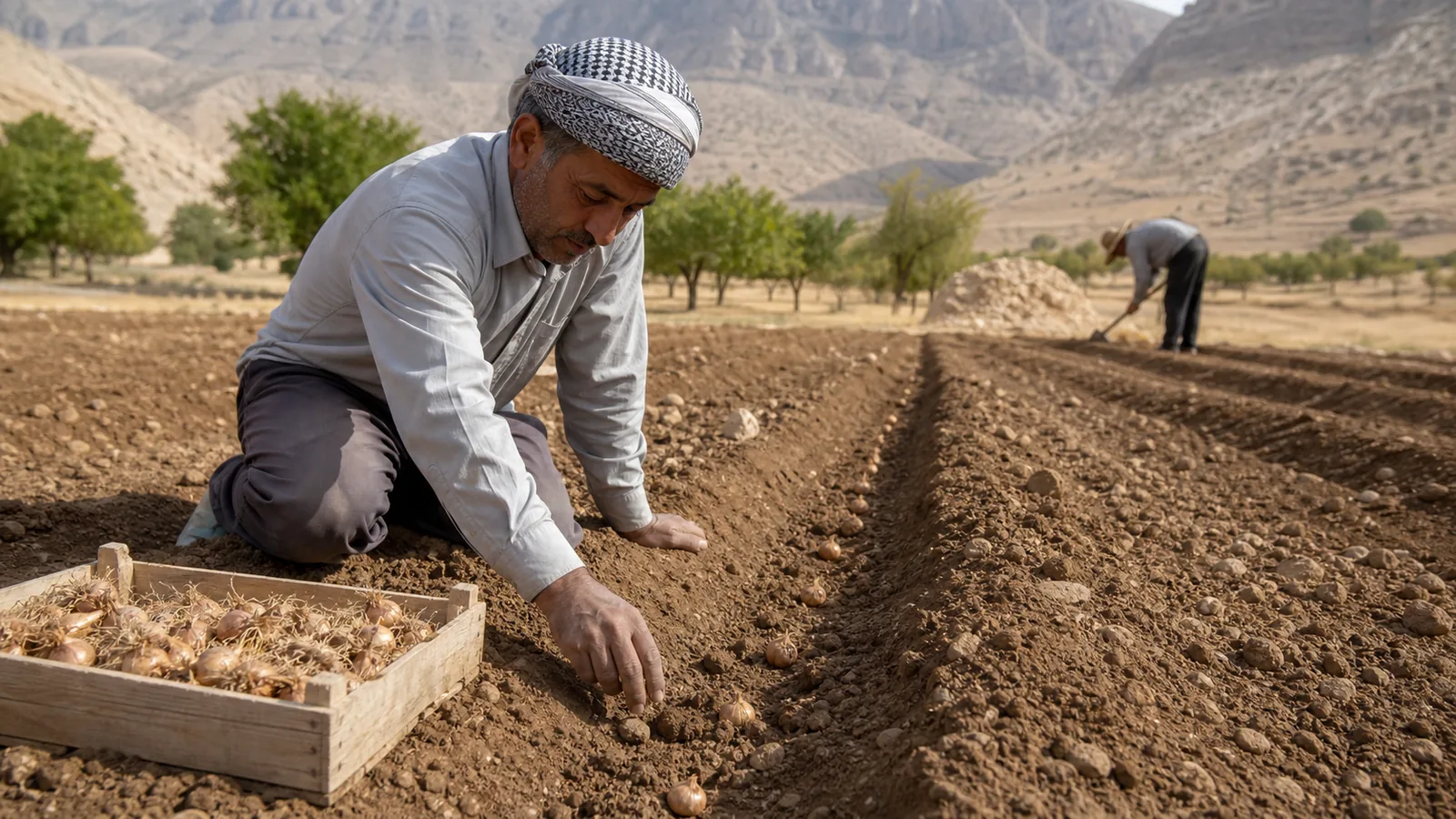
Planting saffron corms in Fars Province is established most clearly around Estahban, where growers use the crop in dry conditions and schedule field work around the local climate. The “saffron onion” in this page’s title means the corm of Crocus sativus, not an edible onion.
The historical report described Estahban as Fars Province’s saffron centre. It also made broad claims about water, yield, quality, and exports. Those figures are useful as an archive, but they need their date and original wording because acreage and performance have changed.
Why Estahban growers planted saffron
Ranjbar, then identified as the director of the Estahban Agricultural Jihad office, told IRIB News that saffron suited places facing water shortages. He said irrigation occurred in autumn and winter and that rainfall supplied much of the crop’s water.
The report gave an annual water-use figure of 3,000 cubic metres per hectare. That is a reported local estimate, not a promise for every Fars field. Rainfall, soil texture, drainage, corm density, field age, irrigation method, and seasonal heat can all change the water balance. A field still needs an irrigation plan; “lower-water crop” does not mean “no-water crop.”
Correcting the old production translation
The surviving English text says “800 thousand kilograms” of dried saffron, but the embedded Persian sentence says “one thousand and 800 kilograms.” The intended historical figure was therefore about 1,800 kilograms, with a stated average of five kilograms per hectare.
Those two numbers correspond to roughly 360 productive hectares if they refer to the same season and area. The source did not state the precise planted and bearing areas in the translated passage, so that arithmetic should not be turned into a new acreage claim.
Ranjbar also described Estahban saffron as exceptional in quality, aroma, and flavour. No laboratory results or comparison protocol appeared in the article. The statement is retained as his assessment rather than presented as an independently measured ranking.
When saffron corms are planted in Estahban
Planting dates should follow local extension advice rather than a universal online calendar. A later report from Iran’s Agricultural News Agency said Estahban corm movement for planting ran from mid-August to mid-September and that bearing area had reached 546 hectares. See the IANA report on Estahban cultivation.
A grower preparing to plant should confirm:
- that the field drains well and has been assessed for soil and water limitations;
- that corms come from a traceable, healthy lot and are graded before planting;
- that depth, spacing, and corm quantity match the local production system;
- that irrigation is available when the crop needs it, even in a low-rainfall year; and
- that labour and drying capacity will be ready during the short harvest window.
Healthy planting material matters because saffron is propagated vegetatively. Damage or disease introduced with a corm can persist and spread through daughter corms. Buying on size or price alone is not enough; field origin and condition belong in the decision.
Fars saffron and export markets
The historical article said 30 percent of Estahban saffron was exported to Spain, Germany, France, China, Japan, South Korea, and Persian Gulf markets. It did not provide customs data, a crop year, export tonnage, or explain whether the product left directly from Estahban or through traders elsewhere.
That market list should be treated as a period statement. For a grower, the practical questions are who will buy the crop, which grade and testing documents the buyer requires, where it will be processed, and when payment will be made. Expanding a field before confirming those details shifts most of the risk to the farmer.
Is planting saffron in Fars a good response to water scarcity?
It can be part of a lower-water cropping strategy in suitable districts, and Estahban has a long enough record to provide local evidence. It is not automatically the best choice for every water-stressed parcel.
The final decision should compare expected yield, corm and labour costs, irrigation reliability, drying and quality-control capacity, and a realistic selling route. Start with the field, not the reputation of the crop. A small, recorded trial is more informative than repeating an old province-wide average.

![Exporting Saffron to Turkey + Price Guide [Complete 0 to 100]](https://img.rowhanisaffron.com/20260827003933/saffron-export-turkey-quality-inspection.webp)



