


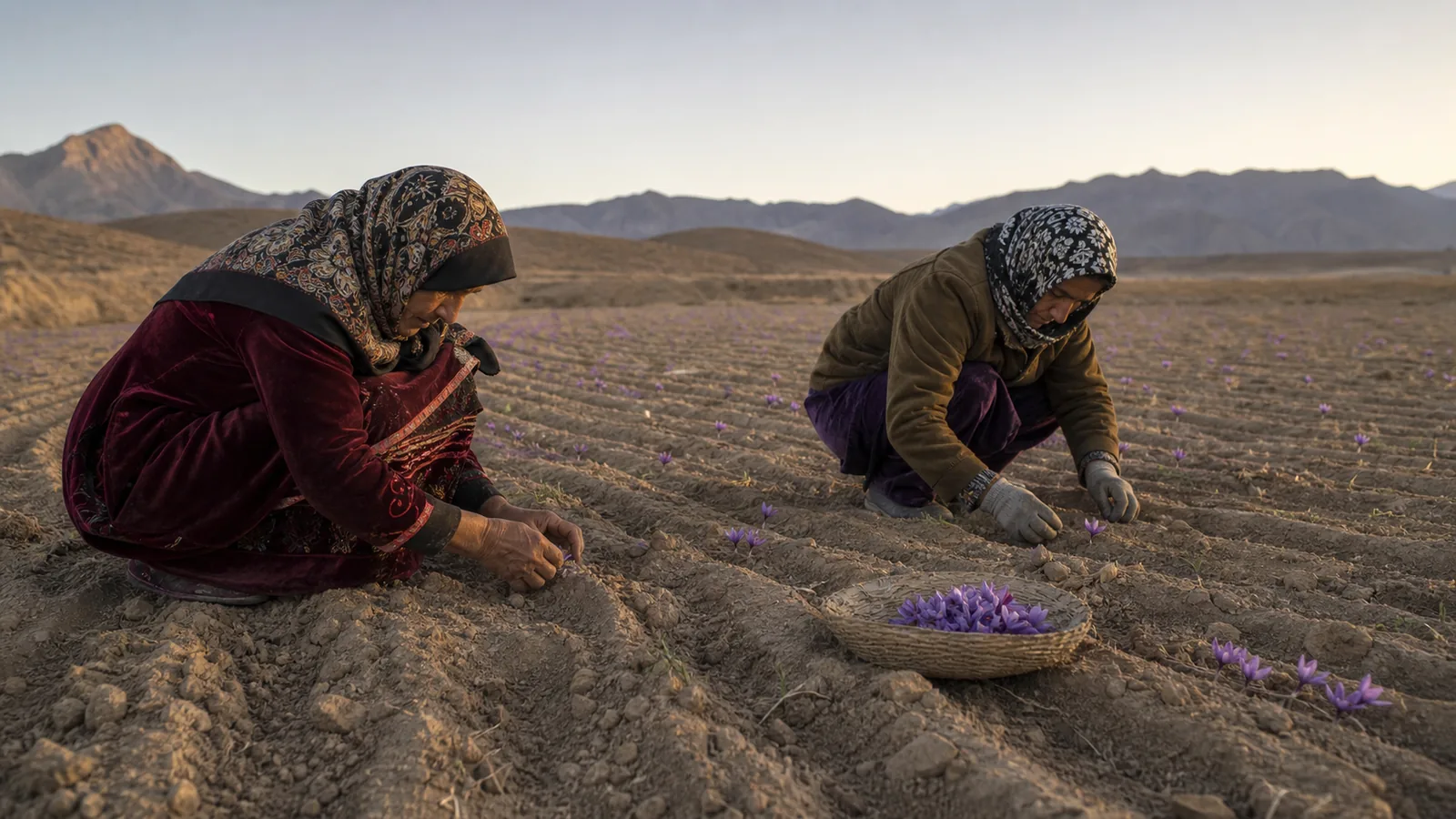
The low Khalil Abad saffron harvest described here was a seasonal warning tied to poor late-winter rainfall and exceptional heat. The historical report quoted local agricultural director Majid Taherpour and projected about 14 tonnes of dried saffron from the county’s farms.
The title says the harvest “has been low,” but the source passage mixes a yield decline with a forecast for that year. It does not provide the previous season’s tonnage, planted area, or percentage loss. The article can explain why officials expected a weaker crop; it cannot calculate the size of the decline.
Why Khalil Abad expected less saffron
Taherpour attributed lower performance to reduced precipitation in Esfand, the final month of the previous Iranian year, and to unusually intense heat over recent years. Both points were presented as the local official’s assessment in a Razavi Khorasan report by IRIB News.
Weather can affect a saffron field at more than one stage. Moisture and temperature influence vegetative growth, the development of replacement corms, dormancy, and the next flowering period. The outcome also depends on field age, soil, irrigation timing, corm condition, and management. Without field-level measurements, the archived report cannot separate the contribution of rainfall from heat or other causes.
The 14-tonne number should also be read carefully. The Persian wording indicates what growers were expected to harvest that year, not a final audited result. A later end-of-season record would be needed to confirm it.
What support growers received
The report said 400 tonnes of different chemical fertilizers had been distributed to support saffron growers. It did not state the fertilizer types, nutrient analysis, number of recipients, treated hectares, application rates, or whether recommendations followed soil tests.
That missing detail matters. A county-wide distribution total is not a safe fertilizer instruction for an individual field. Nutrient decisions should follow soil and plant evidence, the crop stage, and local professional advice. More input does not automatically repair weather stress, and unnecessary application can increase cost without improving the harvest.
Agricultural Jihad specialists were also said to make regular field visits with the aim of improving saffron productivity. That type of observation is most valuable when each farm records irrigation, inputs, field age, flower yield, dried stigma yield, and corm condition. Comparing those records across seasons can show whether a change actually helped.
The UNIDO pilot in Mazdeh village
Taherpour said a joint project with the United Nations Industrial Development Organization had begun as a pilot in Mazdeh village. An agricultural specialist was to conduct classes and supervise cultivation and crop care.
UNIDO’s own project records confirm that Mazdeh in Khalil Abad was among the selected saffron villages. A 2015 UNIDO saffron project report lists Mazdeh and records 550 hectares of saffron for that village in the project material. This supports the programme and place name, but it does not verify the later 14-tonne forecast.
A useful pilot should leave growers with more than a single class. Practical gains come from consistent field records, clear recommendations, follow-up visits, harvest and drying controls, and a way to compare participating farms with their earlier performance.
Where Khalil Abad is located
Khalil Abad lies in Razavi Khorasan between Kashmar and Bardaskan. The archived report places it about 12 kilometres from Kashmar, 20 kilometres from Bardaskan, and 240 kilometres from Mashhad by way of Kashmar.
These distances help explain the local production context. The county sits within a wider saffron-growing region, but its fields still have their own water, heat, labour, and management conditions. A regional reputation cannot substitute for measurements from the county or village.
What does this report tell us about the low harvest?
It shows that local officials expected lower saffron yield after weak late-winter precipitation and sustained heat, while projecting roughly 14 tonnes of dried crop and responding with inputs, field visits, and training.
It does not tell us the final harvested tonnage, the decline from the previous year, or whether the support measures restored productivity. Those limits should stay visible. For growers and buyers, the reliable next step is to compare verified end-of-season yield with field area, weather, and management records rather than repeat the forecast as a completed harvest.

![Exporting Saffron to Turkey + Price Guide [Complete 0 to 100]](https://img.rowhanisaffron.com/20260827003933/saffron-export-turkey-quality-inspection.webp)



