


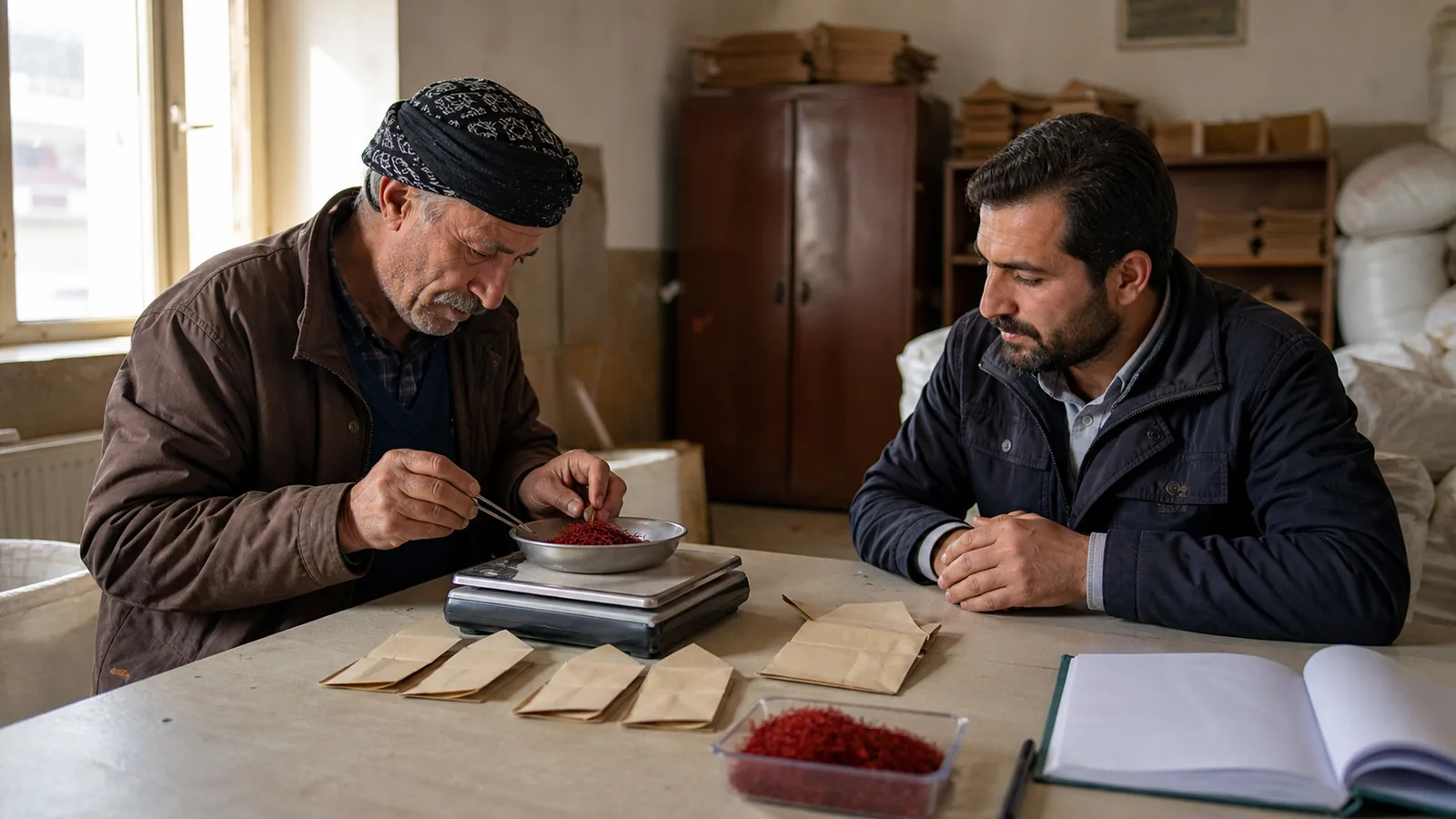
Saffron growers in Selsele County were selling cheaply to brokers because local processing, packaging, and marketing channels were weak. The historical report did not argue that every intermediary was harmful. Its central point was that farmers had too few ways to prepare and sell their crop, so they had little bargaining power at harvest.
Selsele is a county in Lorestan Province. The old machine translation sometimes turns its name into “Dynasty,” but the article concerns the place, its farmers, and the farm-gate saffron market.
Selsele’s reported saffron crop
Sepahvand, identified as the head of the local Agricultural Jihad office in a Young Journalists Club report, described Selsele’s climate and fertile soil as suitable for saffron. He said 20 hectares were under the crop that year, with an average yield of four kilograms per hectare and expected production of 80 kilograms.
The three figures are arithmetically consistent: 20 hectares multiplied by four kilograms per hectare gives 80 kilograms. They are still historical estimates, not current county statistics, and the report does not say how much of the planted area was mature or whether the final harvest matched the forecast.
Sepahvand put annual income at 250 to 300 million rials per hectare and called saffron more profitable than other crops. The article does not list corm, labour, water, fertilizer, drying, packaging, finance, or selling costs. That range should therefore not be read as verified profit or converted into a present-day business forecast.
Why brokers could buy Selsele saffron cheaply
Freshly picked saffron flowers cannot wait long. The stigmas must be separated and dried carefully, while growers may also need cash soon after paying seasonal workers. A buyer who can collect the crop immediately, assess it, and pay quickly provides a real service.
The imbalance appears when the farmer has only one or two buyers, no reliable grade result, no safe storage, and no way to reach a packer or wholesale customer. Under those conditions, the buyer controls more of the information and timing. The grower may accept a lower price even when the saffron is good.
The report blamed the absence of a local packaging industry and weak marketing. Packaging alone, however, does not create value. A local facility must have appropriate hygiene, traceability, weighing, quality control, compliant labels, working capital, and actual customers. An expensive packing line without enough crop or sales can become another cost for farmers.
What would improve the farmer’s position?
A stronger local market starts with information and shared services. Growers do not all need to become retailers, but they should be able to compare offers on the same basis.
- Record each lot’s grower, field, harvest date, drying method, and net weight.
- Use transparent grade and moisture checks before negotiating the price.
- Keep lots separate so better material is not lost in an anonymous mixture.
- Publish comparable buying terms, including payment time and deductions.
- Share drying, testing, storage, or packing services when individual volume is small.
- Develop buyers before expanding acreage, not after the crop is ready.
A cooperative, contracted processor, or private buyer can each work if responsibilities are clear. The important question is whether the arrangement gives growers dependable quality feedback, a genuine choice of buyers, and prompt payment.
The seven-year claim needs context
Sepahvand listed rural employment, income, relatively low water use, and productivity among saffron’s advantages. He also said a farmer plants once and harvests for at least seven years.
Saffron is a perennial crop, but “plant once” does not mean “work once.” Fields need irrigation, weed and nutrient management, flower picking, stigma separation, drying, and monitoring of corm crowding and health. How long a planting remains productive depends on its site and management. Seven years was the local official’s stated horizon, not a universal guarantee.
How should the cheap-selling problem be understood?
The problem was not simply that brokers existed. It was that Selsele growers reportedly lacked enough local infrastructure, market information, and competing routes to sale. The 20-hectare crop was small, which also made it harder to support dedicated facilities without cooperation.
The safest response is to preserve the useful role of collection and finance while making grading, weights, deductions, and prices transparent. When farmers can prove what they produced and compare more than one offer, an intermediary has to compete on service rather than rely on urgency.

![Exporting Saffron to Turkey + Price Guide [Complete 0 to 100]](https://img.rowhanisaffron.com/20260827003933/saffron-export-turkey-quality-inspection.webp)



