


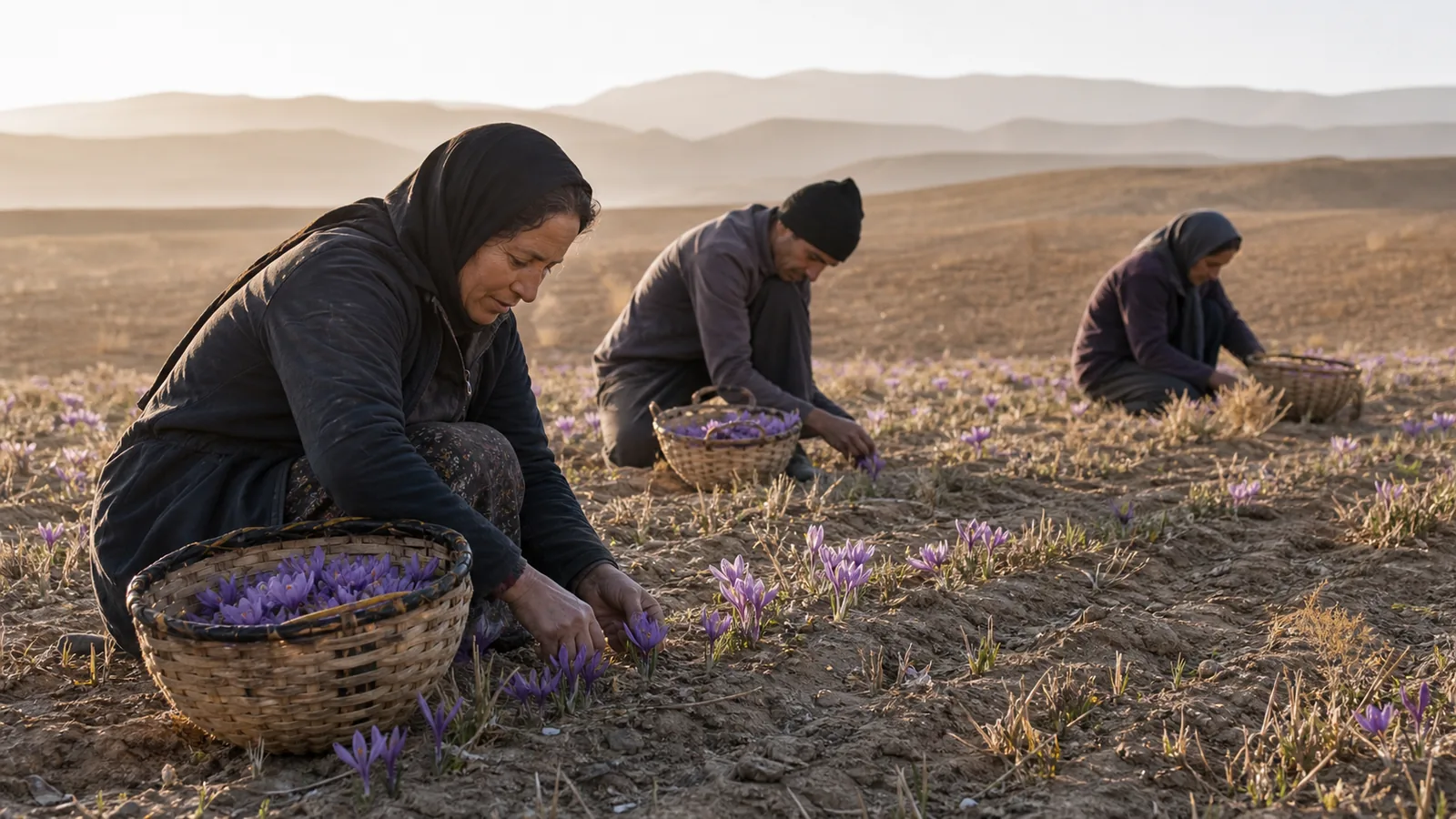
An archived report on the saffron harvest in Bardeskan described 3,700 hectares of fields, an expected crop of about 10 tonnes, and more than 100 seasonal jobs during the month-long flowering period. It also expected output to be 10% lower than the previous season. Those figures provide a useful snapshot of the county’s saffron economy, but they are historical—not a forecast for the current harvest.
The reported saffron harvest in Bardeskan
Bardeskan is in Khorasan Razavi, one of Iran’s central saffron-growing regions. In the report, local Agriculture Jihad official Hossein Mohammadi said picking began at the start of the Iranian month of Azar and continued until its end, roughly spanning late November and December. He estimated that the county’s 3,700 cultivated hectares would yield around 10 tonnes of dried saffron.
The same report projected a 10% year-on-year decline. It did not establish a cause, so weather, water, crop management, or market conditions should not be presented as the explanation without further evidence. What it does show clearly is the scale of the work: because flowering and picking are concentrated into a short period, the harvest was expected to provide seasonal employment for more than 100 people.
What picking saffron involves
The purple flowers must be collected during their brief flowering window, then the red stigmas are separated from the rest of each flower. The work does not end in the field. Careful post-harvest handling, drying, testing, and storage protect the spice before it is packed or sold.
A 2025 FAO field visit to saffron farms and processing units in Khorasan Razavi highlighted the importance of post-harvest practices and quality integrity across the value chain. That distinction is useful here: a harvest total tells us how much was expected, but not whether every batch received the same handling or met the same quality specification.
How Bahar’s smaller fields compare
A second archived report followed saffron growing in Bahar County, Hamedan Province, on a much smaller scale. Houshang Karami, the local Agriculture Jihad director, expected about 15 kilograms from four hectares of productive fields. He put typical yield at three to four kilograms per hectare and said fields generally achieved their strongest production from their third through seventh years.
The Bahar report adds practical detail that the Bardeskan account did not include:
- planting one hectare required roughly four to five tonnes of saffron corms;
- harvesting ran from early November through late December in that locality;
- new plots had been planted in Qaraghaj and other villages; and
- about 30 people worked in saffron planting, field care, and harvesting across the county.
The different calendars are not contradictory. Flowering time varies with location, altitude, temperature, and the conditions of a particular season. The reports should be read as local observations, not as one fixed national harvest date. For a broader explanation of field preparation and corm management, see our guide to saffron cultivation and growing conditions.
Why field age and yield belong together
A hectare count alone does not reveal how much dried saffron will be produced. A newly planted field, a mature productive field, and an ageing or poorly managed field can contribute very different amounts. The Bahar figures make that relationship visible: its four productive hectares and reported three-to-four-kilogram yield align with the expected total of about 15 kilograms.
Bardeskan’s much larger area likewise needs to be read beside its expected tonnage and reported decline. Dividing the two figures gives only a rough implied average, not a quality score or a farm-level benchmark. County totals combine fields of different ages and conditions, while the finished spice also depends on separation, drying, and sorting after the flowers leave the field.
The market context behind the harvest
Harvest volume is only one part of the grower’s position. A separate market report republished in 2018 quoted Gholamreza Miri of the Khorasan Razavi Saffron Exporters Association. He said saffron prices had risen by about 300,000 tomans, or 5%, since the start of that Iranian year, mainly because farmers were supplying less product to the market.
Miri rejected the idea that conditions justified another 50% price jump like the one reported in the previous year. At the same time, he described weak retail trading in Mashhad: some sellers had bought stock for the Nowruz period but still held it because sales were below earlier years. These are dated market observations, not today’s saffron price. Currency values and trading conditions have changed too much for the old numbers to function as a current buying guide.
A historical export expectation, not a present forecast
The market report also recorded Miri’s view that saffron exports had been relatively resilient to sanctions and could grow 20% if direct banking interaction became easier. That was an expectation made at the time, not a verified outcome and not a forecast for the present year. It remains relevant because it shows how growers, local traders, and exporters are connected: a change in farm supply can affect price, while payment channels and overseas demand influence how readily inventory moves beyond the domestic market.
Reading the Bardeskan figures responsibly
The most useful conclusion is modest. Bardeskan’s report documents a large cultivation base, a concentrated harvest, significant seasonal labour, and a predicted fall in output. Bahar supplies a smaller-field comparison and agronomic context. The market report explains why production figures cannot be interpreted without considering supply behaviour, unsold stock, and access to export trade.
Together, the three accounts give a fuller picture of saffron harvest in Bardeskan and beyond: flowers are picked locally, field performance changes over a plantation’s life, and the value of the finished crop is decided only after it passes through processing and a changing market.

![Exporting Saffron to Turkey + Price Guide [Complete 0 to 100]](https://img.rowhanisaffron.com/20260827003933/saffron-export-turkey-quality-inspection.webp)



