


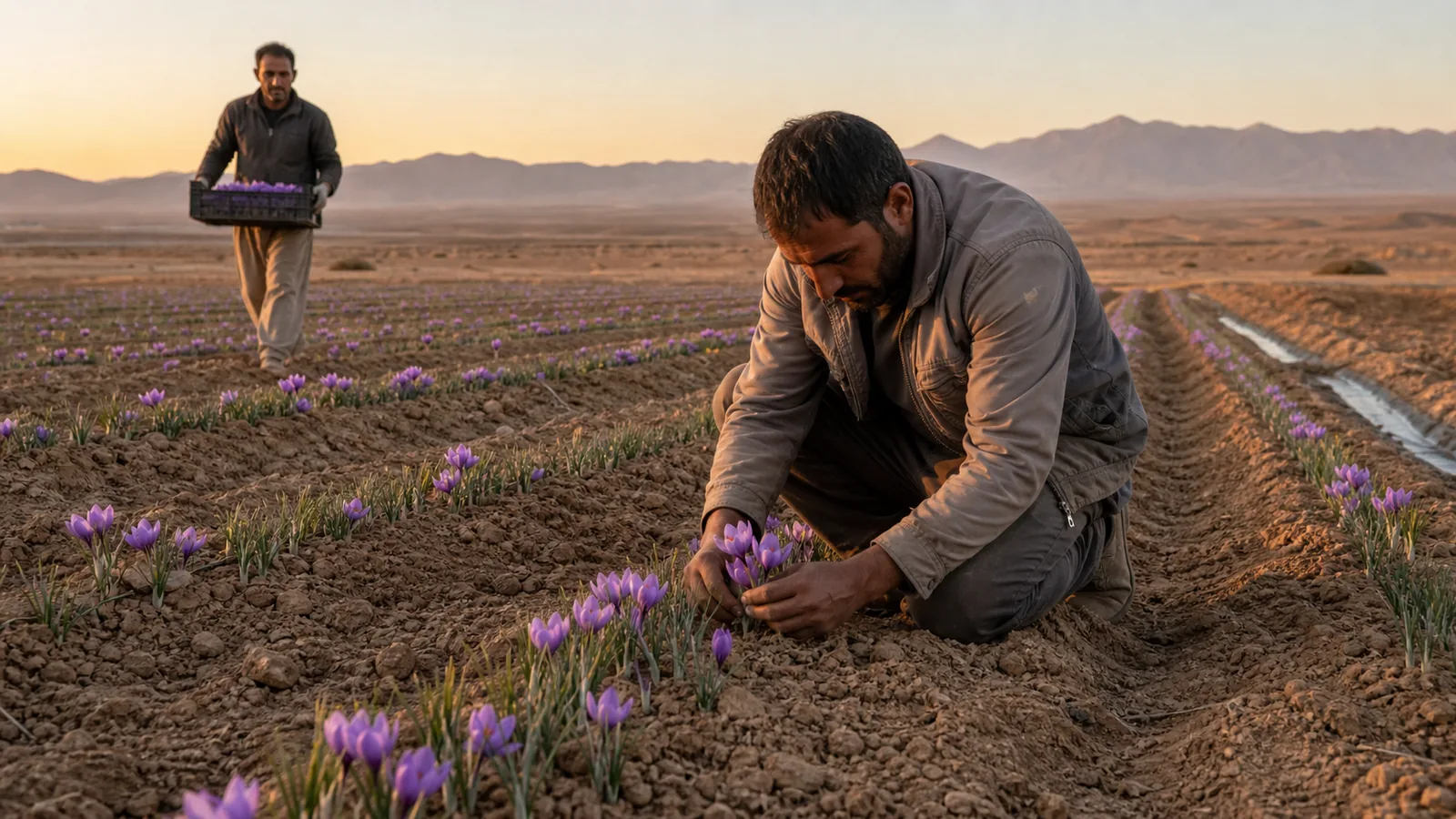
Saffron cultivation in Bam began around the Iranian year 1388 (2009–10) and had reached eight hectares in the historical report preserved here. The city produced 32 kilograms in the preceding season, an average of 4 kilograms per hectare, while local officials saw room to expand towards 50 hectares. That small Bam programme was part of a wider move into saffron across Kerman and other water-stressed parts of Iran.
The figures below come from reports published at different times in the 2010s and early 2020s. They are useful as a record of how regional programmes developed, but they are not current acreage, production, price, loan, or ranking data. Each place also had a different starting point: some were testing a few hectares, some were rebuilding an old crop, and Kerman was already operating at provincial scale.
How saffron cultivation expanded in Bam
Reza Ghahri, then director of Agricultural Jihad in Bam, said the city had eight hectares under saffron. Three hectares had been added in the preceding year. Reported production was 32 kilograms, equal to 4 kilograms per hectare, while the best local result in earlier seasons had reached 5 kilograms per hectare.
The long-term proposal was to increase the area to as much as 50 hectares. That was a development target, not acreage already planted. The distinction is important because the original machine-translated article made the eight-hectare base and 50-hectare potential sound like simultaneous totals.
Support for growers reportedly included extension classes and financing of 250–300 million rials per hectare. Saffron corms were obtained from Zarand through coordination with the provincial horticulture organisation and then made available to Bam farmers. Both the finance and the rial amounts belong to that reporting period; they should not be treated as a current programme or budget.
Bam’s production and harvest window
The Bam report placed harvest from mid-Aban to late Azar in the Iranian calendar, approximately early November through late December. It estimated that harvesting one hectare could employ about 10 people while flowers were being picked and processed. That describes seasonal labour demand during a short, intensive harvest, not 10 permanent full-time jobs for every hectare.
A yield of 4 kilograms per hectare also helps explain why the 32-kilogram total and eight-hectare area belong together. It is a cleaner measure than promotional descriptions of saffron as simply a high-value crop: farm results depend on corm quality, field age, weather, management, labour, drying, and the price growers can actually obtain.
The wider Kerman province picture
A later provincial report quoted horticulture director Mehdi Lotfalizadeh as saying Kerman ranked fourth in Iran for saffron cultivation at that time. It forecast up to 5,100 kilograms from 1,600 hectares, with harvesting from mid-November to late autumn. Zarand had the province’s largest cultivated area, while Rigan had the smallest.
Most of the reported crop was consumed within Kerman, with some product exported through neighbouring provinces. The report identified fragmented smallholdings and frost as problems for growers. It also linked farmer interest to the region’s climate, access to facilities, the move towards crops with lower water demand, and opportunities for household-scale processing.
This provincial context makes the Bam figures easier to understand. Bam’s eight hectares were a small local programme within a much larger Kerman saffron economy, and sourcing corms from Zarand connected the newer area to the province’s most established production centre.
Training in Ravar supported the same transition
Another Kerman report recorded a workshop at the Ravar Agricultural Jihad Administration. At the request of local management, the province’s Agricultural Research and Training Center covered saffron planting, crop care, harvesting, and weed control. The item named the local official as Ghanbari.
The workshop was small news, but it supplies an important part of the regional story. Expanding acreage requires more than distributing corms or announcing credit. New growers need field-level guidance before planting and through harvest, particularly where saffron is entering a different soil, climate, and farming system.
Koohdasht: from two hectares to 11
In Koohdasht, Lorestan, Agricultural Jihad director Bahman Fereiduni told ISNA that saffron area had risen from 2 hectares in earlier years to 11 hectares. Officials hoped to reach 50 hectares in the near future. As in Bam, 50 hectares was an ambition rather than a completed area.
The stated reason was water deficit and falling groundwater, which were pushing the county to reconsider its cropping pattern. Fereiduni described saffron as a high-value export crop and said Koohdasht farmers would not lose by planting it. No crop can carry that guarantee. Profit depends on establishment costs, yield, quality, labour, processing, market access, and price, so the statement is best read as official encouragement rather than a financial promise.
Asadabad: 12 hectares and a once-a-year harvest
Asadabad in Hamadan province offered a different snapshot. Socrates Birang, the county’s Agricultural Jihad director, forecast more than 40 kilograms from 12 hectares. He gave a yield range of 3–6 kilograms per hectare and said the crop was planted around mid-September, with flowers harvested once a year from mid-November into December.
“Once a year” refers to saffron’s annual flowering season; it is not a special variety or a claim that other saffron regions harvest continuously. The city had 18 saffron growers, six of whom were women. Six growers had used Farmers Support Fund facilities, and the largest individual saffron holding was reported as 2.5 hectares.
The main production areas named were Chahardoli, Gonbaleh, Vandarabad, and the surroundings of Asadabad. These details show how a 12-hectare county programme was spread among small growers rather than concentrated in one large plantation.
Ardestan: a revived crop and figures that need context
In Ardestan, Isfahan province, Agricultural Jihad director Ali Akbar Saleh reported that harvest had begun across 84 hectares and forecast more than 580 kilograms. He described saffron as a crop that had disappeared locally before being revived over the previous decade, with the planted area then increasing year by year.
The article also said average yield would exceed 8 kilograms per hectare. Those two numbers do not reconcile: 580 kilograms divided by 84 hectares is about 6.9 kilograms per hectare, while an eight-kilogram average would imply at least 672 kilograms. Both statements are retained as part of the historical report, but the discrepancy means they should not be combined into one precise performance claim.
Saleh placed harvest from mid-November in colder parts of the county to mid-December in warmer areas. He also said more than 7,000 people worked directly in Ardestan’s agricultural sector and more than 20,000 indirectly. Those totals covered all local agriculture, not saffron alone.
The county was reported to have attracted 3.2784 billion tomans in bank credit for farm mechanisation. Again, that was sector-wide credit at the time, not a saffron-only fund or a current offer.
A university used saffron as a research-farm crop
A separate report described an Islamic Azad University unit planting more than 6,000 square metres of its research farm and adjoining campus land with saffron. Mojtaba Hassanzadeh framed the project as part of the Iranian year 1395 (2016–17) “resistance economy” programme and the university’s effort to develop income beyond tuition.
He also encouraged university units in suitable parts of Razavi Khorasan to make productive use of idle agricultural land and connect research with farming. The report gives the planted area and the institutional purpose, but no harvest result, yield, or financial return. It should therefore be treated as a demonstration and income-diversification project, not proof that university saffron farming was profitable.
What the regional reports have in common
Although Bam, Ravar, Koohdasht, Asadabad, Ardestan, and the university project were separate programmes, the same practical themes appear repeatedly:
- Water pressure: officials promoted saffron as part of a shift away from crops with greater irrigation demands.
- Healthy corms: Bam relied on planting material from Zarand, while new areas needed to manage quality and plant-health risks.
- Training: extension classes in Bam and Asadabad and the Ravar workshop supported growers entering an unfamiliar crop.
- Finance: establishment costs made loans and facilities important, but every amount in these reports is historical.
- Seasonal labour: flower picking and stigma separation create concentrated work during a short annual harvest.
- Market risk: a valuable crop is not automatically a profitable one; quality, processing, route to market, and price determine the result.
How to read these historical numbers
The safest comparison separates planted area, productive area, forecasts, targets, and actual output. Bam had eight hectares and reported 32 kilograms, while 50 hectares was potential. Koohdasht had 11 hectares and a 50-hectare target. Asadabad forecast more than 40 kilograms from 12 hectares. Ardestan reported 84 hectares and more than 580 kilograms, but its separate yield figure was inconsistent. Kerman’s 1,600 hectares described an entire province, not the city of Bam.
Seen this way, increasing saffron planting in Bam was one chapter in a broader regional experiment. The durable lesson is not that every district should copy the same acreage target. It is that expansion works only when water planning, suitable land, healthy corms, local trials, grower training, harvest labour, processing, finance, and a realistic market are developed together.

![Exporting Saffron to Turkey + Price Guide [Complete 0 to 100]](https://img.rowhanisaffron.com/20260827003933/saffron-export-turkey-quality-inspection.webp)



