


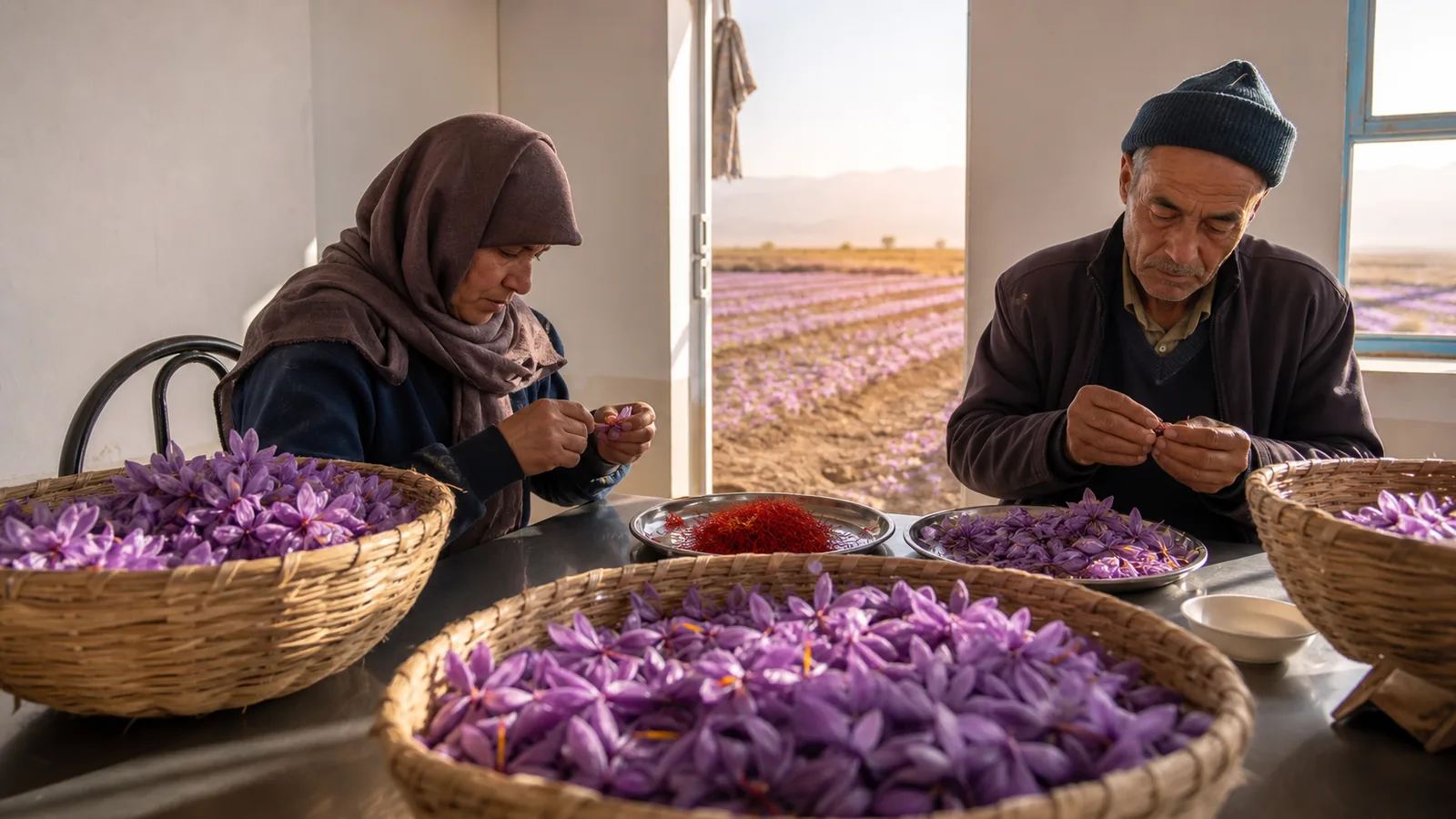
Planting saffron in Bakharz was already a large part of the county’s agriculture when this historical report was published. The place name is باخرز, normally written “Bakharz” in English. “Bakhazar” in the page title and URL is an older transliteration, so the address remains unchanged while the article uses the clearer name.
Hasan Mosaferi, identified as the director of the Bakharz Agricultural Jihad office, reported 3,500 hectares of saffron and an average of five kilograms of sargol saffron per hectare. He also described a serious gap after harvest: local growers lacked enough facilities to separate, process, and pack the crop.
The reported scale of saffron in Bakharz
In the Young Journalists Club report, Mosaferi called Bakharz one of Razavi Khorasan’s agricultural centres. He said the county accounted for nine percent of provincial saffron production and six percent of national production, with about 5,000 growers or operators active in the sector.
Those are period figures, not current statistics. The article does not give a crop year, total harvested weight, or distinguish planted area from mature bearing fields. Applying five kilograms to all 3,500 hectares would suggest 17.5 tonnes, but that is only arithmetic; it is not a substitute for a recorded harvest.
The word sargol also matters. It refers to a commercial cut made from separated red stigma material. A stated sargol yield is not automatically comparable with a figure for whole dried threads, bunch saffron, or fresh flowers.
Why growers sent flowers to neighbouring counties
Mosaferi said Bakharz lacked sufficient processing and packaging industries. At harvest, farmers either sold cheaply to intermediaries or sent fresh saffron flowers to nearby counties for the red stigmas to be separated. Transport and outside processing reduced the return that stayed with growers.
This is a time-sensitive bottleneck. Saffron flowers are picked during a short season, and the valuable stigmas must be separated and dried promptly and hygienically. Delay, crushing, contamination, uneven drying, or mixing lots can reduce quality and traceability.
A local solution does not have to begin with a large factory. Depending on verified crop volume, growers might use trained seasonal separation teams, shared clean rooms, contract drying, mobile collection, or a cooperative facility. The right scale is the one that can handle peak daily flower volume without sitting idle for most of the year.
What planting decisions should include
The size of Bakharz’s existing crop does not make every new field a safe investment. Before planting, a grower still needs to check soil and drainage, water quality and timing, healthy corm supply, labour availability, and the route from flowers to a tested saleable lot.
A practical plan should answer:
- How much graded, traceable corm material will the field require?
- Who can pick and separate flowers during the short harvest peak?
- Where will stigmas be dried, and how will temperature and hygiene be controlled?
- How will each grower’s lot remain identifiable through processing?
- Which buyer needs which grade, package, test result, and delivery date?
These questions connect planting to the post-harvest problem in the original story. Adding hectares without adding suitable handling capacity can increase the volume sold under pressure.
Was all Bakharz saffron organic?
The historical official said 100 percent of the county’s saffron farms were organic. The article did not identify an organic standard, certification body, inspection system, or list of approved inputs.
“Organic” is a controlled market claim, not a synonym for traditional or low-input farming. Unless a specific lot has valid certification for its destination market, it should be described through verifiable practices rather than given an unqualified organic label. This protects both growers and buyers.
From production centre to complete saffron chain
The original report showed that Bakharz had production scale and grower knowledge, but not enough local capacity at the most time-sensitive point of the chain. Later agricultural policy also recognised the need for dedicated oversight of planting, crop care, harvest, packaging, and export in Bakharz; an IANA report records that broader remit.
For farmers, the useful measure is not the number of machines installed. It is whether flowers move quickly into controlled separation and drying, lots stay traceable, quality is measured, and growers can compare fair offers for the finished saffron.

![Exporting Saffron to Turkey + Price Guide [Complete 0 to 100]](https://img.rowhanisaffron.com/20260827003933/saffron-export-turkey-quality-inspection.webp)



