


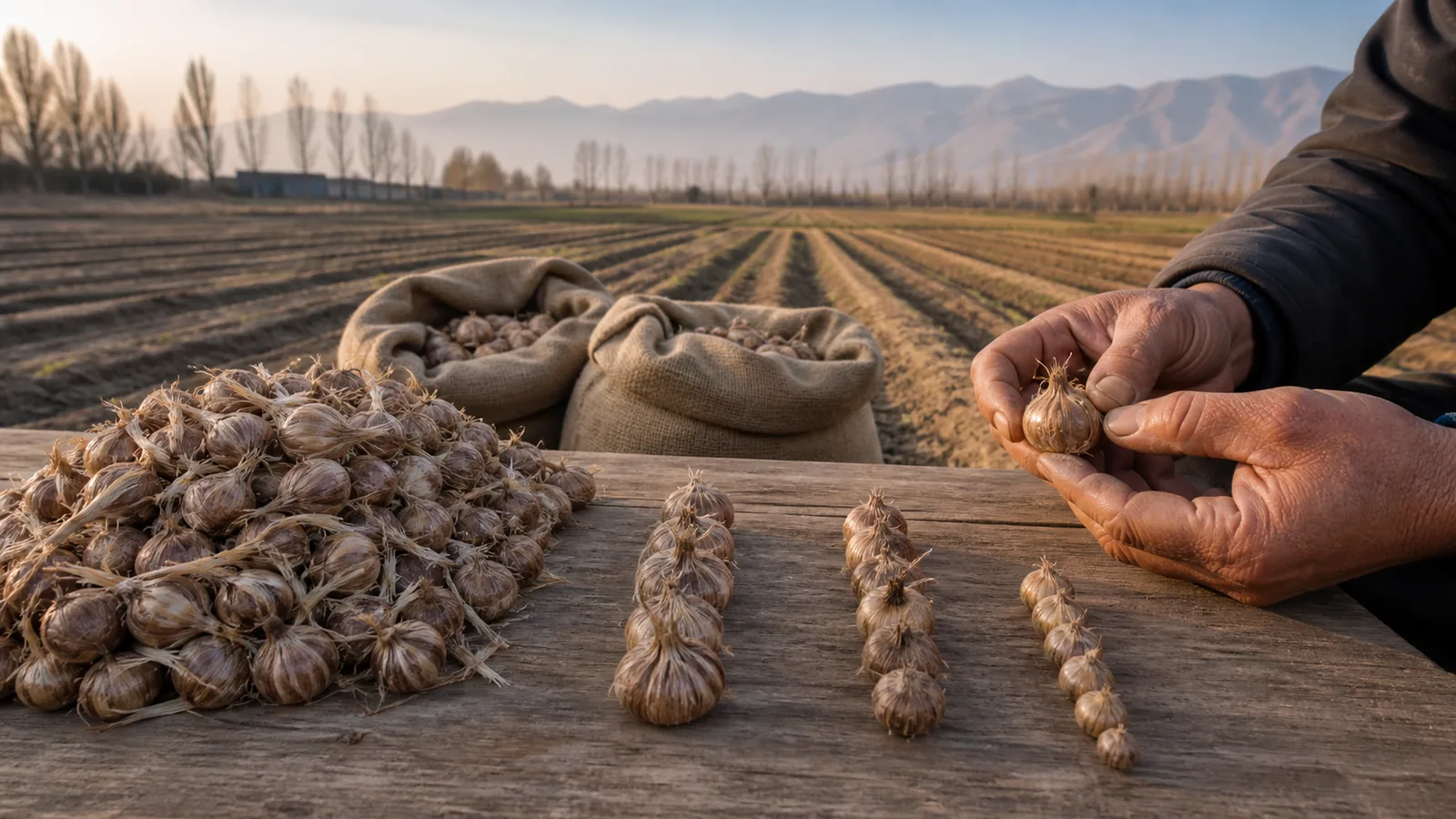
A historical report from North Khorasan said the province was growing saffron but could not yet supply its own planting stock. Growers still bought saffron corms from Razavi Khorasan and South Khorasan, according to Majid Tashakkori of the provincial Agricultural Jihad Organization.
The page title uses “saffron onion,” a literal translation of the Persian term for a saffron corm. It does not mean the kitchen vegetable. A corm is the underground planting structure from which Crocus sativus grows and produces daughter corms.
Why North Khorasan depended on corms from other provinces
Tashakkori told ISNA that 300 hectares had been planted during the previous year. He described North Khorasan as relatively new to saffron cultivation and said local fields had not matured to the point where they could provide all the corms needed for further planting.
That distinction matters. Producing dried saffron and producing dependable planting material are related, but they are not the same task. A field can yield flowers while its corm population is still being multiplied. Local supply also needs enough suitable corms to cover expansion without weakening productive fields.
The report regarded North Khorasan as having considerable potential, yet potential alone does not make a province self-sufficient. Farmers need healthy, correctly identified planting material, suitable fields, practical training, and enough seasons for daughter corms to develop. Research also shows that mother-corm size influences flowering and daughter-corm performance, so counting kilograms without grading the material says little about its productive value. A two-year field study in Scientia Horticulturae found clear effects from corm size and irrigation management.
What the historical figures do and do not show
The archived article gives an average dried-saffron yield of 6.5 kilograms per hectare and says the province harvested four tonnes of saffron in the previous year. It also says growers collected six kilograms of corms from their fields.
Those figures cannot be treated as a clean statistical set. Multiplying 300 hectares by 6.5 kilograms produces 1,950 kilograms, not four tonnes. The six-kilogram corm figure is also extraordinarily small beside a 300-hectare crop and may reflect a transcription, translation, or source error. The surviving text provides no district breakdown or other explanation that reconciles the numbers.
For that reason, the figures are retained here as statements in the original report, not converted into current estimates or planting advice. Anyone using them for investment, extension planning, or agricultural reporting should first obtain the underlying provincial record and confirm the units, crop year, and productive area.
Local corm production needs a deliberate plan
A reliable local supply begins with more than lifting corms from any established field. The planting stock should be traceable to its field, inspected for damage and disease, graded by size, and kept separate from lots of uncertain origin. Storage and transport conditions also matter because a damaged or unhealthy corm can carry problems into a new field.
The basic planning questions are practical:
- How many hectares are intended for new planting?
- How much graded planting material will each field require?
- Which existing fields can multiply corms without sacrificing their productive role?
- How will lots be inspected, recorded, stored, and distributed?
- What will growers do if a lot establishes poorly?
Until those answers are supported by field records, buying corms from established producing regions can be more responsible than claiming local self-sufficiency too early. It also makes traceability important: “from Khorasan” is not enough information when growers need to know the lot’s condition and origin.
Planting season and training
The old report described autumn as the planting season and said extension classes were underway to support expansion. Its wording should be understood as a description of that provincial programme, not a universal calendar. Planting time depends on the local crop cycle, climate, soil condition, corm dormancy, and irrigation plan.
Training is most useful when it follows the whole cycle. Site selection, corm inspection, planting depth and density, irrigation, weed and disease management, flower handling, drying, and record-keeping all affect whether expansion becomes sustainable. The Food and Agriculture Organization’s cultivation overview likewise describes saffron as a corm-propagated perennial and stresses selected, disease-free planting material.
Could North Khorasan produce its own saffron corms?
Yes, established fields can multiply saffron corms over time. The historical statement was that North Khorasan had not yet reached sufficient local production, not that corm production there was biologically impossible.
A sound decision today would require current acreage, corm inventory, field-health records, yield by field age, and verified demand for new planting. The useful lesson from the report is therefore not a permanent “cannot.” It is that crop expansion should match the supply of healthy planting material, and that old production numbers must be checked before they guide a new season.

![Exporting Saffron to Turkey + Price Guide [Complete 0 to 100]](https://img.rowhanisaffron.com/20260827003933/saffron-export-turkey-quality-inspection.webp)



