


The identity of Iranian saffron is not literally becoming extinct: Iran remains the world’s leading producer. The real risk is that farmers create the product while origin, reputation and value are lost through weak traceability, anonymous bulk trade, inconsistent quality or misleading labelling elsewhere in the chain.
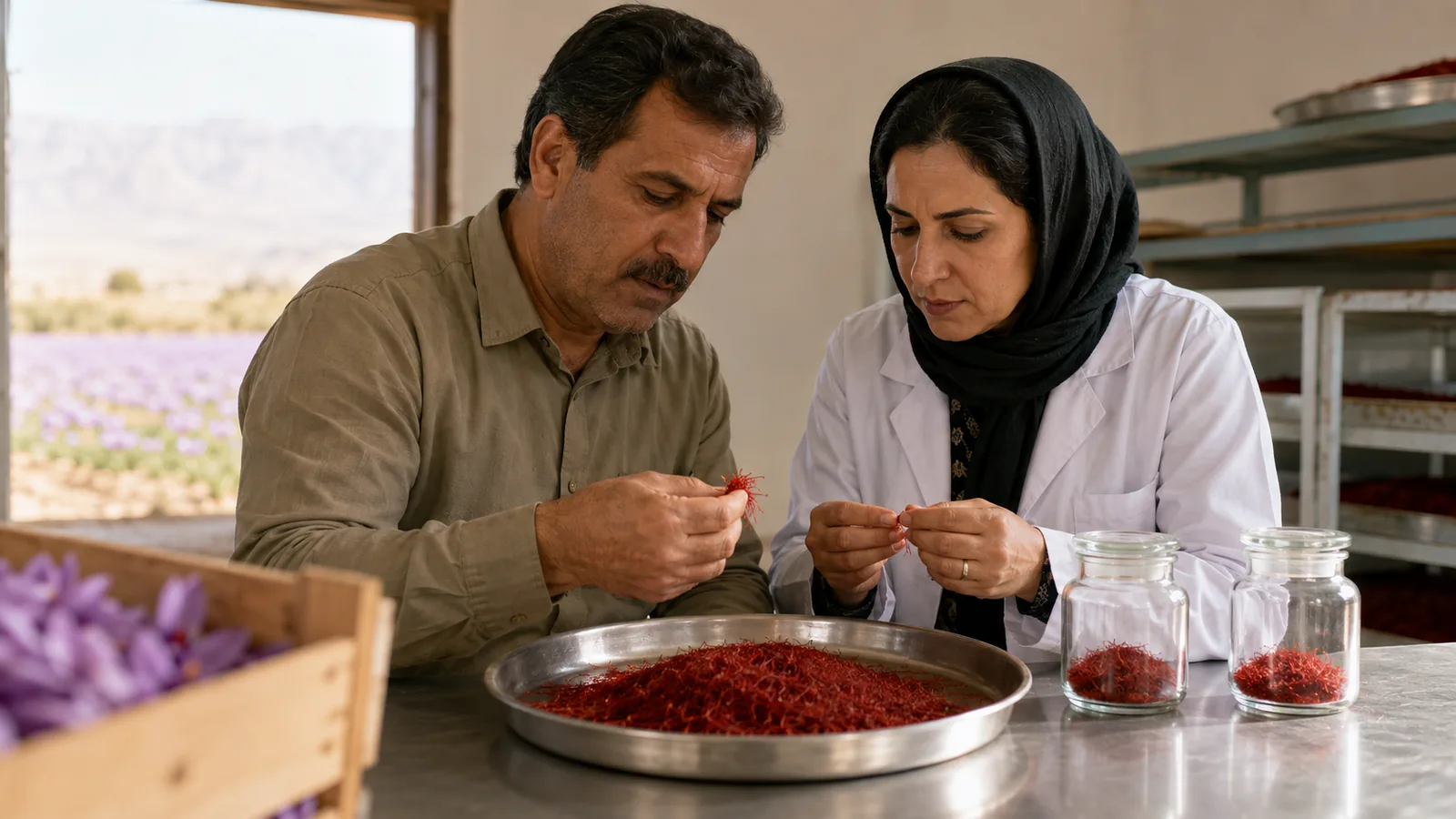
Is Iranian saffron losing its identity?
That question needs a calmer answer than the headline suggests. Saffron cultivation is expanding in several countries, but another country’s lawful production does not erase Iran’s crop or heritage. Identity is weakened when a buyer cannot verify where a lot was grown, who processed it or whether the contents match the label.
Iranian saffron has a history measured in millennia. The earlier version of this article used a precise figure of more than 3,500 years without naming an archaeological or historical source, so that number should be treated as a traditional estimate rather than an exact starting date.
Iran still leads world saffron production
The old claim that Iran produced more than 94 percent of the world’s saffron was widely repeated in earlier market reports, but a global share changes with crop year, weather and the estimates used for countries where production data are incomplete.
Current FAO reporting still places Iran first. A November 2025 FAO account of Iran’s saffron value chain put the country’s share at about 85–90 percent. A separate FAO release in September used “more than 90 percent.” The small difference is a reason to date and source a percentage, not evidence that Iranian production is disappearing.
What Iranian saffron identity includes
Origin is one part of identity, but not the whole of it. A credible Iranian lot should connect its field and harvest to processing, testing, packing and sale. That record lets a buyer distinguish genuine origin from a brand story added at the end.
The practical identity of a lot rests on:
- a truthful country and, where supportable, regional origin;
- a lot code that links grower, field or cooperative, harvest and processor;
- clean separation, controlled drying and suitable storage;
- representative quality and authenticity testing;
- an unbroken record when product changes hands; and
- packaging that does not imply a false place of production.
Why bulk export can hide value
Bulk trade is not inherently illegal or poor quality. It can be efficient for food manufacturers and packers. The identity problem begins when traceability is lost, the origin is removed, or a later seller makes a deceptive claim about where the saffron was grown.
A grower may then receive only the commodity price while another business captures the value of testing, grading, packaging and customer trust. The answer is not simply to put every gram into a small retail box. Iranian exporters need reliable specifications, food-safety controls, consistent supply and origin evidence that follows both bulk and retail lots.
The Nima currency-system concern
The earlier article said exporters were burdened by returning foreign currency through Iran’s Nima system and that this encouraged saffron to leave through unofficial routes. It supplied no date, exchange rule, rate comparison, exporter data or official decision, so it cannot establish that chain of cause and effect.
Currency-return requirements can affect an exporter’s costs and timing, but rules change. Any current analysis should name the regulation, effective period and difference between the official and realizable export rate. Without those fields, the Nima claim remains a record of industry concern, not a present-day fact or a measure of smuggling.
Tariffs in China and India need exact data
The same caution applies to the statement that high entry tariffs in China and India obstruct Iranian saffron. A tariff depends on destination, date, customs classification, product form, declared origin and any applicable trade arrangement. The original report gave none of those details.
Exporters should verify the current rate against the exact HS code and customs schedule before pricing a shipment. A general complaint cannot tell a business what duty it will pay, and it should not be used to explain changes in market share without trade data.
Unofficial trade and “suitcase saffron”
Officials quoted in the earlier account believed difficult formal exports had opened space for border smuggling, including saffron carried in suitcases. The page did not provide seizure records, customs comparisons or an estimated volume. It also mentioned saffron-onion or corm smuggling without documenting a case.
Unrecorded trade would make origin and safety harder to prove, but the scale cannot be inferred from an allegation. Useful monitoring compares production, declared exports, inventories, border seizures and destination-country imports over the same period. Planting-corm movements also raise plant-health and legal questions that are separate from spice exports.
Neighbouring production is competition, not extinction
More saffron acreage in Afghanistan and other neighbouring countries creates competition for growers and exporters. It does not make every competing lot Iranian or justify preventing another country from cultivating its own crop.
The old text also claimed Afghanistan had no domestic saffron consumption and only repackaged Iranian product for export. It offered no evidence, and the absolute statement is not credible. Afghanistan has its own saffron producers and export industry. A specific allegation of false origin would require lot-level trade, laboratory and chain-of-custody evidence.
Re-export itself is not proof of deception. A trader may legally import, test, pack and re-export saffron while accurately declaring its origin. Relabelling Iranian-grown saffron as grown elsewhere is a different matter and should be handled through truthful documentation and enforcement.
Geographical indications can protect origin
A geographical indication links a product’s reputation or characteristics to a place and gives eligible producers a framework for controlling the name. WIPO’s explanation of geographical indications makes clear that protection works when an origin-linked sign and its standards can distinguish conforming goods from others.
Iran also has national geographical-indication legislation. The Iranian law recorded by WIPO Lex provides remedies against false or deceptive attribution of geographical origin. A legal right is useful, but it still needs producer organization, defined specifications, verification and enforcement in the markets where protection is sought.
Testing protects authenticity, not geography by itself
Quality tests can measure characteristics such as colour strength, flavour-related compounds, moisture and foreign matter. Authenticity work can also identify adulteration. A laboratory result alone may not prove the precise field of origin unless the method is validated for that purpose and supported by reference data and records.
In 2025, FAO and Mashhad University of Medical Sciences began work on stronger saffron authenticity testing and post-harvest guidance. FAO described adulteration and inconsistent handling as risks to value and trust. That is a more concrete identity programme than relying on production share alone.
How Iranian producers can keep recognition
Production leadership is a strong foundation, but it does not automatically create a recognized retail origin. Growers, cooperatives, processors and exporters can protect more value by agreeing on lot records, drying and storage controls, representative sampling, transparent grades and labels that say exactly where the crop was grown.
Export strategy also needs current market evidence. Formal channels should be workable, but claims about currency rules, tariffs, illicit flows or foreign relabelling must be dated and measurable. Unsupported accusations weaken credibility when the purpose is to strengthen it.
What buyers should look for
A buyer who wants Iranian saffron should ask for the declared country and region of cultivation, harvest or crop year, lot number, processor or packer, testing basis and a traceable commercial document. Packaging location should not be confused with growing origin.
Iranian saffron is not at the edge of agricultural extinction. Its more realistic challenge is preserving a clear connection between the farmer, the land and the product that reaches the customer. That connection survives through evidence—not through a percentage or a flag on a box.

![Exporting Saffron to Turkey + Price Guide [Complete 0 to 100]](https://img.rowhanisaffron.com/20260827003933/saffron-export-turkey-quality-inspection.webp)



