


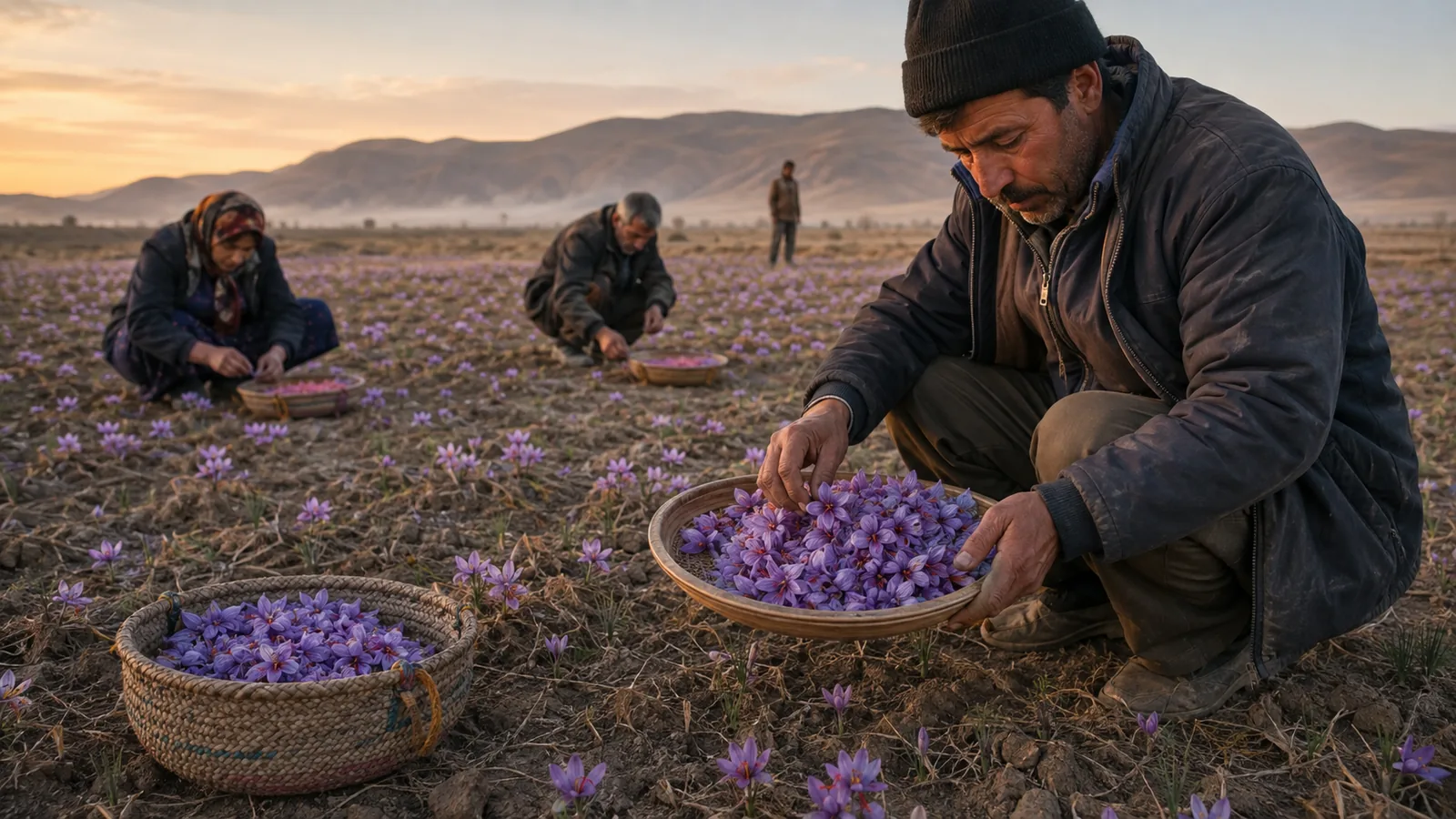
A historical agricultural report recorded the production of 360 kg of dried saffron in Marand city and valued that crop at 14 billion rials. It also described the work of 250 growers, the pressure created by intermediaries and the local need for stronger processing, packaging and producer organisation.
What the 360-kilogram figure represents
The headline figure equals 0.36 tonnes of dried saffron. Rahimzadeh, identified as the head of Marand’s Agricultural Jihad office, presented it as the city or county’s output for the period covered by the original statement.
The article does not preserve a clear harvest year, planted area or average yield for that 360-kilogram crop. It should therefore be read as a historical production snapshot, not Marand’s current annual output.
The reported value of the crop
Rahimzadeh valued the dried saffron at 14 billion rials. Divided by 360 kilograms, that gives an implied average of about 38.9 million rials per kilogram. This is only an arithmetic check: individual lots may have received different prices according to grade, moisture, cleanliness, thread form and the point in the season when they were sold.
Historical nominal values should not be used as present quotations. The rial amount belongs to the original report’s market and currency conditions, and the page does not state whether it was a farm-gate estimate, wholesale value or realised sales total.
About 250 saffron growers
The report associated approximately 250 farmers with saffron production in Marand. For a labour-intensive crop, the economic reach extends beyond field owners to seasonal flower pickers, stigma separators, dryers, traders, packers and transport providers.
That employment number is also historical. It should not be added to newer workforce figures unless both sources define “farmer,” “worker” and “beneficiary” in the same way.
Why intermediaries were a concern
Rahimzadeh described intermediaries as a serious problem for the local saffron sector. His concern was that weak producer organisations and a lack of processing and packaging centres left individual growers with limited bargaining power at harvest, when flowers and freshly separated stigmas require quick handling.
An intermediary is not inherently harmful. Aggregation, transport, financing and finding buyers are real services. The risk arises when grading is opaque, farmers have too few alternatives, origin is obscured or the margin bears no clear relationship to the service provided.
Bulk sales and loss of origin identity
The old statement said Marand saffron could leave the area in bulk through domestic channels or markets around the Persian Gulf and Europe, including Spain. Rahimzadeh argued that some Iranian product was then sold internationally under another country’s name.
That allegation remains attributed to him because the page provides no shipment records with which to verify it. The underlying origin issue is valid: repacking must not create a false geographical claim. Traceable lots, truthful labels and documented custody help protect both growers and buyers.
Why local processing and packaging matter
Rahimzadeh called for saffron processing centres in Marand. A well-run local facility can give growers access to controlled drying, hygienic handling, representative sampling, grading, sealed storage and packaging that protects saffron from moisture, light and contamination.
A facility adds value only if its procedures are consistent. Decorative boxes cannot compensate for poor drying or an untested lot. Useful infrastructure should make quality easier to measure, preserve and explain to the next buyer.
Marand’s later growth in saffron
Official reports from later, identified years show that production expanded beyond the old 360-kilogram snapshot. In 2020, East Azerbaijan’s agricultural authority reported more than 800 kilograms from 195 hectares in Marand, ranking the county first in the province by saffron area and output.
A 2023 county account later described more than 230 hectares and about 1,200 kilograms a year. These figures belong to separate seasons and should be compared as dated evidence, not blended into one average.
Recent scale and changing yields
A still later provincial report for Iranian year 1404 placed Marand at 263 hectares and 1,900 kilograms of saffron, again first in East Azerbaijan. That combination implies roughly 7.2 kilograms per hectare, close to the report’s seven-kilogram provincial average.
Different reports may count planted and bearing land differently, and a forecast is not the same as a final harvest. Drought, field age and selection of the reporting period also affect the apparent yield. The later records are evidence of Marand’s continuing importance, not a reason to rewrite the old headline as 1,900 kilograms.
Where Marand is located
The historical article describes Marand County as covering 3,286 square kilometres and places it about 60 kilometres from Tabriz. It identifies Jolfa to the north, Varzeqan to the east, West Azerbaijan Province to the west and Shabestar to the south.
This north-western setting distinguishes Marand’s saffron story from the much larger fields of Khorasan. Local climate, altitude and farm structure shape the timing and performance of the crop, so production advice should be based on Marand conditions rather than transferred automatically from another province.
A practical route to retaining more value
The old report’s proposed solution was local processing. In practice, retaining value also requires grower training, transparent grades, batch records, moisture control, testing where appropriate, collective negotiation and buyers who recognise verifiable origin.
Producer groups can make those services affordable without forcing every small farm to build its own facility. The aim is not simply to remove every intermediary, but to give growers clear choices and ensure each step in the chain performs a useful, visible function.
How to read the Marand figures
The production of 360 kg of dried saffron, its reported 14-billion-rial value and the 250-grower estimate belong to Rahimzadeh’s historical account. The concern about bulk sales and origin loss is also his attributed assessment, not a verified finding about every trader.
Later official figures show a county whose saffron area and output increased substantially. Keeping each report tied to its year preserves both parts of the story: the earlier constraints that growers faced and Marand’s subsequent rise as East Azerbaijan’s leading saffron-producing county.

![Exporting Saffron to Turkey + Price Guide [Complete 0 to 100]](https://img.rowhanisaffron.com/20260827003933/saffron-export-turkey-quality-inspection.webp)



