


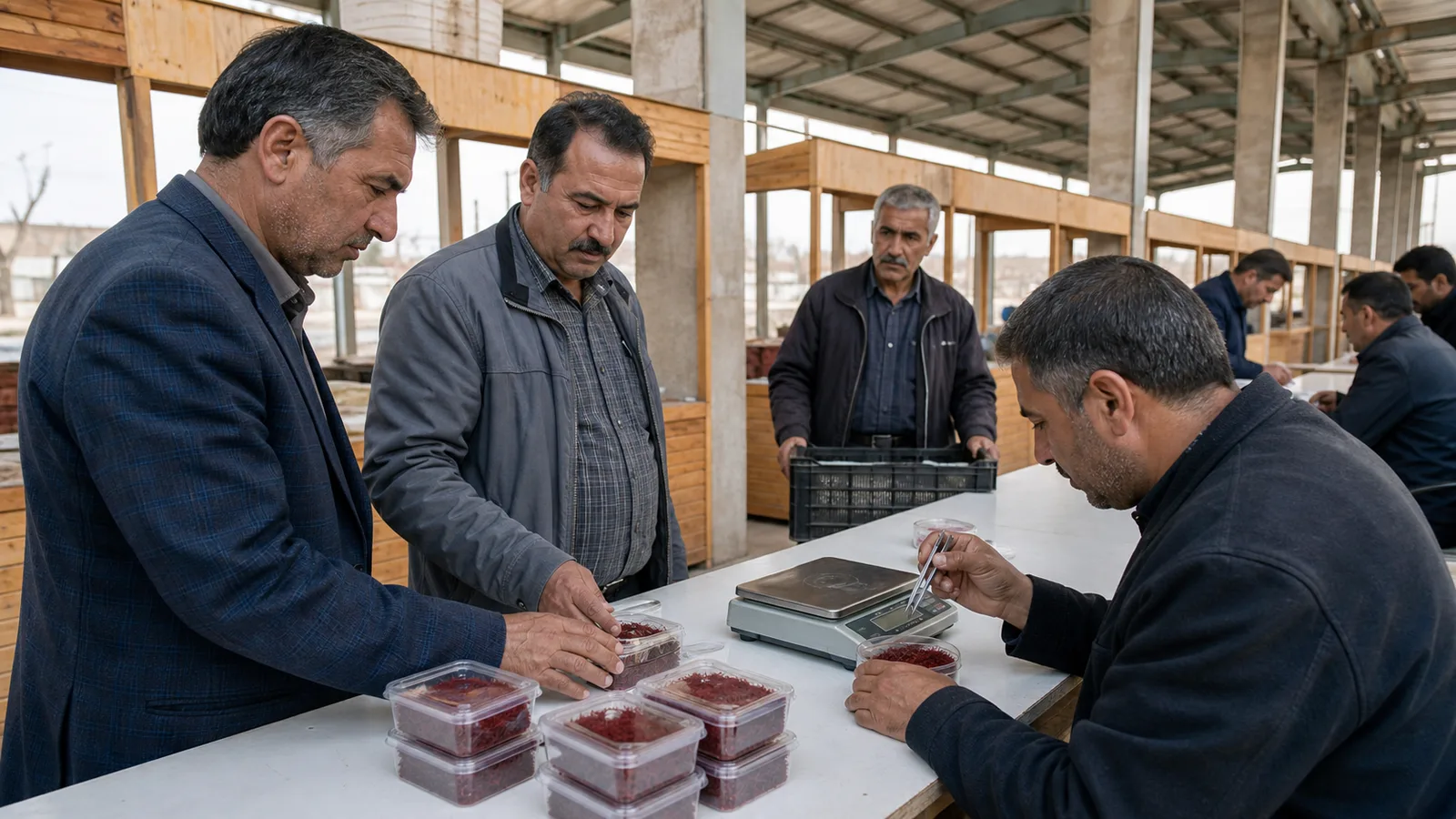
North Khorasan’s saffron policy changed sharply between two period reports. An earlier horticulture director said the province did not want to expand beyond 633 hectares because good land was needed for wheat, barley and sugar beet. A later Agricultural Jihad head reported 4,200 hectares, about 20 tonnes of production and a plan for a specialized market, grading laboratories and licensed packing centres.
The reports are not dated clearly enough to turn either set of figures into current statistics. Read together, they document a shift from limiting acreage to managing the market and processing problems created after cultivation expanded.
The earlier no-expansion position
Mohammad Ali Sharikian, identified as director of horticulture for North Khorasan’s Agricultural Jihad organization, said the province had strong potential for saffron but did not want its best land diverted from strategic crops. His concern was the crop mix: expanding a high-value spice could compete with land used for staples and sugar beet.
At that time, the report listed 633 hectares of saffron:
- 540 hectares described as productive;
- 93 hectares described as not yet productive;
- average yield reported at 4.8 kilograms per hectare;
- previous production reported at about three tonnes;
- a 10% production increase forecast for the next harvest.
The figures are broadly compatible. Multiplying 540 productive hectares by 4.8 kilograms gives about 2.6 tonnes, close to the rounded three-tonne total. The forecast was still only a forecast, and “productive” does not mean every field yielded the average.
The sales figure does not reconcile
The same translated report says growers sold saffron worth 270 million rials. That value is not credible alongside roughly three tonnes unless a unit, multiplier or scope was lost in translation. It is preserved here as a known data problem, not repeated as reliable farm revenue.
The later report: 4,200 hectares and 20 tonnes
Abdullah Yousefi, later identified as head of the provincial Agricultural Jihad organization, said saffron area had increased from 550 to 4,200 hectares. The 550-hectare starting point is close to the earlier 540 productive hectares, but the reports do not establish that the figures use exactly the same year or definition.
The increase is more than sevenfold from the stated 550-hectare baseline. Yousefi also put average provincial production at about 20 tonnes. If 4,200 hectares were all harvested, that implies roughly 4.8 kilograms per hectare—almost the same yield reported in the earlier account. That arithmetic supports internal consistency, but it does not verify the underlying statistics.
Why North Khorasan planned a specialized saffron market
Yousefi said prices had fallen sharply in the previous season and that a specialized market had been approved with help from the cooperatives’ union. The plan was to sell saffron through dedicated booths rather than the fragmented method described by the translated headline as “single sale.”
The original wording is ambiguous. It may refer to loose, ungraded or individual selling rather than a ban on retail sales. The practical measures in the report make the aim clearer: bring lots into one organized venue, test grades and create a more visible route between growers and buyers.
What a market booth can and cannot fix
A shared market can lower the time growers spend finding buyers and make comparable offers easier to see. It cannot prevent price falls when supply exceeds demand, buyers are concentrated or quality varies. The market also needs written lot identity, accurate weights, fair access and a way to resolve grading disputes.
Grading laboratories and packing licences
The later plan included equipping specialized laboratories to test saffron during harvest. Testing can help separate lots by measurable characteristics and identify material that does not meet a buyer’s specification. The current international specification is ISO 3632-1:2025, covering dried saffron in filament, cut-filament and powder forms. A laboratory report must still identify the actual lot and method used; it is not a permanent certificate for every product from the same grower.
Yousefi said about six saffron packaging centres had been licensed. A licence is evidence of authorization at a particular stage, not proof that all six centres were operating, buying significant volumes or meeting every destination-market requirement. Useful follow-up data would include operating status, throughput, test failures and the price difference between graded packed saffron and ungraded bulk material.
The missing processing layer
Despite the saffron expansion, Yousefi said North Khorasan remained weak in medicinal-plant processing. The province reportedly had one processing unit, and part of its output lacked the required health licence. He connected that weakness to marketing and called for contract farming.
Contract farming can coordinate variety, quality, delivery and price terms before harvest, but only when the agreement is understandable and enforceable. Growers need to know how grade is measured, who bears rejection risk, when they are paid and whether the buyer must take the agreed quantity.
What changed—and what still needed proof
The early policy tried to protect land for strategic crops. The later policy accepted that saffron area had already expanded and turned toward market organization, grading and packing. Those positions are not necessarily contradictory: a province can stop encouraging more hectares while improving the value chain for the hectares already planted.
The strongest measure of progress would combine both concerns. Track saffron area without displacing essential crops, then report productive area, yield, water use, grade, processing volume and farmgate price by year. A booth count or a licence count alone cannot show whether North Khorasan growers gained a more stable market.

![Exporting Saffron to Turkey + Price Guide [Complete 0 to 100]](https://img.rowhanisaffron.com/20260827003933/saffron-export-turkey-quality-inspection.webp)



