


Khalilabad saffron yield fell by as much as 30% in the historical season covered by this report. Local officials linked the decline to sustained winter cold, low rainfall in February and March, and higher summer temperatures. Harvesting still began across 4,000 hectares, with production forecast at about 11 tons. A related report from nearby Bajestan recorded an even steeper 60% fall, showing that the weather shock was regional but did not affect every district equally.
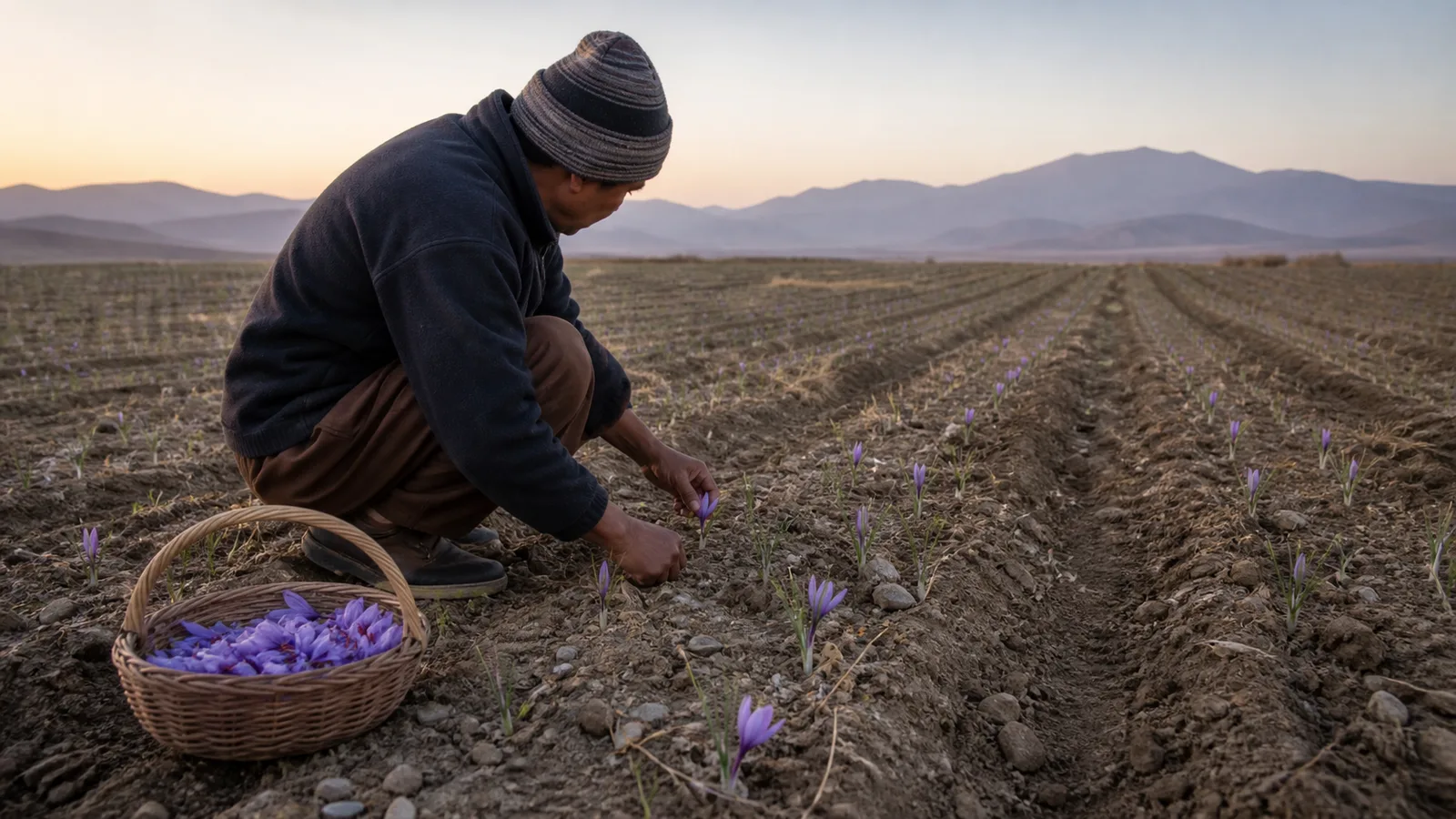
Why Khalilabad saffron yield fell 30%
Manouchehr Ahmadnejad, then director of the Khalilabad Agricultural Jihad office, described a difficult sequence for saffron farms: a prolonged sharp drop in winter temperature, reduced rainfall during late winter, and hotter conditions in summer. He said the combined stress cut farm yield by up to 30% compared with the previous year.
The wording matters. The report describes a reduction of “up to” 30%, not a uniform loss on every farm. Differences in elevation, irrigation timing, soil, corm condition, and the stage of plant growth can make neighboring fields respond differently to the same weather.
What the 4,000-hectare and 11-ton figures show
Khalilabad’s harvest covered about 4,000 hectares, and officials forecast roughly 11 tons of dried saffron. Dividing those two rounded figures gives an implied average of about 2.75 kilograms per hectare, assuming all reported land was productive. It is a useful scale indicator, not a precise measured yield for every field.
Cultivated area, yield per hectare, and final production are different measures. A district may maintain the same planted area while harvesting less because each hectare produces fewer flowers or fewer usable stigmas. Our overview of saffron production statistics provides broader context for reading those figures without combining unlike reporting periods.
Bajestan’s harvest fell by 60%
The related Bajestan report described a sharper decline. Seyed Mohsen Fakhr Kazemi, then director of the city’s Agricultural Jihad office, said production from 2,283 hectares was about 60% lower. He primarily attributed the loss to a temperature drop in the final months of the preceding year.
The Khalilabad and Bajestan percentages should not be added or averaged. They describe separate local harvests, different planted areas, and potentially different field conditions. Together they show the range of damage reported across this part of Khorasan: serious losses in Khalilabad and a substantially deeper fall in Bajestan.
The Mazdeh training and monitoring pilot
Khalilabad’s response included a joint pilot with the United Nations Industrial Development Organization (UNIDO) in Mazdeh village. According to Ahmadnejad, an agricultural specialist helped supervise saffron planting and field maintenance while training classes were offered to growers.
The purpose was practical: improve field decisions before the next harvest rather than treat production loss as a weather problem alone. The local office also reported regular farm visits focused on corm quality, corm disinfection, and crop management.
The historical article says 400 tons of chemical fertilizer were distributed and names post-harvest urea and potassium chloride use. Those details should not be read as a universal application rate or a recommendation for another farm. Fertilizer choice and quantity depend on soil testing, irrigation water, field history, and qualified local advice. The durable point is that officials paired material support with field inspection and grower training.
Harvest labor was another constraint
The Khalilabad report estimated about 200 person-days of work per hectare during the production and harvest stages. “Person-days” is the sensible reading of the translated statement: it describes the combined labor required over time, not 200 people working simultaneously on each hectare.
Saffron has a short picking window. Flowers are collected early, then stigmas must be separated and dried promptly. A weather-reduced crop may lower total output, but farms still need enough trained workers during the days when flowers open. Labor planning therefore remains important even in a poor-yield season.
Bajestan had packaging capacity but sought more processing
Three saffron packaging workshops were operating in Bajestan at the time of its report. The local agricultural office also invited investment in processing, recognizing that a valuable crop creates more local benefit when cleaning, drying, grading, packaging, and quality control can be carried out close to production.
Packaging workshops do not prevent frost or drought losses, but they can reduce post-harvest waste and help protect quality in the saffron that is successfully harvested. That makes processing capacity part of resilience, not simply a marketing concern.
What the two harvest reports establish
These reports are historical snapshots rather than current production forecasts. They establish that Khalilabad expected about 11 tons from 4,000 hectares after a yield decline of up to 30%, while Bajestan reported a 60% reduction across 2,283 hectares. Both accounts connected the loss to temperature stress, with Khalilabad also citing low late-winter rainfall and summer heat.
They also show how the region responded: monitored cultivation in Mazdeh, grower training, farm visits, attention to corm quality, and calls for additional processing investment. Weather caused the immediate setback, but careful field management and strong post-harvest infrastructure determined how well each district could recover and protect the crop that remained.

![Exporting Saffron to Turkey + Price Guide [Complete 0 to 100]](https://img.rowhanisaffron.com/20260827003933/saffron-export-turkey-quality-inspection.webp)



