Saffron is effective in treating eye diseases is too broad a claim. Saffron has been studied as a supplement in a few specific retinal conditions, especially age-related macular degeneration (AMD), but it has not been proved to treat eye diseases as a group. It does not correct refractive error, strengthen “weak eye muscles,” reverse cataracts or replace treatment from an eye-care professional.
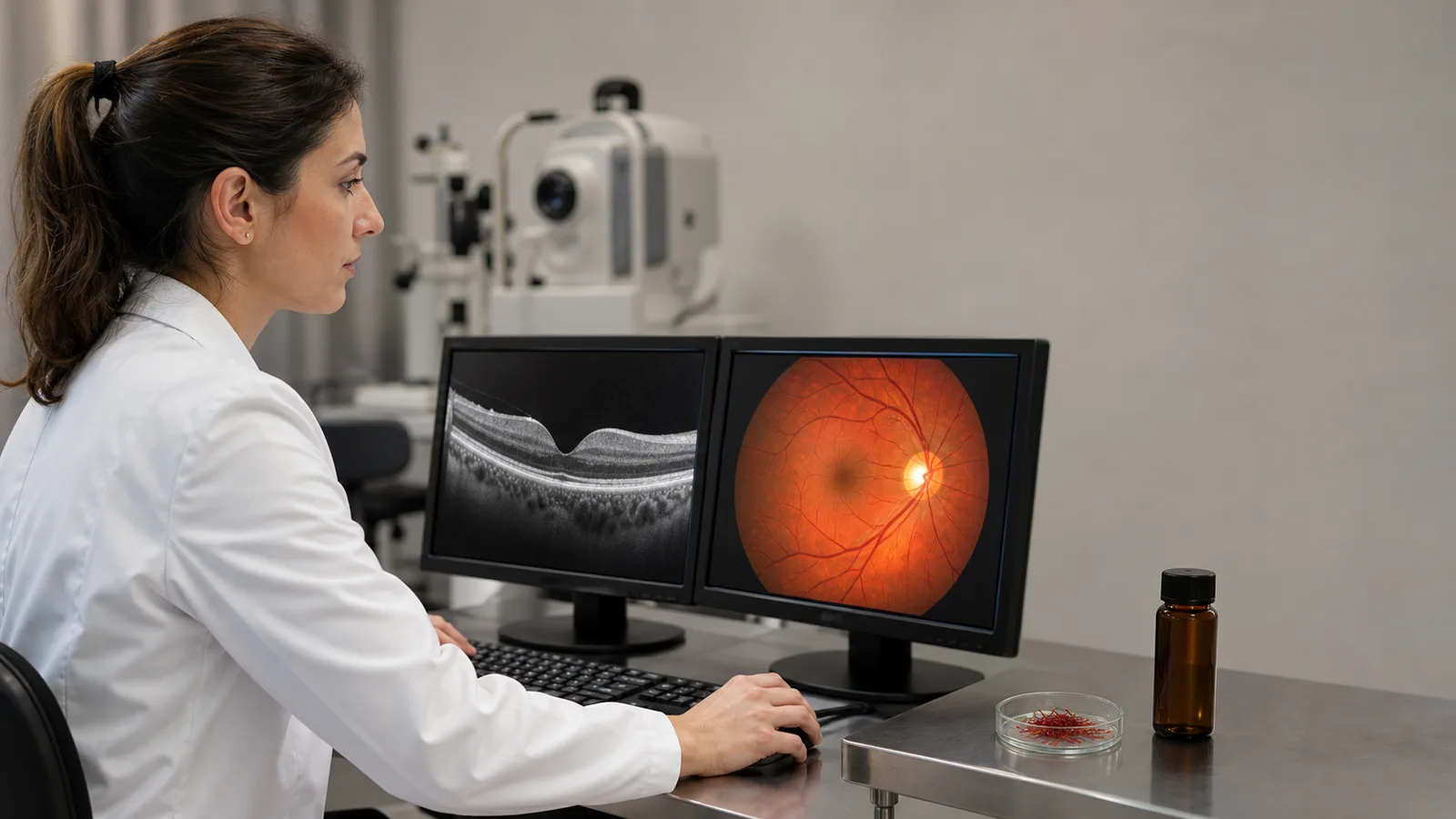
The most useful way to read the research is to separate a culinary spice from a standardised supplement, and a small change in a study measurement from a meaningful improvement in everyday sight.
What researchers have actually tested
Most human research has focused on AMD, a disease of the macula that can blur central vision. The trials used measured saffron preparations under clinical supervision. They did not test ordinary servings of saffron in food, and their results cannot be applied automatically to glaucoma, cataracts, diabetic retinopathy, infection or general poor eyesight.
A 2018 randomised, double-blind crossover trial enrolled 100 adults over 50 with mild or moderate AMD. Participants took a 20 mg saffron supplement or placebo for three months, then crossed to the other treatment. Compared with placebo, saffron was associated with an average improvement of 0.69 letters on a best-corrected visual-acuity chart and small changes in one retinal electrical measurement. The published trial called the effect modest and said longer-term study was needed.
That result is statistically interesting, but less than one letter on an eye chart is not evidence that saffron restores normal sight. The trial was short, and many participants continued their existing Age-Related Eye Disease Study (AREDS) supplements.
A separate six-month randomised trial studied 60 people with wet or dry AMD using 30 mg of saffron a day. Some electroretinography changes appeared at three months, but several were not sustained at six months, and an anatomical retinal measurement did not significantly improve in the dry-AMD group. The study’s mixed findings support more research, not a general treatment claim.
Saffron has also been tested in a pilot crossover study of 31 people with ABCA4-related Stargardt disease. The authors said their findings warranted longer trials. A small pilot in one inherited retinal condition cannot be extended to ordinary age-related vision loss or to other eye diseases.
What established AMD guidance says
The U.S. National Eye Institute (NEI) recommends the AREDS2 formula for certain people with intermediate AMD or late AMD in one eye. AREDS2 contains specific amounts of vitamin C, vitamin E, zinc, copper, lutein and zeaxanthin. It does not contain saffron.
Even AREDS2 is not suitable for everyone and does not prevent early AMD from becoming intermediate AMD. The NEI advises people to discuss supplements and medicines with their doctor because high-dose ingredients can carry risks or interact with other medicines. Its official AREDS2 guidance explains which stages may benefit.
This distinction matters. Evidence for one defined formula, in a defined stage of one disease, does not validate every antioxidant supplement. A person with AMD should not replace examinations, injections for wet AMD or an ophthalmologist’s treatment plan with saffron.
Why the antioxidant explanation is not enough
Saffron contains crocins, crocetin and other compounds that have antioxidant and anti-inflammatory activity in laboratory experiments. Researchers have proposed that these compounds may affect oxidative stress, inflammation or retinal signalling. A plausible mechanism helps justify a trial; it does not prove that a product prevents disease in people.
The original article said saffron strengthens the eye muscles and that regular use improves vision in old age. The cited research does not establish either claim. AMD is a retinal disease, not simply a problem of weak eye muscles. “Poor eyesight” can result from many causes, and each requires a proper diagnosis.
New distortion, a dark or empty area in central vision, sudden vision loss, flashes, a sudden increase in floaters or eye pain should prompt professional assessment. Trying a spice or supplement first can delay time-sensitive care.
Food saffron and a saffron supplement are not the same exposure
A small amount of saffron used to flavour food is different from taking 20 or 30 mg of a standardised preparation every day. Extracts can vary in crocin and safranal content, purity and dose. Products may also be adulterated or may not match the preparation used in a published trial.
Do not copy a research dose without medical advice. People who are pregnant or breastfeeding, children, people taking medicines and anyone managing an eye or other medical condition need individual guidance. A 2026 systematic review of saffron safety found that it was generally tolerated in clinical studies, but adverse events occurred and the authors recommended clinical monitoring for higher-dose or prolonged medicinal use (PMID 42057871).
What happened to the article’s other health claims
The original text attributed a long list of effects to Leila Shoorvarzi, described as a nutrition expert at the Neishabour School of Medical Sciences and Health Services. It said saffron treats Alzheimer’s disease, menstrual disorders, osteoarthritis pain, fatigue, depression, asthma, insomnia, pertussis, abdominal pain, kidney stones, gum pain and heart disease; “purifies the blood”; improves blood flow and memory; and lowers bad cholesterol. It also linked premenstrual and depressive symptoms to serotonin.
Some of those topics have been explored in small trials or reviews, while others reflect traditional use. They cannot be combined into evidence that saffron treats all of those conditions. A 2021 evidence map of 19 saffron meta-analyses found signals for some outcomes, including depressive symptoms, cognition and several metabolic measures, but also found heterogeneous results and shortcomings in the quality of the reviews. Its conclusion called for larger, high-quality trials in multiple countries (PMID 34419735).
Traditional use can be recorded as history, but it is not clinical proof. None of these claims should encourage a reader to stop prescribed treatment, and they do not belong as supporting evidence for an article about eyesight.
The liver-cancer paragraph also needs limits
The archived article described research in mice in which saffron appeared to affect apoptosis, inflammation and cell proliferation in chemically induced liver cancer. Mouse or cell findings are preclinical; they do not show that saffron prevents or treats hepatocellular carcinoma (HCC) in people.
The article also called HCC the fifth most common cancer and the third leading cause of cancer death. Global rankings change by dataset and year. Current U.S. National Cancer Institute guidance says liver cancer was the sixth most common cancer and third leading cause of cancer death worldwide in 2022. It lists chronic hepatitis B, chronic hepatitis C, cirrhosis, heavy alcohol use, aflatoxin exposure, fatty liver-related disease, smoking and certain inherited conditions among the recognised risks. Iron overload caused by untreated hereditary hemochromatosis is another recognised risk; ordinary dietary iron is not equivalent to that condition. The NCI risk guidance does not recommend saffron as prevention or treatment.
The careful conclusion
Small clinical trials suggest that standardised saffron supplements may influence some visual or retinal-function measurements in selected people with AMD. The effects reported so far are modest, trial sizes are limited and the results do not cover most eye diseases.
So the accurate answer is not “saffron treats eye disease.” It is that saffron is an experimental supplement of interest in a narrow part of retinal research. Diagnosis, established AMD guidance and professional eye care come first.