


The headline “125 kg of saffron was harvested in Hamedan province” preserves an early production figure, but the surviving report beneath it does not show when or how that total was measured. Its area, water and local-history details can still be read carefully, then compared with a later official snapshot.
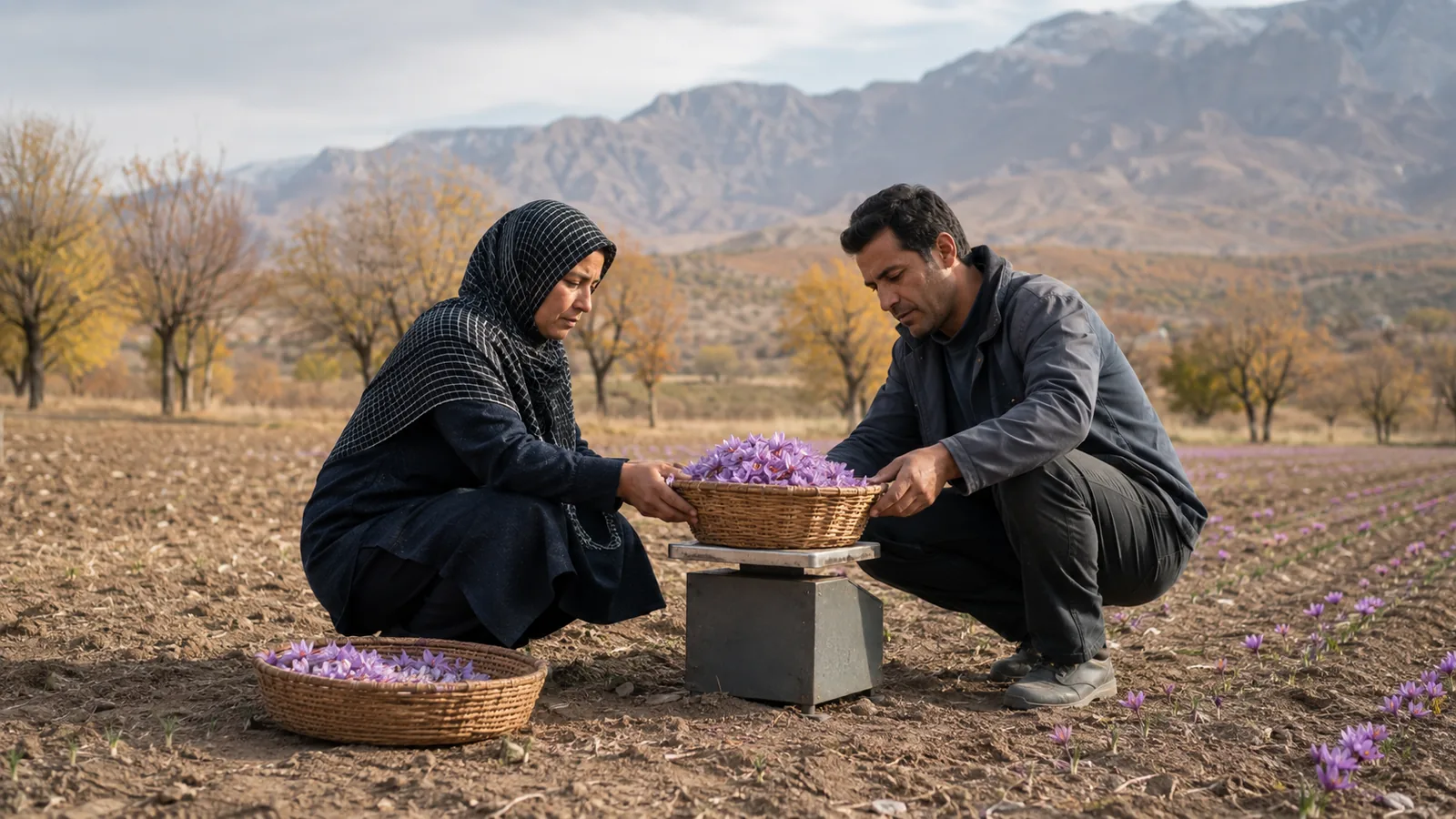
What is known about the 125-kilogram headline
The stored article carries a definite 125-kilogram harvest in its title, yet its body does not repeat that number. It gives no crop year, final weigh-in, harvested area for the 125 kilograms, district breakdown or source document that would allow the total to be checked.
For that reason, 125 kilograms should remain an attributed historical headline, not be converted into a yield or presented as Hamedan’s current production. Dividing it by 32 or 40 hectares would assume that the title and the body describe the same season and area, which the source never establishes.
The body recorded renewed interest in saffron
A deputy horticulture official from the Hamedan Agricultural Jihad Organization, identified by the surname Bayat, said cultivation had increased again during the previous four years. The province had reportedly planted 32 hectares in the preceding year and expected the area to reach 40 hectares in the current year.
Malayer accounted for 15 hectares of the stated total. These are planted-area figures, not confirmed productive area. Young fields and mature fields should be separated when harvest performance is compared because their flowering potential can differ markedly.
Rudavar has a documented saffron history
Bayat described Rudavar, in the Tuyserkan area, as an early centre of saffron cultivation and trade. The translation then says the city later became a village, but does not identify the historical period or administrative change.
Medieval geographic writing does support Rudavar’s reputation for abundant saffron. A modern academic study of trade routes, drawing on Istakhri and Ibn Hawqal, describes saffron from Rudavar in the Hamedan region being carried to other areas. The historical trade-route study supports regional continuity; it does not prove that cultivated saffron originated only in Hamedan. The crop’s ultimate origin is a broader and still-debated question.
Why cultivation had previously declined
The old account said saffron once occupied more land but was replaced by other profitable crops because it required substantial domestic labour. The wording is awkward, yet the practical issue is clear: flower picking and stigma separation are concentrated into a short period and rely heavily on available workers.
A crop can use less irrigation than a summer alternative and still be labour-intensive. Profit depends on field establishment, the speed and cost of harvest, drying losses, grade and the price received. No cost or labour record accompanied the old Hamedan figures, so the article cannot decide which competing crop was more profitable.
The irrigation wording needs precision
Bayat referred to two irrigation stages, one in late September and another in October, and gave an annual water figure of 3,000 cubic metres. The English source called these “waterlogging irrigation,” but prolonged waterlogging can harm corms; the likely meaning is a substantial first and second seasonal irrigation.
The report did not state clearly whether 3,000 cubic metres applied per hectare, per farm or to another unit. It should therefore not be used as a universal irrigation prescription. Soil texture, rainfall, field age, planting depth and local weather determine how much water a particular field needs and whether drainage is adequate.
Climate suitability varies within Hamedan
A later GIS study used 20 years of rainfall, temperature, sunshine and freezing data, together with soil, slope and elevation. Its Hamedan saffron-suitability assessment identified the strongest potential mainly in southern and eastern areas, including Malayer, Nahavand, Tuyserkan, Asadabad, eastern Hamedan and Qahavand.
That finding fits the old references to Tuyserkan and Malayer, but it is a zoning result rather than a guarantee for every plot. Frost exposure, drainage, corm health and timely moisture still need field-level assessment.
How growers were invited to seek support
The official said the provincial organization had no special credit line dedicated to expanding saffron. Prospective growers could nevertheless submit applications as agricultural-sector development plans and seek facilities available through that route.
An application process does not establish that finance was approved or that planting was technically suitable. A sound development proposal would need a realistic site assessment, water source, corm plan, labour schedule, drying capacity, budget and route to market.
A later official snapshot recorded 63 hectares
An IANA report from Hamedan, dated to Iranian year 1394, recorded more than 63 hectares under saffron. Hojatollah Shahbazi said Malayer then had the largest county area at 23 hectares, while Asadabad had 500 square metres.
The later report gave an average yield of 3.8 kilograms per hectare and mentioned finance intended to encourage lower-water cropping. It did not repeat the 125-kilogram total. Its 63-hectare area and yield belong to that later dated snapshot and should not be used to reconstruct the missing arithmetic behind the earlier headline.
What a reliable provincial series would include
To compare seasons, Hamedan reporting would need the crop year, total planted and productive area, young-field area, final dry harvest and yield by county. It should define the water figure’s unit, record labour in person-days and separate forecasts from measured totals.
Rudavar’s historical significance, the early 32-to-40-hectare expansion and the later 63-hectare report each answer a different question. Keeping those layers separate produces a more accurate picture than forcing them into one continuous statistic.
How to read the Hamedan harvest record
The 125-kilogram title is part of the site’s historical record, but its supporting date and calculation are missing. The article body more securely records 32 planted hectares, a forecast of 40, Malayer’s 15-hectare share, two autumn irrigation stages, a stated 3,000-cubic-metre water figure and a development-application route.
Later evidence confirms that saffron area expanded and that Malayer remained central to production. It also reinforces the need to date every figure. The strongest conclusion is not a reconstructed 125-kilogram yield, but a documented revival of saffron cultivation in a province with both medieval history and modern agronomic potential.

![Exporting Saffron to Turkey + Price Guide [Complete 0 to 100]](https://img.rowhanisaffron.com/20260827003933/saffron-export-turkey-quality-inspection.webp)



