


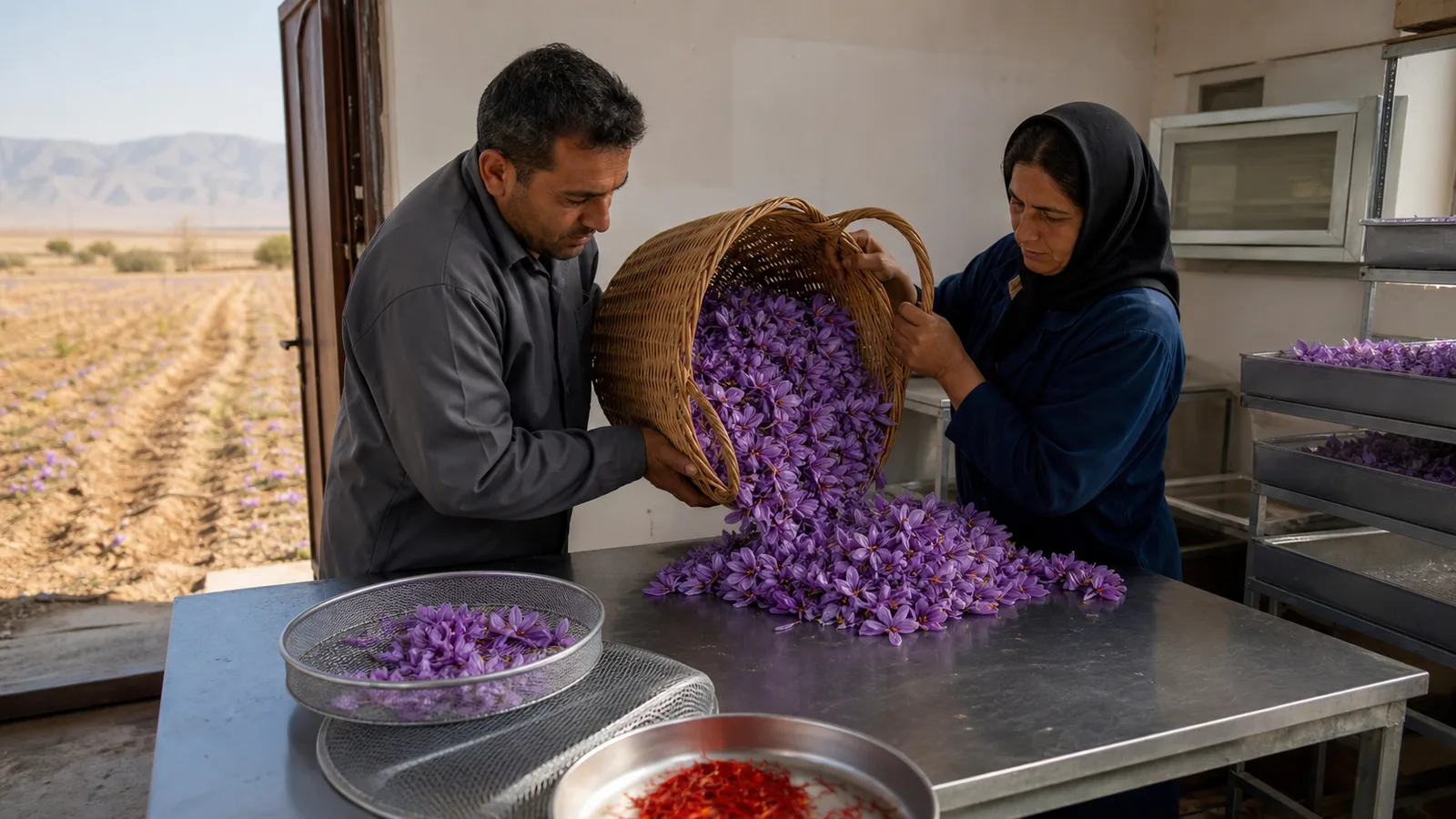
A historical agricultural forecast put dried saffron production in Ghainat at 14,000 kilograms from 4,067 hectares. The report also recorded lower output pressure from drought and falling groundwater levels. A separate account from Taybad, in neighbouring Khorasan Razavi, shows how another eastern Iranian production area was approaching the same harvest period.
Both accounts are dated regional reports, not current crop forecasts. Their value is in showing the scale, local constraints and post-harvest support reported at the time.
The 14,000-kilogram Ghainat forecast
Mohsen Raufi announced the forecast during a harvest event at a sample farm in Aliabad village. The 14,000-kilogram estimate and 4,067-hectare area imply an average near 3.4 kilograms of dried saffron per hectare if both numbers used the same land and output basis. Actual farms can vary substantially, and the article did not publish a final measured total.
The projected crop was valued at approximately 308 billion rials in that reporting year. This is a historical nominal value. It should not be converted into a current saffron price without the date’s exchange rate, grade mix, sales level and inflation context.
Raufi said consecutive droughts and a lack of timely rain during winter and April had reduced production compared with the previous year. He identified limited irrigation water and declining groundwater aquifers as the leading problem for local growers.
Support for harvest and processing in Ghainat
The local agricultural authority reported distributing 320 kilograms of micronutrient fertiliser, 375 sieves and 92 flower-harvest baskets. It also said training on planting, harvesting and processing reached 1,800 saffron workers.
Those figures document the programme’s scale, but they do not by themselves demonstrate higher yield or quality. Inputs need an agronomic basis, while harvest equipment and training need consistent field use. For buyers, the relevant evidence remains the condition, traceability and test results of the finished lot.
Ghainat lies in north-eastern South Khorasan. The original article described a 7,502-square-kilometre area near the Khorasan Razavi border, with Qaen on the route connecting Mashhad, Zahedan and Chabahar. That location links the producing area to regional transport, but distance to a road does not replace careful drying, packaging and storage.
Taybad’s 2,570-hectare harvest
In Taybad, agricultural director Hossein Elhamipour said harvesting had begun across 2,570 hectares. The source described the area entering harvest as 23 percent higher than in the previous crop year. It did not provide final dried-saffron output, so the percentage should not be treated as a 23 percent increase in harvested weight.
The Taybad authority reported supplying 350 tonnes of fertiliser and distributing 200 sieve trays and heaters for more hygienic drying. These quantities belong to that historical programme; they are not current recommendations for an individual farm.
Elhamipour listed shortages of both livestock manure and chemical fertiliser, reduced canal water and successive droughts among growers’ problems. The combination matters: expanding or maintaining cultivated area does not guarantee output when water and suitable inputs are constrained.
Organisation and packaging gaps in Taybad
The Taybad report said growers lacked a private-sector organisation and that the city had no local packaging facilities, despite an official claim that its saffron quality was desirable. A regional reputation still needs lot-specific evidence, but the organisational gap can have practical consequences.
A grower group or cooperative can coordinate training, shared equipment, lot separation and negotiations with processors. Local packaging may shorten the path from drying to protected storage. Neither automatically creates quality: poorly controlled packaging can trap moisture or mix lots, while a well-managed producer can use a qualified facility elsewhere.
Taybad is in eastern Khorasan Razavi near the Doqarun crossing with Afghanistan. That border position gives the region a trade context, but the archived article did not publish export volumes or prove that its crop moved through the crossing.
What the two regions have in common
Ghainat and Taybad differed in province, programme and reported scale, yet their constraints overlap:
- water availability after repeated drought;
- access to appropriate agricultural inputs;
- labour and clean equipment during the short harvest;
- controlled separation and drying of stigmas;
- lot protection, packaging and access to buyers;
- training and producer coordination.
The Ghainat article supplied a dried-output forecast; the Taybad article supplied harvested area but no final kilograms. A direct yield comparison would therefore be misleading. The correct comparison requires final dried weight, actual harvested hectares and matching crop-year data for both locations.
How regional production becomes saleable saffron
The harvested flower is only the beginning. Stigmas must be separated, dried and stored without contamination, excessive moisture or damage. Lots should remain identifiable rather than being mixed solely to reach a volume target.
ISO 3632-1:2025 covers dried saffron in filament, cut-filament and powder forms. It offers a common specification framework, while the buyer and supplier still need to agree on sampling, test evidence, packaging and acceptance criteria for the actual lot.
For broader context on the crop and product forms, see what Iranian saffron is. The historical Ghainat and Taybad figures explain local production conditions; current quality must be established from the saffron being offered now.
Reference: ISO 3632-1:2025 saffron specification. Regional quantities, programme details and attributed comments are retained from the two archived posts consolidated here.

![Exporting Saffron to Turkey + Price Guide [Complete 0 to 100]](https://img.rowhanisaffron.com/20260827003933/saffron-export-turkey-quality-inspection.webp)



