


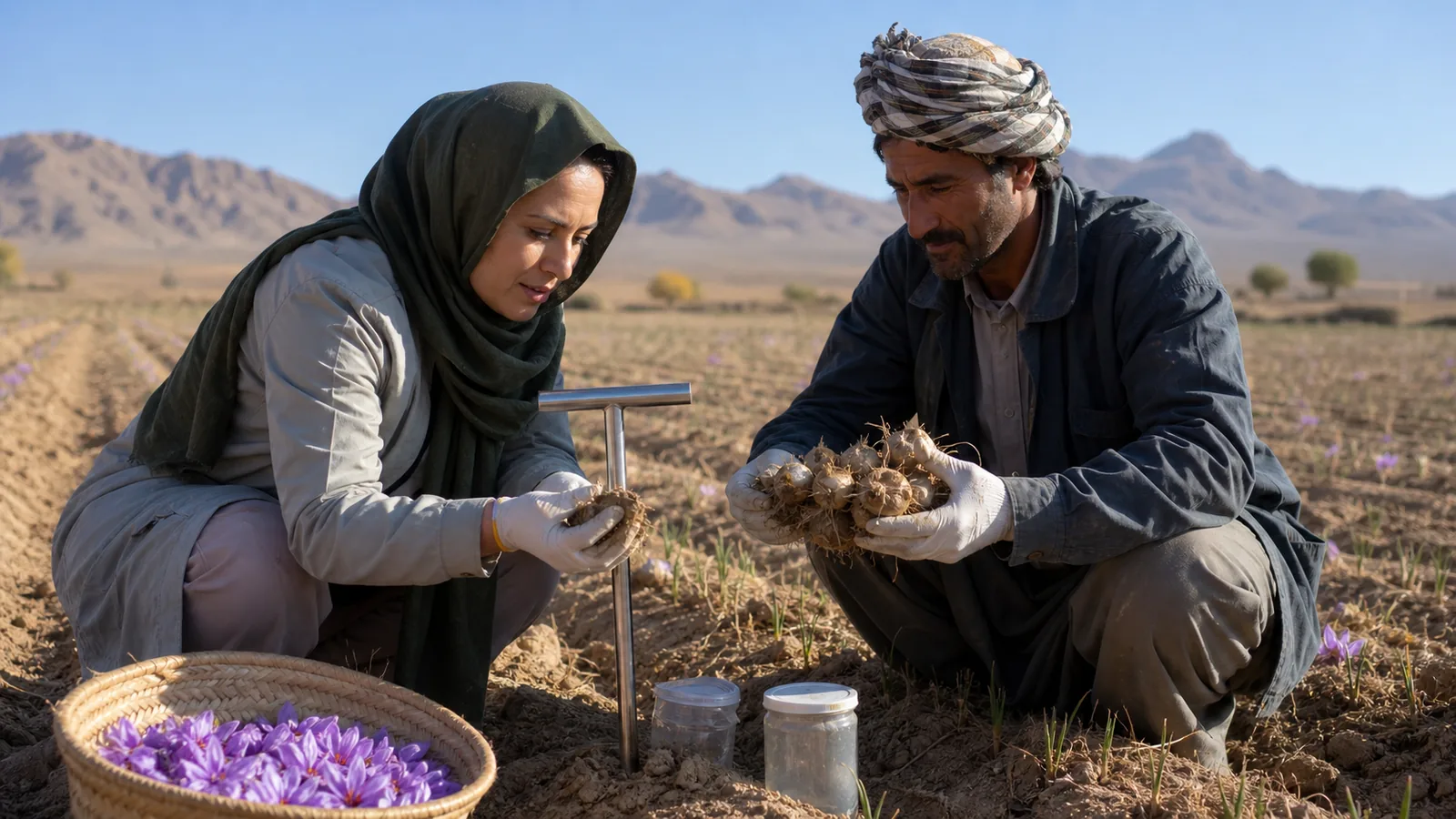
A saffron quality plan in Ghaenat was designed to move improvement from a general promise into five village-level projects. The archived announcement linked a local pilot to a wider Khorasan strategy: train growers, improve planting material and field decisions, record where and when each batch was produced, and pursue higher yield without simply expanding cultivated land under drought.
What the Ghaenat saffron plan announced
Mohsen Ehtesham, vice president of Iran’s National Saffron Council, announced that a project to improve the quality and identity of Iranian saffron would be implemented in five villages of Ghaenat. The article, republished in 2022, said a pilot had been carried out the previous year and described its results as successful enough to justify a wider rollout.
The saved report does not name the five villages, define the pilot sample, or publish before-and-after measurements. It also ends mid-sentence just as it begins to discuss production standards. The plan should therefore be reported for what the archive establishes—its scope, stated purpose, and intended expansion—without inventing results that were never supplied.
Quality and production are related, but not identical
More dried saffron per hectare can lower unit costs and improve farm income, but yield alone does not prove quality. A large crop can still be damaged by late picking, contaminated handling, poor drying, excess moisture, or weak storage. Conversely, a carefully handled batch is not automatically economical if the field produces too little.
A complete improvement plan therefore needs two sets of evidence:
- field performance, including corm health, plant density, inputs, water, labour, and dried yield per hectare; and
- finished-product performance, including traceable origin, clean processing, moisture control, authenticity, and defined laboratory tests.
The current ISO 3632-1:2025 specification applies to dried saffron in filament, cut-filament, and powder forms and includes storage and transport recommendations. It gives quality work a defined product context; a project still has to document how its own samples were collected and tested.
The parallel Khorasan yield strategy
A related provincial briefing quoted a plant-production deputy identified as Sarban. In response to drought and reduced water resources, he argued that growers should avoid expanding saffron area and instead raise average yield on existing land. The archived figures set a starting average of 3.5 kilograms per hectare and an ambitious target of eight to 10 kilograms.
That target was a programme objective, not a guaranteed result or a universal recommendation. Field age, corm condition, soil, climate, irrigation, disease pressure, and management all affect yield. Pushing one number without monitoring product quality, input cost, and water use could trade one problem for another. The sound principle is improvement per unit of land and water, verified under local conditions.
Better planting material, not just more planting
The provincial programme included saffron corm-propagation farms. The old English text sometimes calls the planting material “onions” or “seed,” but saffron is commercially propagated with corms. A propagation programme can help growers start with identifiable, suitable planting stock and reduce the temptation to expand fields using poorly documented material.
Healthy-looking corms still need correct handling, field preparation, and local agronomic advice. Growers seeking the broader crop cycle can read our guide to saffron cultivation and growing conditions. The Ghaenat plan’s contribution was to connect that field work to training and an identity record for the harvested product.
The identification code and what it was meant to record
After training, each participating farmer’s product was intended to receive an identification code based on quality indicators. The archived report said that code would record:
- the place of planting;
- the farmer’s name;
- the farm name;
- the harvest time; and
- the production or processing time.
Those fields create the beginnings of traceability. If a processor finds a problem, a batch can be connected to its origin and handling window instead of being treated as anonymous regional saffron. The code does not prove purity by itself; it becomes valuable when records are accurate, batches remain separated, and test results are linked to the same identity.
FAO’s 2025 agreement with Ferdowsi University of Mashhad similarly emphasizes laboratory verification and field-ready post-harvest guidance to protect saffron authenticity. That current work supports the direction of traceability while avoiding the unsupported claim that the old Ghaenat code alone completed the job.
Soil testing, inputs, mechanization, and insurance
The Khorasan briefing also listed soil-informed fertilizer provision, mechanization, insurance, facilities, and preparation of planting material. It said 18,500 soil studies had been carried out in the province. The archived sentence then breaks off while discussing a fertilizer quantity, so that incomplete number should not be repeated as a verified allocation.
Soil testing is useful when it changes a specific decision—what nutrient is deficient, whether an input is needed, and how much is appropriate for the field. Mechanization also needs a defined purpose. Equipment may improve land preparation, sorting, drying, or record consistency, but it should not be credited with better quality until the relevant output is measured. Insurance and accessible finance address a different need: helping growers manage production risk and adopt improvements without relying on one good harvest.
How success should be demonstrated
The Ghaenat announcement supplies a sound outline but too little result data for a final verdict. A credible follow-up would report participation by village, baseline and final yield, water and input use, cost per kilogram, rejected batches, drying conditions, test methods, traceability coverage, and the share sold under the identification system.
That is the practical meaning of improving saffron quality and production in Ghaenat: not expanding claims, but connecting the farm, the batch, the test, and the buyer. The archived project points in that direction. Transparent results are what would show how far it travelled.

![Exporting Saffron to Turkey + Price Guide [Complete 0 to 100]](https://img.rowhanisaffron.com/20260827003933/saffron-export-turkey-quality-inspection.webp)



