


Production of more than 400 kg of saffron in East Azerbaijan farms was forecast for the Iranian year 1391. The original agricultural notice gives a clear 135-hectare baseline, while a later provincial update shows how far the crop expanded after that early stage.
The 400-kilogram figure was a forecast for 1391
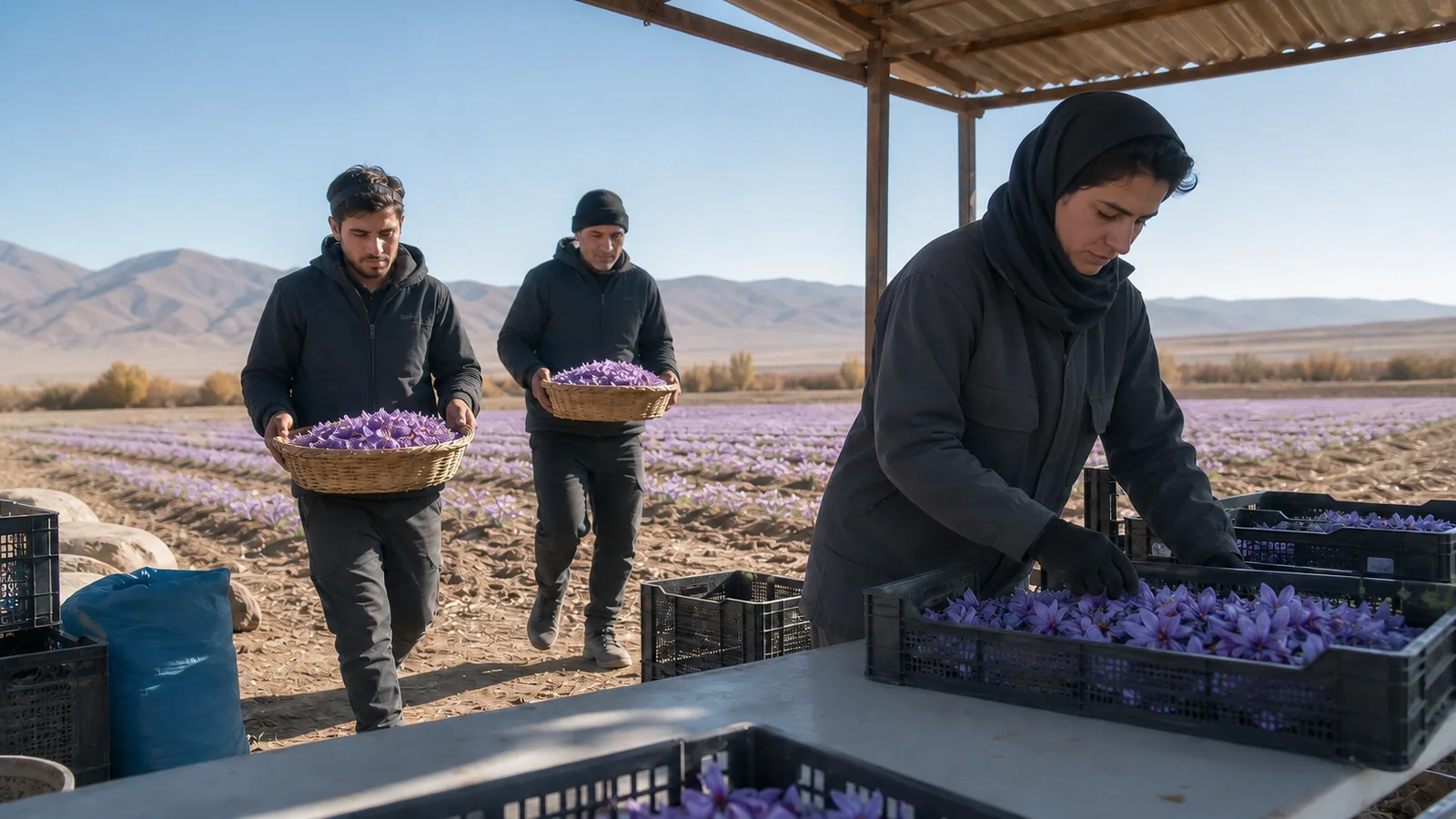
Sadollah Eskandari, then horticulture director of the East Azerbaijan Agricultural Jihad Organization, said more than 400 kilograms of saffron were expected from the province’s farms. The dated source was published on 1 Azar 1391 and attributed the information to the organization’s public-relations office.
This was a production forecast, not a laboratory-certified final harvest total. Keeping the year and the word “expected” beside the number prevents an old projection from being mistaken for current output.
The cultivated area was 135 hectares, not 1,035
The earlier English version of this article rendered the planted area as 1,035 hectares. The original IANA report says 135 hectares. It also states that 98 percent of that area consisted of productive farms.
The correction is material. A 400-kilogram forecast over 135 hectares implies roughly 3 kilograms per planted hectare, although the notice did not provide farm-level yields. Applying the same output to 1,035 hectares would create a very different and implausibly weak provincial average. The official figure should control.
Marand was the province’s main saffron centre
Eskandari said supported saffron production had begun in East Azerbaijan 15 years earlier with demonstration plots. By 1391, Marand County held more than 90 hectares and was described as the province’s most important production centre.
That history explains why the province was still discussing expansion into suitable arable land. Demonstration farms can establish whether a crop fits local soil, temperature and water conditions, but successful results at one site do not make every field suitable. The source said extension of the cultivation pattern to capable counties was an organizational priority.
Why a perennial saffron field appealed to planners
The notice presented saffron as a crop that could remain productive for roughly 10 to 12 years after establishment. A multi-year field avoids annual replanting, yet it is not maintenance-free. Corm health, planting density, weeds, soil condition, irrigation timing and daughter-corm crowding can alter performance as the stand ages.
It also highlighted employment and export value. Saffron requires concentrated labour during flower picking, stigma separation and drying, so its economic effect extends beyond cultivation. Whether it improves net farm income still depends on establishment costs, seasonal labour, grade, packaging and the price received.
Water use needs a careful comparison
Eskandari described saffron as having very low water demand and said its irrigation did not overlap with the main irrigation period of other orchard and field crops. The old notice also used an eightfold water-saving comparison per hectare. It did not name the comparison crop, irrigation method or measurement period, so eightfold should remain a reported programme claim rather than a universal agronomic ratio.
The practical advantage is timing as well as volume. Saffron’s active cycle and important irrigations occur mainly in the cooler part of the year. Even so, local rainfall, soil water-holding capacity and the condition of the field determine the actual schedule; “lower water use” never means a crop can be planted without a water plan.
Packaging and branding do not replace product quality
The 1391 report said more than 60 percent of Iran’s saffron production was exported and argued that better packaging and branding could retain more value in international markets. That percentage belongs to its historical context and should not be read as today’s export share.
Presentation matters once the spice itself is sound. Clean separation, controlled drying, protection from moisture and light, traceable lots and accurate labelling come first. The Codex standards register provides the international standard framework for dried saffron. A “high quality” description in a forecast is not a substitute for representative sampling and test results.
A later report shows substantial provincial growth
A more recent IANA update for Iranian year 1404 reported more than 448 hectares of saffron in East Azerbaijan and forecast approximately 3 tonnes despite drought conditions. It gave an average yield of 7 kilograms per hectare and identified Marand, Mianeh, Ahar and Azarshahr as the leading counties.
In that later East Azerbaijan production report, Marand alone accounted for 263 hectares and a reported 1,900 kilograms. The province represented 0.3 percent of national saffron area. Those figures should not be blended with the 1391 baseline: they measure a later, larger production system.
What the two snapshots reveal
The original 135-hectare figure and the later 448-hectare figure show expansion of more than threefold in planted area. Marand’s reported area rose from more than 90 hectares to 263 hectares. Production moved from an expected total above 400 kilograms to a forecast around 3 tonnes.
These are useful directional comparisons, but they are not a continuous annual series. Weather, field age and reporting methods may differ. A rigorous trend record would list final harvested weight, productive versus young area, average yield, rainfall and tested grade for every crop year.
How to read the East Azerbaijan milestone
The more-than-400-kilogram headline captures an early stage of commercial saffron production in East Azerbaijan. Its correct base is 135 hectares, 98 percent described as productive, with Marand contributing more than 90 hectares. It also records the province’s interest in multi-year cultivation, off-season irrigation, rural work and better market presentation.
The later figures do not make that announcement obsolete. They show what followed it. Read together and kept in their own years, the two official reports document the province’s movement from demonstration-led development toward a larger saffron sector.

![Exporting Saffron to Turkey + Price Guide [Complete 0 to 100]](https://img.rowhanisaffron.com/20260827003933/saffron-export-turkey-quality-inspection.webp)



