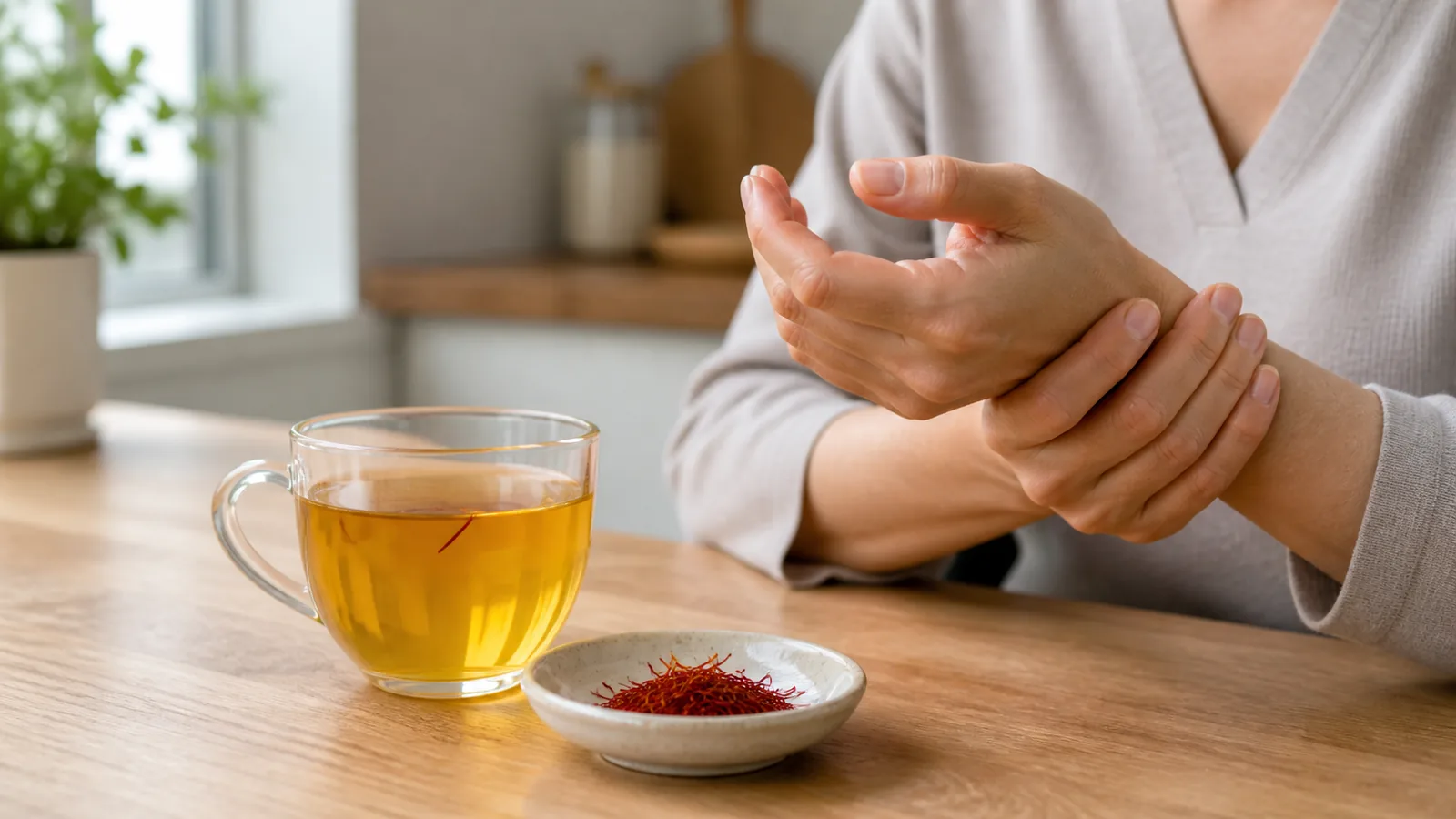
Saffron and its constituent crocin have produced encouraging results in memory research, but the evidence does not show that saffron cures memory impairment, Alzheimer’s disease or Parkinson’s disease. One study behind this article found that crocin improved performance in rats with experimentally induced memory problems. Small human trials have also reported possible cognitive benefits, although reviewers warn that the studies are too limited and potentially biased to establish saffron as a standard treatment.
This is medical research, not a reason to replace an evaluation, prescribed medicine or a neurologist’s advice with saffron tea or a supplement. Memory changes can have many causes, and timely diagnosis matters.
What the crocin memory study actually tested
Mohammad Javad Azmand and Ziba Rajaei of Isfahan University of Medical Sciences studied crocin in a laboratory model. Their paper, published in the Avicenna Journal of Phytomedicine, did not enrol people with Alzheimer’s disease. It used rats given lipopolysaccharide, or LPS, to create systemic inflammation and impair learning and memory.
The researchers treated groups of rats with crocin at 50 or 100 milligrams per kilogram of body weight. They then used a water-maze task to assess spatial learning and a passive-avoidance task to assess aversive memory.
Crocin-treated rats performed better on several behavioural measures: they found the hidden platform faster, spent more time in the target area during the probe test and delayed entering the dark compartment in the avoidance task. However, the study found no significant differences among groups in the measured oxidative and neuroinflammatory markers.
The result supports further research into crocin and memory pathways. It does not establish a human dose, prove an Alzheimer’s mechanism or show that eating saffron reverses memory loss. A dose expressed per kilogram in a rat experiment should never be converted into self-treatment instructions.
What human studies say about saffron and cognition
Human evidence exists, but it is still a small evidence base. A systematic review of randomized controlled trials found five eligible studies involving 325 people. Four studies enrolled participants with mild cognitive impairment or Alzheimer’s disease, and one enrolled cognitively healthy adults.
Across those trials, cognitive scores favoured saffron over placebo in some comparisons and did not differ significantly from donepezil or memantine in others. That sounds promising, but the reviewers explicitly called for larger, lower-bias trials before saffron’s role could be assessed with confidence. Similar test scores in a small trial do not make a supplement interchangeable with an approved medicine.
The US National Institute on Aging states that no vitamin or supplement has been proven to prevent Alzheimer’s disease or cognitive decline. Its treatment guidance also notes that approved therapies and symptom-management plans should be chosen with a healthcare professional. Saffron should be presented as an area of study, not as prevention or a cure.
Alzheimer’s disease and Parkinson’s disease are not the same claim
The older source post grouped Alzheimer’s and Parkinson’s together as “age-related brain disorders” and said saffron was effective in treating both. That wording is too strong.
Alzheimer’s trials have mostly measured cognitive and functional scales over relatively short periods. They have not shown that saffron stops the underlying disease. Parkinson’s research is even less settled. A recent 12-week randomized trial studied saffron as an add-on in 92 people with Parkinson’s and reported changes in several inflammatory, mood, cognitive and quality-of-life measures. It did not establish that saffron replaces Parkinson’s medication or slows neurodegeneration.
The Parkinson’s Foundation advises that evidence for herbs and supplements remains limited, products may vary in strength and purity, and people with Parkinson’s should discuss them with their clinician because of side effects and drug interactions.
What about depression and other traditional claims?
Saffron has also been investigated for depression, anxiety and sleep. A 2024 systematic review of clinical evidence found favourable results across some randomized trials, but the preparations, doses, conditions and study durations varied. Those findings do not justify telling a person to stop antidepressants or treat a new symptom without medical care.
The archived interview described saffron as “hot and dry” in traditional Iranian medicine and listed effects on digestion, appetite, circulation, kidney pain, cough, bronchitis, blood pressure, cholesterol, insomnia and other conditions. “Hot and dry” is a traditional classification, not a modern clinical measurement. The post supplied no study for most of those claims, so they should not be presented as established treatments.
A person with persistent low mood, confusion, tremor, sleep disruption or a decline in daily function needs an appropriate assessment. These symptoms are not specific to one condition, and delaying care while trying a food or supplement can carry real risk.
Which part of the plant is being studied?
Saffron comes from Crocus sativus, a perennial plant grown from a corm. The corm is often called a bulb in everyday language, but botanically it is a compact underground stem. Narrow leaves and purple flowers emerge seasonally, and each flower carries three red stigmas.
Those dried stigmas are the culinary spice. Research may use whole-saffron powder, a standardized extract or isolated constituents such as crocin. These are not automatically equivalent. A trial result depends on the identity, concentration, dose and quality of the tested preparation.
Saffron safety: food use is not supplement dosing
The tiny amount used to colour and flavour food is different from taking concentrated capsules, extracts or gram quantities. A 2026 systematic review of adverse events examined 102 clinical trials and one case report. Saffron was generally well tolerated, but reported effects were most often gastrointestinal, and the authors advised clinical monitoring for higher-dose or prolonged medicinal use.
The old interview stated that about 20 grams could be lethal. That figure must not be treated as a threshold below which self-dosing is safe. Toxicity depends on the preparation, amount, person and circumstances, and serious effects may occur at lower amounts. Suspected overdose requires urgent medical or poison-control advice.
Pregnancy deserves particular care. The source recommended avoiding saffron entirely, even though culinary use and medicinal dosing are not the same exposure. A 2026 evidence review found that safety data remain limited and linked higher doses or occupational exposure with uterine stimulation and miscarriage risk. Pregnant or breastfeeding people should not use saffron supplements or concentrated preparations without advice from their obstetric clinician.
Anyone taking medicines for a neurological condition, mood disorder, blood pressure, clotting or another chronic problem should check a saffron supplement with a pharmacist or physician first. Product labels do not resolve possible interactions or confirm that an extract matches the material used in a study.
The responsible conclusion
Crocin improved learning and memory performance in an LPS rat model. A small group of human trials has produced promising cognitive results, especially in mild cognitive impairment and Alzheimer’s disease. Neither finding proves that culinary saffron or an over-the-counter supplement can prevent, cure or replace treatment for a brain disorder.
The useful next step is better research: larger independent trials, clearly identified preparations, longer follow-up, prespecified outcomes and careful safety reporting. For an individual experiencing memory or movement changes, the useful next step is clinical assessment—not an experimental dose copied from a headline.