


“The city of Torbat-e Heydarieh is the center of saffron in the world” was Khorasan Razavi Governor Mohammad Sadegh Motamedian’s description during a county visit. It was a statement about the region’s economic identity, not a permanent audited world ranking for the municipal boundary.
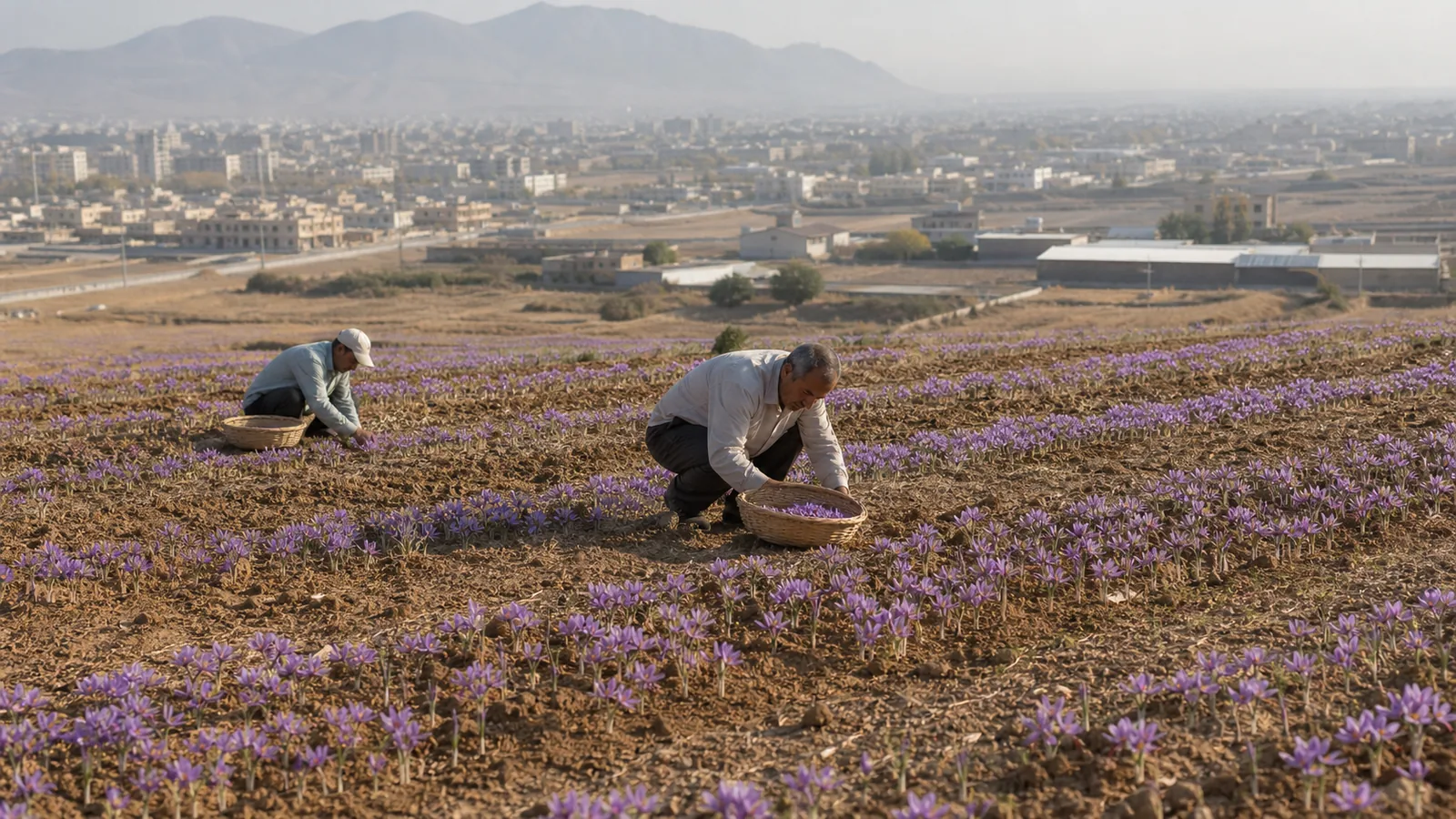
Why Torbat-e Heydarieh is called a saffron centre
Torbat-e Heydarieh sits within southern Khorasan Razavi’s dense belt of saffron farms, markets, processors and seasonal labour. Growers in the city’s surrounding county are also connected with production in neighbouring districts, so the local economy cannot be understood from a city map alone.
The title uses the spelling “Torbat-e Heydarieh,” while other English sources use Torbat-e Heydariyeh or Torbat Heydariyeh. They refer to the same place. Preserving that spelling in the title and URL matters, but a reader should not mistake a transliteration difference for a different saffron region.
An Iranian Agriculture News Agency account likewise described the Torbat-e Heydariyeh region as a major saffron producer and noted its role in Iran’s saffron warehousing and commodity trade. That supports the regional importance behind Motamedian’s phrase without turning it into a current city-only percentage.
The governor’s remarks came from a broader development meeting
Motamedian made the statement at a meeting summarising his trip to Torbat-e Heydarieh. His comments were not limited to saffron. He presented a profile of the area that included its history, horticulture, silk, livestock, industry and minerals.
He described Torbat-e Heydarieh as an old city with a historical background in several fields. He also praised its productive land and the hard work and religious character of its residents. These are the governor’s qualitative observations from the visit, not measurements that can be independently scored.
The old English copy has no event date or link to the original Persian speech. The claims therefore need to remain attached to Motamedian and that visit rather than being presented as live municipal statistics.
Saffron production involves more than cultivated hectares
Calling a place a production centre can refer to several things: planted area, dried-saffron output, number of growers, seasonal labour, local trading volume, processing capacity or influence on price discovery. The archived statement does not say which measure Motamedian used.
The distinction matters because saffron moves through a regional chain. Flowers may be grown in one county, separated or dried in another, traded in Torbat-e Heydarieh and packed for a buyer elsewhere. A claim about the “centre” can describe that concentration of activity even when no single municipal statistic captures the whole chain.
Production volume is also not the same as value retained locally. Drying quality, grading, laboratory evidence, traceability, packaging, storage and access to the final buyer determine how much value remains near the farm.
Horticulture was another stated advantage
Motamedian said Torbat-e Heydarieh held rankings in 23 horticultural products and called that variety a comparative advantage. The translation says “23 items of garden products,” which is better understood as 23 kinds of orchard or horticultural produce.
The source does not list the products, specify whether each rank was provincial or national, or give a year. The number should therefore stay as the governor’s historical statement. It should not be expanded into a list or current ranking without the underlying agricultural report.
Diversified farming can still be strategically useful. It spreads labour and income across more than one crop and gives local processors or traders a broader supply base. Saffron remains the identity highlighted in the title, but it was not the only agricultural capacity discussed.
Silk yarn and livestock were part of the same local economy
The governor also called Torbat-e Heydarieh a national centre for silk-yarn production. The wider county includes Bayg, long associated with silk reeling. A separate industry account cited by the Iranian Agriculture News Agency said more than 80 percent of the country’s silk was produced there at that reporting time.
The archived translation then calls the city one of the country’s “livestock docks.” That phrase is not natural English and appears to be a machine-translation error. In context, “livestock hub” or “livestock centre” is the safer meaning, but the Persian wording is unavailable. The article can preserve the economic point without repeating “dock” as a formal designation.
Silk, livestock and saffron rely on different production cycles, yet all connect rural work with city-based services, finance, processing and trade. Motamedian’s description was therefore of a mixed local economy rather than a single-crop settlement.
What the 64 industrial units represented
Turning to industry, Motamedian cited 64 industrial units and about 3,000 industrial jobs in Torbat-e Heydarieh. The post does not identify the units, define whether they were operating, or give a survey date.
Those figures should not be treated as a present-day factory census. As a historical snapshot, they show why the governor framed industry as one of the county’s advantages. The number of registered units alone also says little about output, capacity use, job stability or the connection between those businesses and saffron.
For the saffron economy, the most relevant industrial capacity is work that protects or adds value to the crop: hygienic separation and drying, testing, sorting, packaging, storage and product development. A factory count is useful only when the activities and performance behind it are known.
Mining was presented as a separate development path
Motamedian also described Torbat-e Heydarieh as one of Khorasan Razavi’s mineral hubs with rich deposits. He called for better identification of mineral capacity and referred to using organizations such as IMIDRO and SHASTA for studies, extraction and processing.
IMIDRO is Iran’s Mines and Mining Industries Development and Renovation Organization; SHASTA is the Social Security Investment Company. The old post gives no project names, deposit estimates, environmental assessment or investment commitment. It records a development proposal, not proof that a particular mine or processing plant followed.
Mining belongs in this article because it was part of the governor’s account of Torbat-e Heydarieh. It should not be folded into the saffron claim or used to imply that every proposed industrial opportunity was realised.
What gives a saffron centre lasting value
A large growing region earns lasting influence only when its product reaches buyers with consistent quality and a clear identity. In 2025, the Food and Agriculture Organization and Iranian partners focused on post-harvest handling, safety, traceability and marketing in the Iranian saffron value chain.
Those priorities are directly relevant to Torbat-e Heydarieh’s “centre” status. Field production brings the crop into existence; careful processing and credible documentation protect it; market access determines who captures the value.
The strongest version of the regional identity is therefore practical rather than ceremonial. Growers, workers, laboratories, warehouses, processors and traders have to function as one dependable chain.
How to read the headline today
The headline should be read as Mohammad Sadegh Motamedian’s historical description of Torbat-e Heydarieh’s position in the saffron economy. It is supported by the region’s long production and trading role, but it is not a current audited claim that the city boundary alone produces more saffron than every other place.
His wider message was that Torbat-e Heydarieh combined old roots with several economic strengths: saffron, horticulture, silk yarn, livestock, 64 industrial units, roughly 3,000 industrial jobs and mineral potential. Keeping those points together preserves the purpose of the original report while making clear which details are attributed, dated and still in need of current verification.

![Exporting Saffron to Turkey + Price Guide [Complete 0 to 100]](https://img.rowhanisaffron.com/20260827003933/saffron-export-turkey-quality-inspection.webp)



