


“Iranian saffron production will be halved in 2050” was a climate projection reported by Iman Babaeian of Iran’s Climatological Research Institute. It was not an observed production result or a guarantee of what will happen in a particular year.
What the 2050 claim actually says
Babaeian said global warming could reduce Iranian saffron production by more than 50 percent by 2050. The original account did not publish the crop baseline, climate model, emissions pathway, geographic coverage or assumptions about irrigation and farm adaptation behind that number.
Without those details, “more than 50 percent” should be read as an attributed scenario result. It signals a potentially serious risk, but it is not precise enough to forecast the tonnage Iran will harvest in 2050.
Temperature can affect saffron flowering and yield
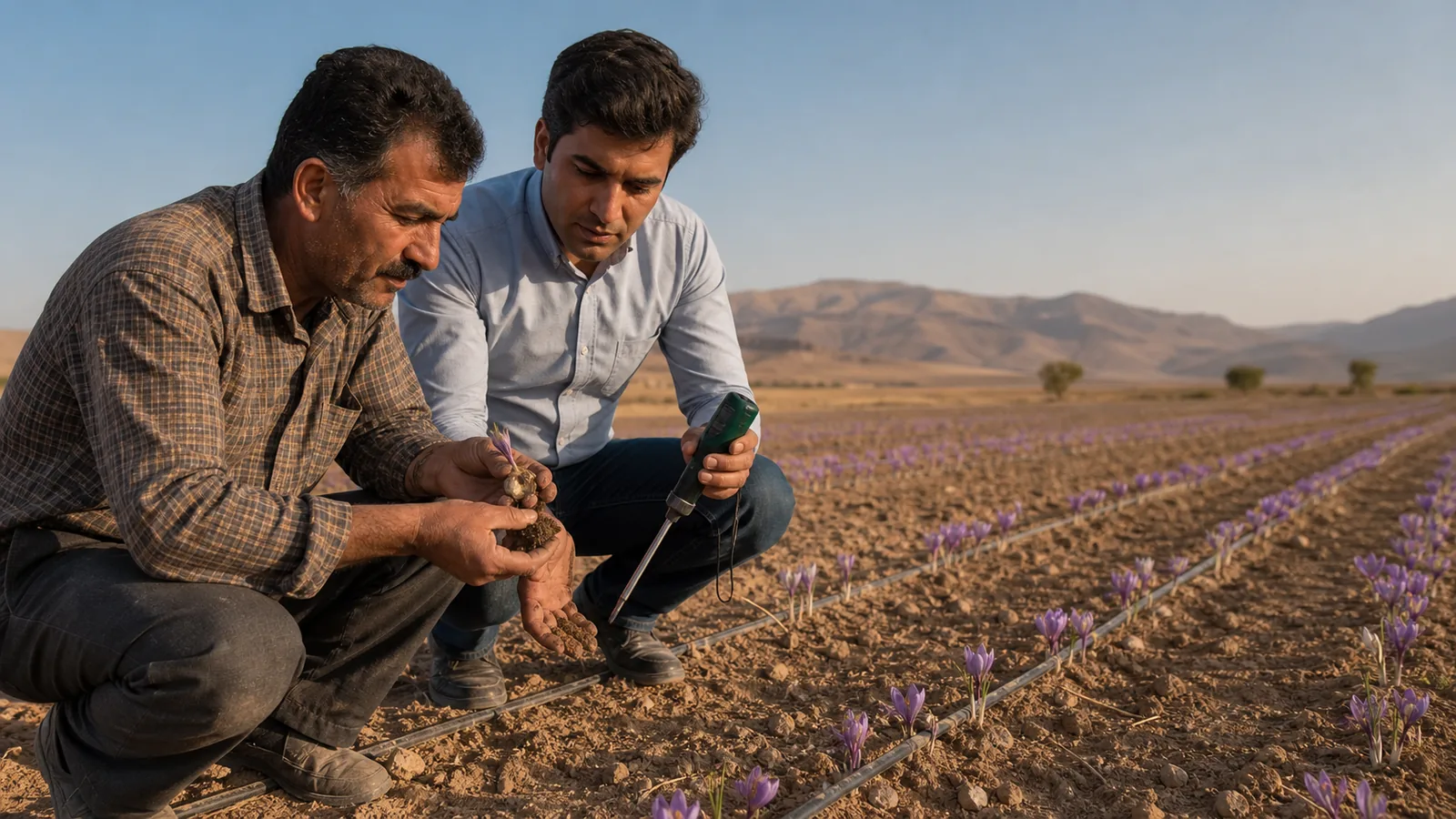
The mechanism behind the warning is credible even though the exact national percentage remains unverified. A 2023 Iranian field study examined saffron in 13 regions and found that climate, field age, soil, irrigation and management all influenced yield. Temperature was more strongly related to yield than precipitation, and cooler conditions before flowering were associated with higher output.
A science-society summary of that peer-reviewed research explains how the team combined field, satellite, climate, soil and irrigation data. The evidence supports concern about warming, but it also shows why a single climate variable cannot determine every farm’s future crop.
Less average rain can coexist with heavier downpours
The climatologist also expected heavier showers in parts of Iran while some regions receive less precipitation overall. Those statements are not necessarily contradictory: annual or seasonal rainfall can decline even as a larger share arrives in short, intense events.
For saffron, timing matters. Rain or irrigation before flowering may help the crop, while poorly timed heavy water can create drainage problems. A national statement about downpours therefore cannot be converted directly into a yield forecast for every saffron district.
The Zagros and Kashafrud projections were regional
Babaeian identified the Zagros as the Iranian region expected to experience the greatest temperature rise and the largest decline in precipitation. He said this made protection of the Zagros forests especially important.
For the Kashafrud basin in Razavi Khorasan, he projected a 7–19 percent reduction in rainfall. That basin is relevant to water conditions around Mashhad, but the reported range does not by itself measure water available to every saffron farm or prove a nationwide 50-percent production loss.
The Caspian statement also needs its time horizon
The report said wet areas associated with the Caspian region could shrink substantially by 2100 and that Iran’s dry areas could expand by 10 percent. The old English wording called this the “wetland of the Caspian Sea,” without defining the mapped area.
Both figures remain attributed projections for 2100, not descriptions of present conditions. They add context to the broader drying concern but are separate from the saffron estimate for 2050.
The Paris Agreement sentence was mistranslated
The original article confused greenhouse-gas emissions with temperature, saying there would be a “two-degree increase in greenhouse gas emissions by 2030.” Degrees measure warming, not emissions.
The official Paris Agreement explanation states the goal correctly: hold the increase in global average temperature well below 2°C above pre-industrial levels and pursue efforts to limit it to 1.5°C. These are temperature limits, not an emissions forecast for 2030.
Current policy does not put the world safely on that path
Babaeian’s broader point was that reported greenhouse-gas output was not aligned with the agreement and had continued to grow. The wording about perfect compliance still producing a two-degree rise was too imprecise to retain as a factual conclusion.
The IPCC’s Sixth Assessment mitigation summary gives a clearer comparison: without policies stronger than those implemented by the end of 2020, modelled emissions rise beyond 2025 and lead to a median 3.2°C of warming by 2100. That assessment is global and scenario-based; it does not validate the article’s specific saffron percentage.
How to read the risk to Iranian saffron
The headline should be treated as a warning attached to one reported projection, not a countdown to a fixed outcome. Warmer flowering periods, changing rainfall and water stress can put saffron at risk, while field age, soil, corm health, irrigation timing and management also shape production.
A defensible 2050 estimate would need a published baseline, named climate scenarios, regional crop models and transparent assumptions about adaptation. Until those details are available, the strongest conclusion is narrower: climate change presents a material risk to Iranian saffron, but the exact claim that production will be halved remains uncertain.

![Exporting Saffron to Turkey + Price Guide [Complete 0 to 100]](https://img.rowhanisaffron.com/20260827003933/saffron-export-turkey-quality-inspection.webp)



