


Production of 20 tons of saffron in Bakhrez city was the headline figure attached to an autumn crop forecast. The underlying report said local agriculture officials expected the harvest to approach 20 tonnes; it did not document a final, independently measured total of exactly 20 tonnes.
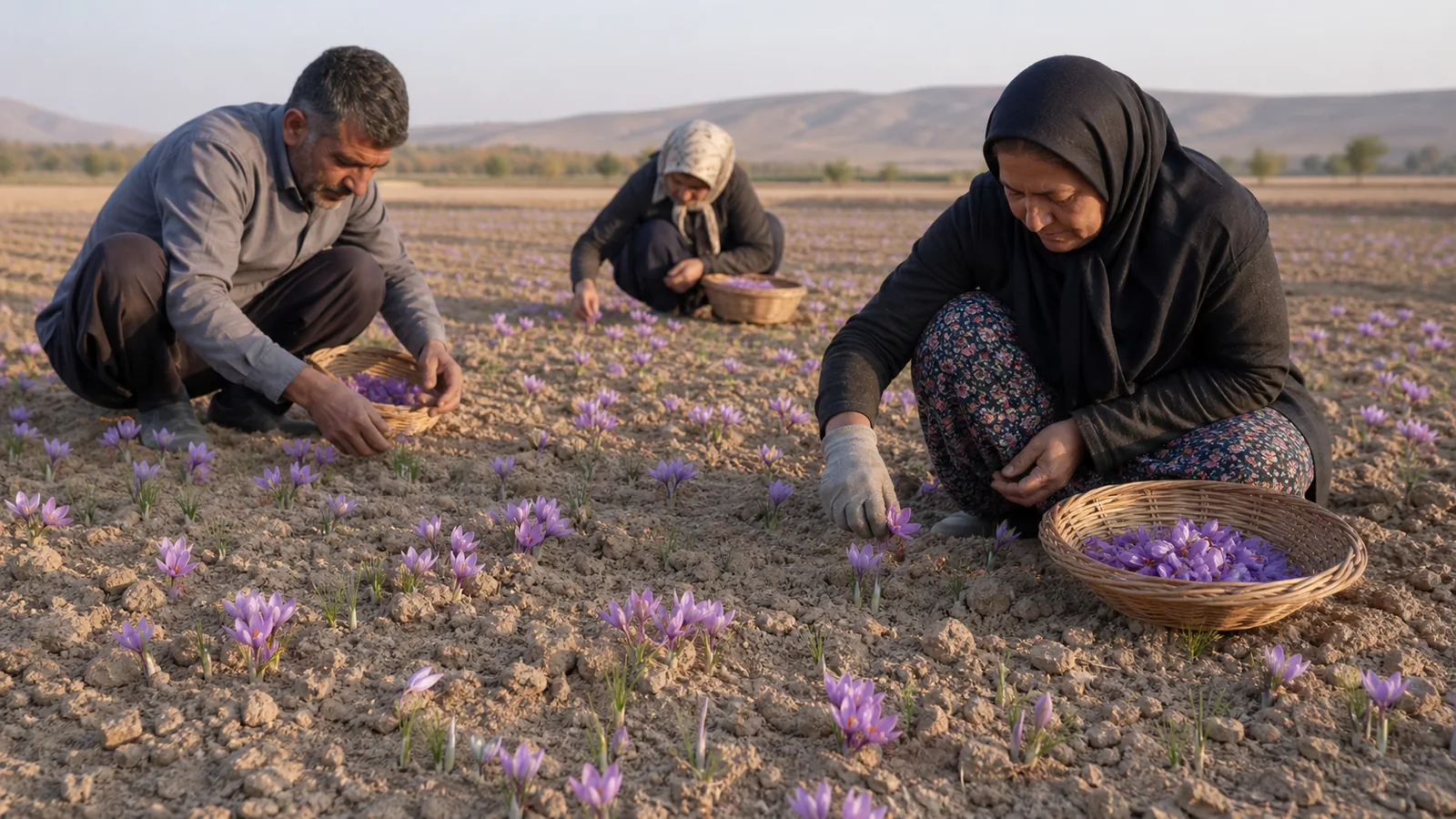
The 20-ton figure was a forecast
Mohammad Dostkhah Ahmadi, then director of the local Agricultural Jihad office, said Bakharz was expected to produce 20 tonnes of dried saffron in the current crop year. The place name is also transliterated as Bakhrez in the original English title.
The contemporary Khorasan newspaper report describes the number as a forecast. That matters because the old English article changed an anticipated result into a completed one. Keeping the 20-ton figure is useful, but it should not be presented as a certified final harvest without a closing production record.
Saffron area expanded to 4,500 hectares
Ahmadi said the area planted with saffron increased by 500 hectares to 4,500 hectares. He reported the change as 12 percent compared with the previous crop year. Calculated from a 4,000-hectare starting point, the increase is 12.5 percent, so the published percentage appears to have been rounded.
Of the 4,500 hectares, 4,000 were described as productive and 500 as not yet bearing a commercial crop. A surviving local record of the agriculture office’s figures also reports the 4,500-hectare total, 350 kilograms of fresh flowers per hectare, more than 18 tonnes of dried saffron and 8,000 beneficiary households. The productive/non-productive split is important because the original report did not give a separate yield estimate for the new fields.
The previous harvest exceeded 18 tonnes
The most internally consistent figure in the report is the previous crop year’s average of 4.5 kilograms of dried saffron per productive hectare. Applied to 4,000 productive hectares, that equals 18,000 kilograms, or 18 tonnes. The same account says the county harvested more than 18 tonnes of dried saffron.
It also records a fresh-flower yield of 350 kilograms per hectare. Fresh flower weight and dried stigma weight are different measurements, so they should not be compared as though they describe the same product. The flowers include petals and other material removed before the red stigmas are dried.
To reach the forecast 20 tonnes from 4,000 productive hectares, the average dried yield would need to be about five kilograms per hectare. If some of the new area also flowered, the required average across all 4,500 hectares would be about 4.44 kilograms. Those calculations show why 20 tonnes was a plausible target, but they do not prove it was achieved.
About 8,000 households benefited from the crop
Ahmadi said around 8,000 households in the county benefited from saffron. That figure conveys the crop’s local reach, although the report does not divide the households into landowners, tenant farmers, seasonal workers, processors or traders.
The English version also says “150 people” worked for every hectare from planting through harvest. Without the original labour unit, this should not be read as 150 permanent jobs per hectare. It may refer to workers engaged at different stages or to person-days of labour. Saffron is labour-intensive, especially when flowers must be picked and stigmas separated in a short period, but this particular figure needs its unit before it can support an employment estimate.
Farm support went beyond expanding the planted area
The local programme described several forms of support for growers: chemical and micronutrient fertilisers, newer irrigation methods, weed control, measures to prevent livestock grazing in saffron fields, and technical advice. Ahmadi also reported that 510 tonnes of chemical fertiliser had been distributed that year.
That 510-tonne number is a distribution total, not a recommended application rate. The article does not identify the fertiliser products, nutrient analysis, receiving area or soil-test basis. A grower should therefore not divide it by the county’s hectares and treat the result as a field prescription.
The official linked saffron’s popularity with its relatively modest water demand compared with some other crops. “Low water” still does not mean “no water.” Irrigation timing, soil condition, corm health and weather all affect a field, so the appropriate programme remains site-specific.
Production volume was only part of the local challenge
The newspaper account placed the forecast in a difficult harvest market. Growers described low flower prices and dependence on intermediaries. Ahmadi also identified a shortage of labour for separating stigmas from flowers and said local processing, branding and better market organisation were needed if more of the crop’s value was to remain in Bakharz.
Those details help explain why a larger harvest does not automatically mean a better year for every household. Timing, labour, processing capacity and the price paid for flowers or dried saffron can matter as much as the headline tonnage.
How to read the Bakhrez production figures
The figures form a coherent historical snapshot: 4,500 hectares planted, 4,000 hectares productive, more than 18 tonnes harvested in the previous year, an average of 4.5 kilograms of dried saffron per productive hectare, and a forecast near 20 tonnes for the next crop.
They should not be treated as current Bakharz statistics or as confirmation that exactly 20 tonnes were ultimately produced. Their value is more specific. They show the scale of saffron farming in the county at that time, the rapid addition of new fields, the number of households said to depend on the crop, and the practical support and market problems surrounding the harvest.

![Exporting Saffron to Turkey + Price Guide [Complete 0 to 100]](https://img.rowhanisaffron.com/20260827003933/saffron-export-turkey-quality-inspection.webp)



