


“85% of the world’s saffron is produced in Iran” was Seyyed Jamal Sajjadipour’s estimate at a Red Gold Saffron Festival in Yazd Province. Recent official guidance still places Iran first, although the exact share changes with the crop year and dataset.
Where the 85 percent figure came from
Sajjadipour, then head of the Yazd Province Agriculture Jihad organization, said Iran had 105,000 hectares under saffron and produced 85 percent of the global crop. He made the remarks at the third Red Gold Saffron Festival in Nabiz village, Bahabad.
The source does not give its publication date, the world-production denominator or a harvest tonnage. Its percentage and area should therefore remain a dated official estimate rather than a permanent conversion rule.
In November 2025, the Food and Agriculture Organization described Iran as producing about 85–90 percent of the world’s saffron. That FAO value-chain account supports the central point of the headline: Iran remains the leading producer. It also shows why a range is more honest than a timeless single number.
Production share is not the same as export share
The 85 percent statement concerns where saffron was produced. It does not say that Iran captured 85 percent of final retail sales, packaging revenue or branded products.
Saffron can cross a border in bulk, be graded or repacked elsewhere, and reach consumers under a different seller’s brand. Harvest share, customs export share and final-market value measure different stages. A large production lead creates opportunity, but the value retained in Iran depends on processing, testing, packaging, traceability and direct access to buyers.
Why Yazd officials promoted saffron
Sajjadipour linked saffron with Yazd’s dry climate and limited water resources. The English translation then says the province did not have “aquaculture like saffron” instead of high-demand, low-yield products. That wording is broken: saffron is a field crop, not aquaculture.
In context, the intended argument appears to be that Yazd needed lower-water crops such as saffron in place of crops that demand more water while returning less value. The exact Persian sentence is unavailable, so the article should preserve the water-and-cropping-policy point without repeating the aquaculture error as fact.
Saffron still requires water at the right times. Its suitability depends on soil, salinity, corm health, temperature, irrigation supply, labour and market access. Calling it a lower-water option is not the same as saying every dry field should be planted with it.
Smallholdings were part of the policy
Sajjadipour said the Ministry of Agriculture Jihad supported crops such as saffron because they could offer useful returns on small plots. That was a policy and development case, not a guaranteed profit forecast.
A smallholder’s result depends on stigma yield, flower-picking labour, drying losses, quality, corm and irrigation costs, storage, financing and the selling route. A high-value spice can be appropriate for limited land, yet a small area also leaves little room for poor establishment or a weak market season.
Bahabad’s place in Yazd saffron production
The provincial official said Bahabad had 350 hectares planted with saffron and accounted for 50 percent of Yazd Province production. The report does not provide Bahabad’s dry-saffron tonnage, so its production share cannot be recalculated from the post alone.
A separate 2018 harvest account attributed to Sajjadipour reported 630 hectares of saffron across Yazd Province, 2.6 tonnes of dried saffron and an average of 4.5 kilograms per hectare. The contemporaneous Yazd report also said cultivation was expected to expand. It gives helpful period context, but its province-wide totals do not independently prove the festival’s 50 percent production claim.
The missing processing industry was the main concern
Sajjadipour identified insufficient saffron processing as a major problem and called on investors and the private sector to pay attention to the industry because of its foreign-exchange value.
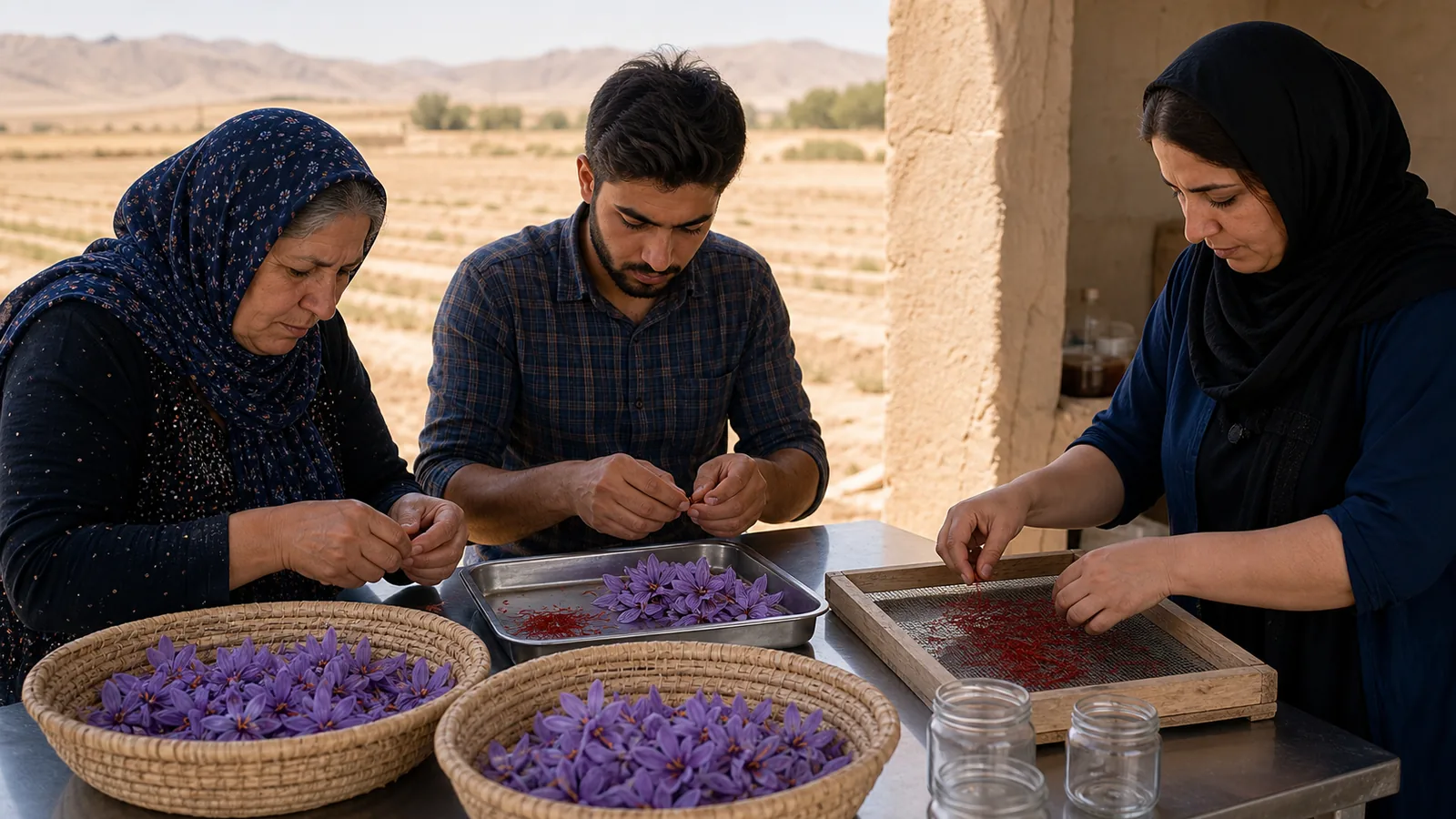
“Processing” should not be reduced to making a package look attractive. Useful post-harvest investment includes rapid and hygienic stigma separation, controlled drying, clean storage, representative sampling, laboratory testing, lot traceability and packaging that protects the spice from moisture, light and contamination.
These steps help growers and businesses sell a documented product rather than an unsupported superlative. They can also reduce quality loss between the flower and the buyer. FAO’s recent work in Iran makes the same broader connection between production practices, post-harvest handling, authenticity, safety, transparency and market competitiveness.
What the 105,000 hectares do—and do not—tell us
Cultivated area shows the scale of commitment to a crop, but it does not reveal yield by itself. Two regions with the same number of hectares can produce different amounts because fields vary in age, density, corm size, weather, irrigation, soil and harvest management.
The historical 105,000-hectare figure also cannot be combined automatically with a current 85–90 percent world share. They come from different reporting moments. A current calculation would need production tonnage for Iran and the world from the same crop year, along with a clear definition of dried saffron.
How to read the headline today
The headline’s core claim remains sound: Iran is the world’s leading saffron producer. The festival statement adds local meaning—Yazd’s water constraints, support for small farms, Bahabad’s substantial role and the need for better processing.
The 85 percent share, 105,000 hectares, 350 hectares and 50 percent provincial contribution belong to that historical account. They are valuable when kept together with their speaker and context. For today’s growers, buyers or investors, the more durable question is how much of Iran’s production can reach the market with verified quality, careful handling and value retained close to the people who grow it.

![Exporting Saffron to Turkey + Price Guide [Complete 0 to 100]](https://img.rowhanisaffron.com/20260827003933/saffron-export-turkey-quality-inspection.webp)



