


Iranian saffron export growth was the commercial theme behind the first National Saffron Day festival in Razavi Khorasan. The 2024 event brought growers, processors, exporters and the public together at harvest time, but its real value was not the celebration alone. It put the work needed to turn a renowned crop into dependable international trade in full view.
What the first National Saffron Day festival celebrated
The main exhibition ran in Mashhad, with related activity involving Torbat Heydarieh, Gonabad, Neyshabur and Torbat Jam. Those places are central to Razavi Khorasan’s saffron economy, from cultivation and flower picking to drying, grading, packing and trade.
The Khorasan Razavi Saffron Exporters Union’s event notice scheduled the public programme for 3–5 Aban 1403 at Koohsangi Park in Mashhad. Those dates correspond to 24–26 October 2024. The earlier English version of this page called them November 3–5, a calendar-conversion error that is corrected here.
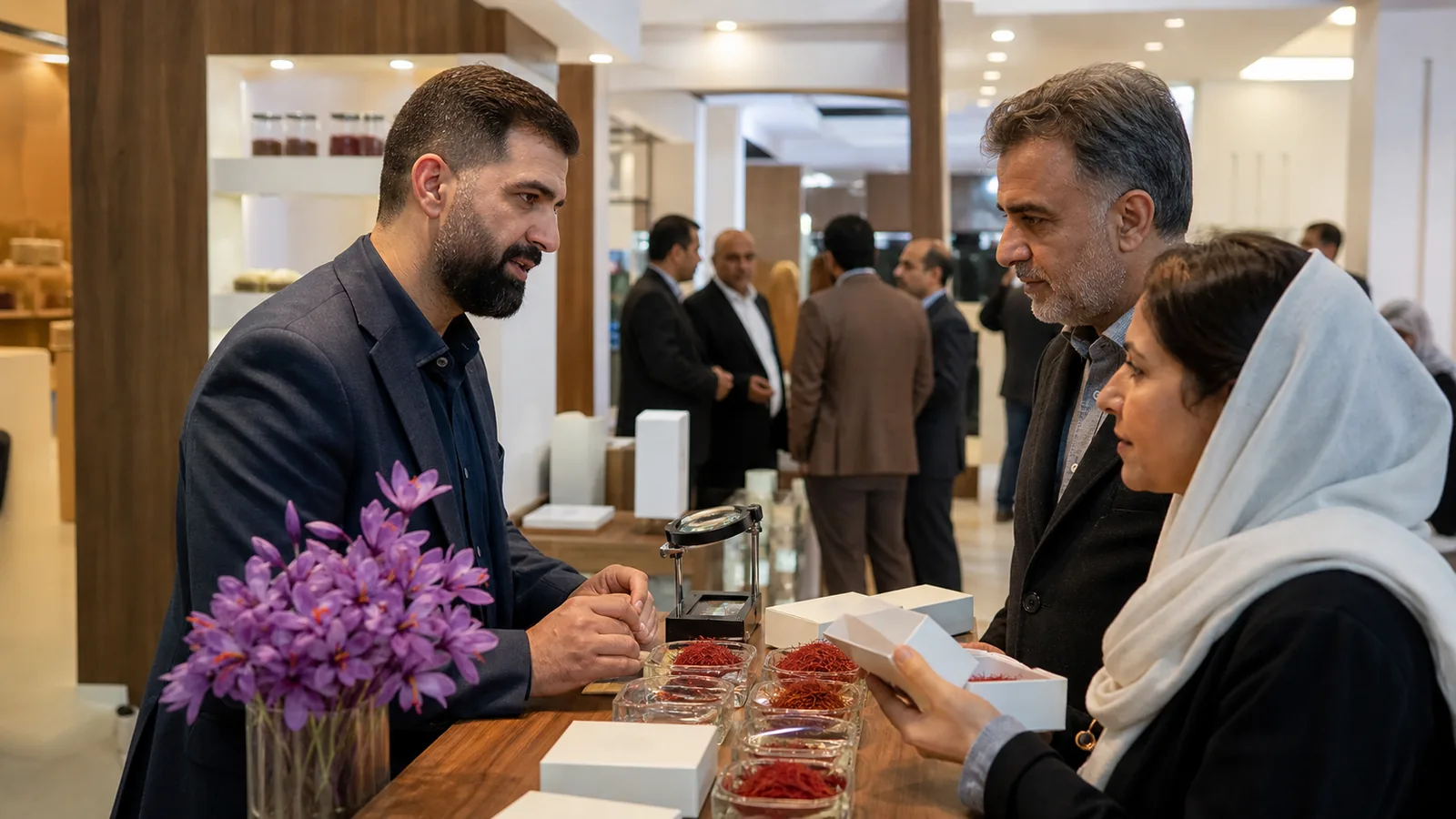
Contemporary coverage described 28 producer booths as well as food, music and photography programmes. Educational extension caravans and tourism activities linked the city event with saffron-growing communities. National Saffron Day itself falls on 5 Aban, close to the moment when flowers begin to colour fields across the region.
Why the festival mattered to Iranian saffron exports
A customer buying a small jar sees the finished threads. An export order depends on a much longer chain: picking flowers promptly, separating stigmas cleanly, drying them consistently, protecting aroma and colour, confirming the grade, testing the lot, preparing compliant packaging and delivering the agreed product on time.
The festival made parts of that chain visible in one place. Producers could present their work directly. Buyers and exporters could discuss the specifications behind an offer. Researchers and provincial officials, including the province’s vice governor for economic affairs, could hear the practical obstacles faced by farms and businesses. Cultural events gave the public a reason to engage, while the trade discussions looked beyond the display stands. The stated ambition was greater global recognition and more export opportunity for Iranian saffron.
That combination helps build recognition, but a festival cannot prove export growth by itself. It can start relationships and clarify problems. Actual progress appears later in signed orders, repeat customers, fewer rejected lots and verified customs records.
Razavi Khorasan’s scale, stated carefully
Razavi Khorasan is Iran’s leading saffron-growing province. An Iran Agriculture News Agency report recorded 91,000 hectares under saffron in the province in 2022, after a substantial expansion. Reporting around the 2024 festival used a figure of more than 96,000 hectares. These are dated agricultural-area estimates, not permanent measurements.
The old version of this article also said that Iran supplied 92 percent of the world’s saffron. That sentence combined two different statistics. One local report described roughly 92 percent of Iran’s saffron-growing area as being in Razavi Khorasan; separate reporting described Iran as producing more than 90 percent of world volume. Neither statement means the province automatically captures the same share of global retail value.
This is more than a statistical correction. Iran can be the dominant growing origin while importers elsewhere undertake final packaging, branding and distribution. Our analysis of Iranian saffron’s position in global trade explains why production share and value share should not be treated as the same thing.
What buyers needed to see beyond “golden spice”
Saffron is often called the golden spice, and the phrase suits a festival. In a commercial conversation, buyers need detail. A credible lot should be described by grade, harvest period, origin, moisture and cleanliness, packaging, batch identity and any test results required for the intended market.
Quality that can be repeated
A beautiful sample is only useful if the supplier can deliver the same agreed quality across the order. Consistent separation and drying, clean handling and representative sampling matter more than broad claims that every thread from one country is automatically superior.
Traceability that survives the supply chain
Batch records should connect the packed saffron to its supplier, processing date and test documentation. Traceability protects the buyer, but it also protects careful growers and processors from being blended invisibly into an anonymous commodity.
Packaging designed for the customer
Retail jars, food-service packs and bulk ingredients serve different needs. The right package protects against light, moisture, contamination and tampering while carrying the information required in the destination market. Decorative packaging has value only after those functions are met.
Education and sustainable farming have a commercial purpose
The festival’s educational component was not separate from export work. Picking time, flower handling, stigma separation and drying can affect the usable quality of the finished lot. Training that reduces contamination or inconsistent moisture helps processors meet specifications and gives exporters a more dependable product to offer. Agricultural innovation is valuable here when it solves a defined field, processing or traceability problem rather than serving as a vague promotional label.
Sustainability also needs concrete meaning. Saffron is adapted to the region’s climate, but that does not make every production decision automatically sustainable. Soil condition, corm health, water timing, labour conditions and the management of crop residues all matter. A buyer who asks about these details is looking for evidence, not a slogan.
The broader National Saffron Day programme across five counties shows how regional training and a central exhibition can support one another without pretending that every county has the same role.
Trade barriers still shape export opportunity
The earlier article correctly connected Iranian saffron export growth with the removal of trade barriers, but it promised the outcome too confidently. Exporters still have to deal with settlement channels, foreign-currency rules, customs documentation, destination-market labelling and unofficial trade. A festival can raise those issues; it cannot remove them on its own.
When formal routes are slow or costly, saffron may leave without a clear origin story or reappear under another brand. That weakens the connection between Iranian growers and the final customer. Our guide to saffron export barriers and smuggling examines this part of the market in more depth.
How to read Iran saffron export news
A useful rule when reading Iran saffron export news is to check the date and the measure before drawing a conclusion. “Growth” may refer to kilograms shipped, customs value, a month-to-month comparison, a forecast or a change in one destination market. Those figures answer different questions.
World Bank WITS data based on UN Comtrade show 2024 saffron imports reported by several markets from Iran. This is useful evidence of international trade, but it does not reveal how much value reached farms, whether the saffron was later repacked, or how much was sold under an Iranian consumer brand.
For a sound comparison, use the same product code, period, trade flow, currency and reporting basis. Treat a speech or event target as an intention until completed data support it.
What successful export growth would look like
The strongest result would not simply be more saffron leaving Iran. It would be more traceable, accurately graded product reaching repeat buyers through reliable contracts, with a fairer share of value retained by farmers, processors and Iranian exporters.
- Growers receive useful feedback about the quality buyers actually require.
- Processors can connect test results and batch records to the product shipped.
- Exporters understand the rules of each destination before the order is packed.
- Buyers receive consistent saffron and return for the next season.
- Market reports distinguish forecasts from completed trade.
The 2024 National Saffron Day festival deserves to be celebrated as a meeting point for that work. Its 28 booths, public programme and participation from Mashhad, Torbat Heydarieh, Gonabad, Neyshabur and Torbat Jam gave the crop a visible stage. The lasting measure is what happened after the event: better practice, stronger buyer relationships and export results that can be verified rather than merely predicted.

![Exporting Saffron to Turkey + Price Guide [Complete 0 to 100]](https://img.rowhanisaffron.com/20260827003933/saffron-export-turkey-quality-inspection.webp)



