


Iranian saffron export depends on more than harvest volume. The first National Saffron Day festival in Razavi Khorasan brought farmers, processors, exporters, researchers and customers into the same conversation, showing why quality, traceability, branding and workable trade rules must connect from the field onward.
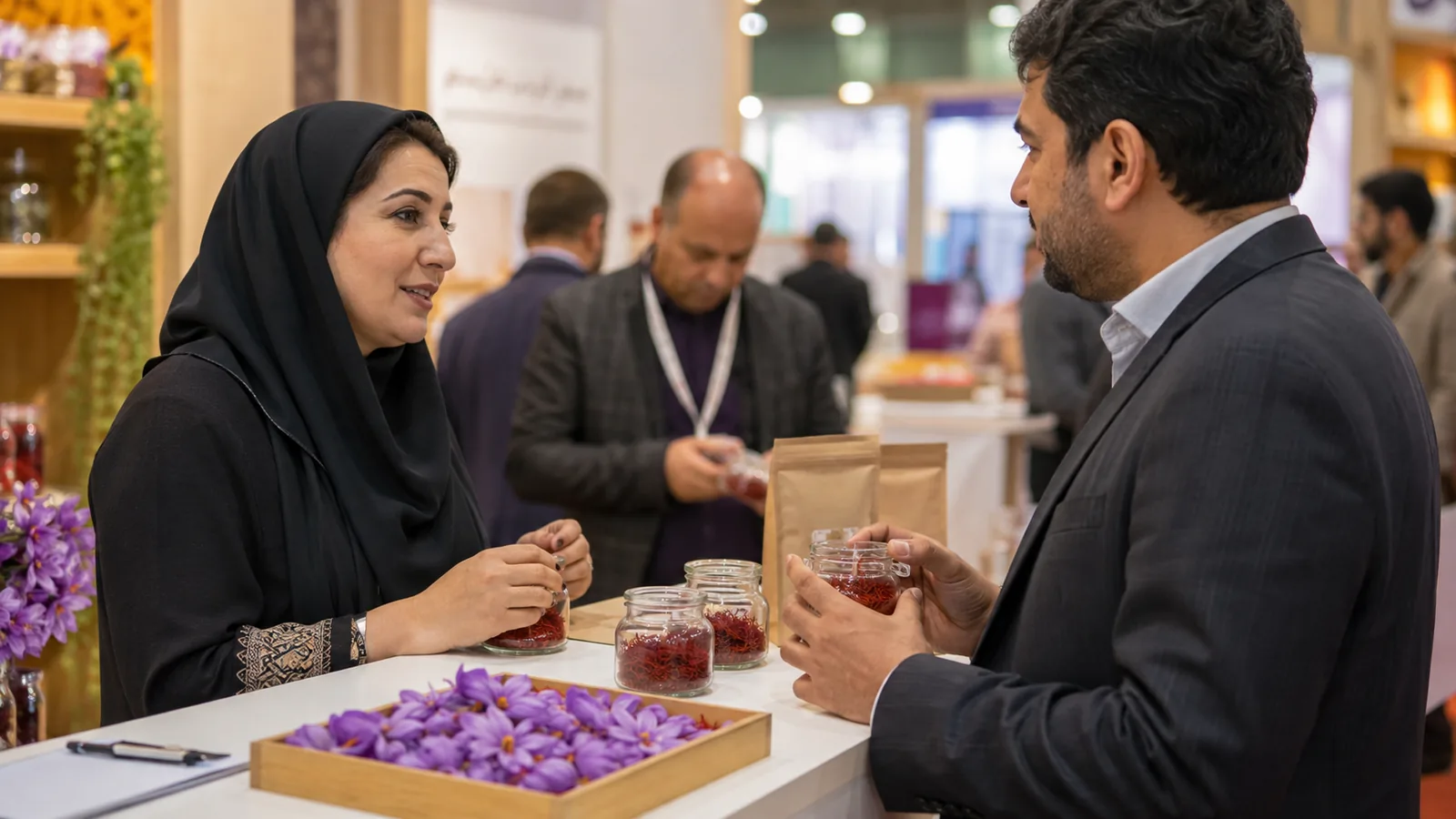
National Saffron Day Exhibitions in Five Counties of Razavi Khorasan
The event described here was held in 2024. Mashhad hosted the main exhibition, with activity linked to Torbat Heydarieh, Gonabad, Neyshabur and Torbat Jam. These are not interchangeable names on a programme: each county has growers, local knowledge and businesses that contribute a different part of the province’s saffron economy.
The Khorasan Razavi Saffron Exporters Union announced the festival for 3–5 Aban 1403, corresponding to 24–26 October 2024. The previous English version of this article rendered the dates as November 3–5; that was a calendar-conversion error. The union’s invitation placed the public exhibition in Mashhad’s Koohsangi Park from 4 PM to 9 PM. The earlier article said 10 PM, but the organiser’s published closing time was 9 PM.
The programme combined a saffron-products exhibition with food, music and photography. Separate educational and tourism caravans were planned for selected producing counties, while the National Saffron Day ceremony was held at the Khorasan Razavi Chamber of Commerce. The earlier version also referred to film screenings; because that item does not appear in the organiser’s invitation, it should not be treated as a confirmed part of the programme.
Why Razavi Khorasan is central to the saffron conversation
Razavi Khorasan is Iran’s largest saffron-growing province and the centre of much of the country’s processing and trade expertise. The figure of more than 96,000 hectares used in reporting around this subject belongs to the 2024 agricultural year, not to every season. Area and production estimates change, so the date matters whenever these numbers are compared.
The scale explains why a national event in Mashhad can draw such a broad audience. Saffron supports farm households, seasonal pickers, separation teams, drying and testing facilities, packaging businesses, traders and exporters. A weak link anywhere in that chain can reduce the value of an otherwise good harvest. Our report on a reduction in the Razavi Khorasan saffron harvest also shows why annual figures must be read in their own weather and market context.
What an exhibition can do for Iranian saffron export
A festival does not create export demand by itself. Its value lies in the meetings it makes possible and the questions it puts in public view. A grower can see how buyers assess a lot. A processor can explain why moisture, foreign matter and inconsistent threads cause rejection. Packaging companies can demonstrate formats suited to wholesale and retail customers, while researchers and regulators can hear where rules or testing capacity are creating friction.
Show the complete journey from farm to market
Customers rarely see the concentrated work behind a small pack of saffron. Exhibitions can make that journey visible: field selection, flowering, early picking, stigma separation, controlled drying, grading, laboratory checks, packing and dispatch. This is useful when it is specific. Broad claims that Iranian saffron is simply “the finest in the world” are less persuasive than a traceable lot with a stated grade and evidence that it meets the buyer’s specification.
Let counties keep their identity without fragmenting the message
Torbat Heydarieh, Gonabad, Neyshabur and Torbat Jam have their own production stories. Presenting them together need not erase those identities. A shared national message can explain Iranian origin and quality controls, while county and producer records show where a particular batch came from. That balance is stronger than anonymous bulk sales on one side or unsupported regional superiority claims on the other.
Bring commercial problems into the same room
The original event coverage highlighted smuggling, packaging and brand identity. Those remain connected issues. When legal export is costly or difficult, informal routes can become more attractive; when lots leave without traceable identity, producers have little control over how they are presented later. A related analysis of saffron export challenges and smuggling looks more closely at that tension.
From attractive packaging to credible branding
Packaging matters, but branding is not a decorative box placed around an inconsistent product. A credible export brand begins with repeatable sourcing and handling. The pack then protects that work and communicates it clearly.
- Identify the lot. Record producer or supplier, harvest period, grade, processing location and batch.
- Verify the specification. Use appropriate laboratory testing and keep results connected to the batch actually shipped.
- Choose the format for the customer. A food manufacturer, restaurant distributor and household buyer do not need the same pack size or presentation.
- Protect aroma, colour and cleanliness. Food-safe material, secure seals and protection from light and moisture are practical quality measures.
- Label for the destination market. Product name, net weight, origin, lot code and any required importer or compliance details must be accurate and legible.
Meeting international standards should be described precisely. No single certificate opens every market, and a test result does not replace the importing country’s labelling, food-safety, customs or documentation rules. Exporters need the current requirements for the actual destination and buyer.
What the trade data can and cannot tell us
World Bank WITS data based on UN Comtrade show substantial 2024 imports of Iranian saffron reported by markets including Spain, China, Italy, Kuwait and Germany. This confirms that Iranian origin reaches important international buyers. It does not reveal what each farmer received, what share was sold under an Iranian consumer brand or how much value was added after import.
That gap is why export value should be discussed alongside volume. Consistent lots, dependable delivery and a buyer relationship can matter more than shipping a larger anonymous quantity. The overview of Iranian saffron in global trade provides more context on the difference between producing origin and final market presentation.
Coordination should produce practical results
The 2024 festival involved provincial authorities, the Chamber of Commerce, sector organisations and saffron businesses. The earlier article described an objective of relocating the National Saffron Council from Tehran to Mashhad. Contemporary reporting instead records a proposal for a permanent saffron secretariat in Mashhad. Those are not the same action, so the relocation claim should not be presented as settled fact.
Whatever organisational form is chosen, growers and exporters need measurable outcomes: accessible grading and testing, clear market information, fewer avoidable administrative delays, training that reaches farms, and a route for commercial problems to be raised with decision-makers. A permanent forum is useful only if it turns those discussions into work that can be checked later.
A better measure of the festival’s value
National Saffron Day celebrates cultural heritage and the people who carry it. For the industry, its longer value should be judged after the displays are packed away. Did producers gain new verified buyers? Did training change harvest or drying practice? Did a processor adopt clearer batch records? Did an exporter solve a recurring compliance problem? Did the counties keep collaborating?
Those questions connect the public celebration to Iranian saffron export in a useful way. The festival can introduce people and make the value chain visible. The durable work—protecting quality, documenting origin, meeting market rules and earning repeat business—continues throughout the year.
Sources and date note
Event dates, venue and public hours are taken from the Khorasan Razavi Saffron Exporters Union’s 2024 invitation. Provincial scale is identified as a dated figure and is consistent with 2024 reporting; an earlier Iran Agriculture News Agency record documents how the provincial area had reached 91,000 hectares by 2022. International market examples use World Bank WITS 2024 importer data for saffron from Iran.

![Exporting Saffron to Turkey + Price Guide [Complete 0 to 100]](https://img.rowhanisaffron.com/20260827003933/saffron-export-turkey-quality-inspection.webp)



