


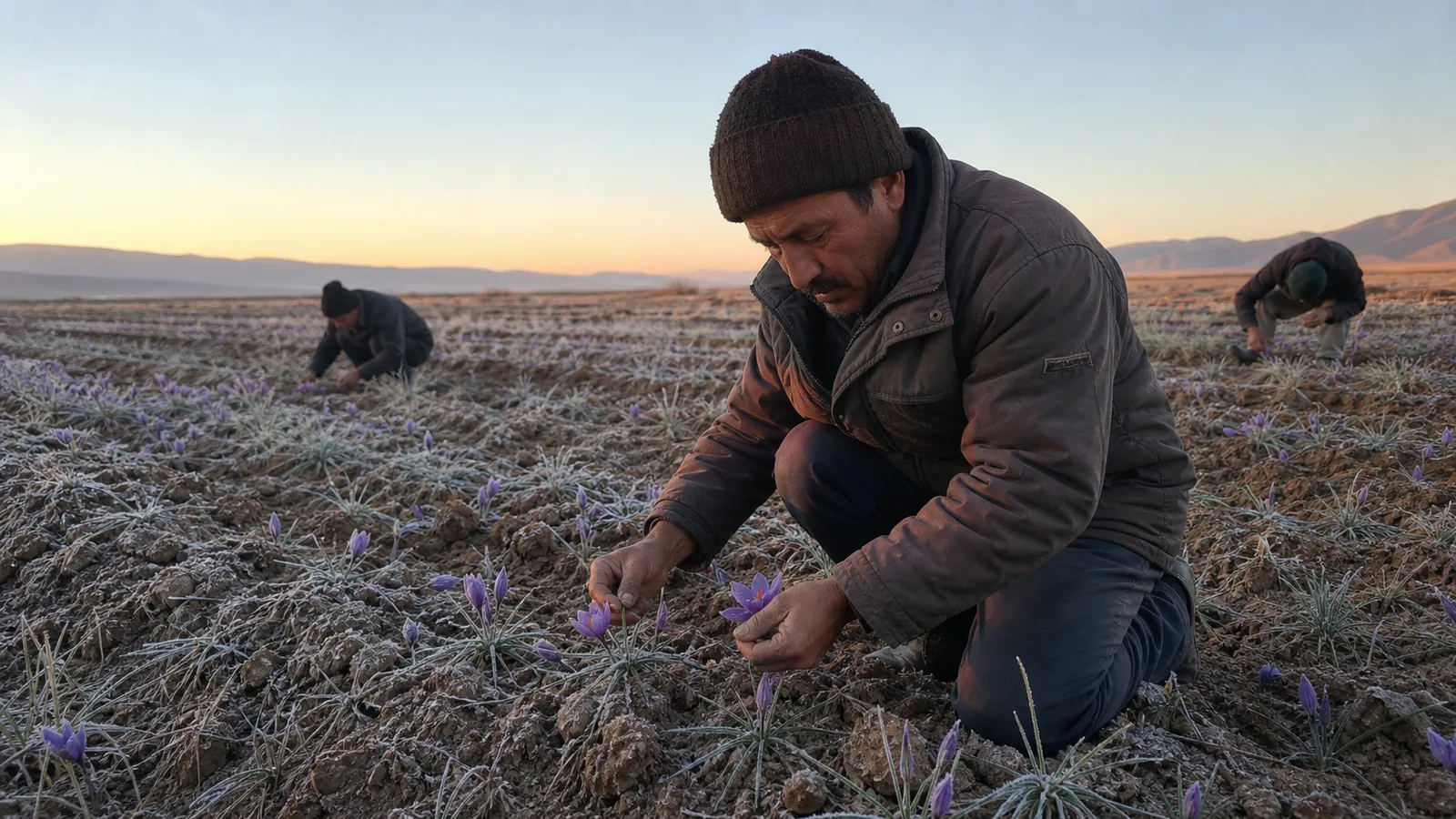
The saffron harvest in Khorasan Razavi fell sharply after severe cold damaged fields across Iran’s main producing province. Provincial officials described a 35% reduction, while the hardest-hit local reports ranged from 50% in Torbat Heydarieh and Zaveh to about 80% around Kashmar.
These are historical figures from one damaging season, not a current crop forecast. Read together, the reports show how a province-wide average can conceal far deeper losses in individual counties.
Khorasan Razavi’s harvest fell to 190 tonnes
Mohammad Reza Ghodsi, then director of horticultural affairs for the provincial agricultural administration, said Khorasan Razavi had harvested 243 tonnes in the preceding year. The next crop was expected to reach 270 tonnes, but cold damage reduced the reported result to 190 tonnes.
The published percentages and tonnages do not reconcile exactly. A fall from 243 to 190 tonnes is approximately 22%, while 190 tonnes is about 30% below the 270-tonne forecast. Neither calculation equals the stated 35% provincial decline. The source may have used a different baseline, provisional data or rounded local totals, but it does not explain which. All three figures are therefore preserved with that limitation visible.
Ghodsi said Torbat Heydarieh and Zaveh County suffered the most damage in the provincial comparison, each with an approximately 50% harvest reduction, while Neyshabur had the smallest decline. Zaveh’s crop is especially relevant to searches about agriculture in the county: in this report, saffron was the crop explicitly identified as suffering a major cold-related loss.
Kashmar’s local loss reached about 80%
A later account focused on the Kashmar region, where an agricultural official reported an approximately 80% reduction following the previous winter’s severe frost. The English source rendered the place as “Kashmir,” but its named local agricultural office and regional context indicate Kashmar in Khorasan Razavi.
Growers had previously harvested roughly four kilograms of saffron per hectare in the area. In the damaged season, many fields flowered poorly or not at all. The report did not provide the cultivated area or final tonnage, so the 80% figure cannot be independently rebuilt from its text.
Why cold damage can appear months later
The source describes a difficult pattern: the most visible winter damage was first noticed in orchards, but the extent of the saffron loss became clear only when the following autumn flowering failed. That delay can make early loss estimates incomplete.
The Kashmar official said damaged fields would need suitable nutrition, fertiliser and irrigation over as many as three years to recover. This should be treated as his assessment for those local fields, not a universal treatment schedule. Recovery depends on the extent of corm damage, soil condition, drainage, planting density and whether damaged planting material should be replaced. Input rates need current field inspection and local agronomic advice.
The provincial report added that farms using suitable planting material and timely irrigation showed less damage. Saffron is propagated commercially from corms, so the source’s translated reference to “seeds” is best understood as healthy planting material rather than botanical seed.
Seasonal work fell with the flowers
The Kashmar report estimated that a normal hectare of saffron created harvest work for about ten people, compared with only two in the damaged year. It does not define whether those numbers mean workers present at one time, jobs across the full harvest or another measure. They remain attributed estimates, but the direction is clear: fewer flowers meant far less picking and separation work.
That labour shock adds to the farm loss. A grower loses saleable saffron, while households that rely on the short harvest window lose paid days. The effect is consistent with the wider employment concerns reported in Torbat Heydarieh’s 25% production decline.
A higher price did not erase the loss
The local official said saffron prices rose as supply tightened, but not enough to compensate for the production collapse. A higher unit price helps only when a grower still has product to sell. It can also weaken demand if buyers reduce quantities, delay orders or seek alternatives.
He warned that China, Pakistan, India and Afghanistan were expanding saffron cultivation and could compete for established markets. The same statement placed Iran near 90% of world production in that period, but it did not cite a dataset. Neither the share nor the forecast that competing fields would mature within two or three years should be treated as a current verified market measure.
The market-risk warning
The official compared saffron with the loss of market position experienced by Iranian carpets. His argument was that production leadership does not protect a country if price, quality, customer relationships and exporter support are neglected.
He called for long-term investment in both existing and new markets and for practical support to exporters. That does not mean insulating every business from normal competition. It means maintaining dependable quality, trade information, logistics and customer service while growers recover from a season they could not control.
What recovery should protect
Field recovery and market recovery need to happen together. Farmers require an evidence-based assessment of corm survival, soil and water before spending on inputs. Seasonal workers need the crop to return. Processors and exporters need enough consistent product to keep buyers supplied without making claims based on uncertain tonnages.
The provincial 190-tonne result, the 50% losses in Torbat Heydarieh and Zaveh, and Kashmar’s reported 80% reduction are different views of the same frost event. Keeping their locations, baselines and uncertainty separate produces a more useful account than forcing them into one apparently precise percentage.

![Exporting Saffron to Turkey + Price Guide [Complete 0 to 100]](https://img.rowhanisaffron.com/20260827003933/saffron-export-turkey-quality-inspection.webp)



