


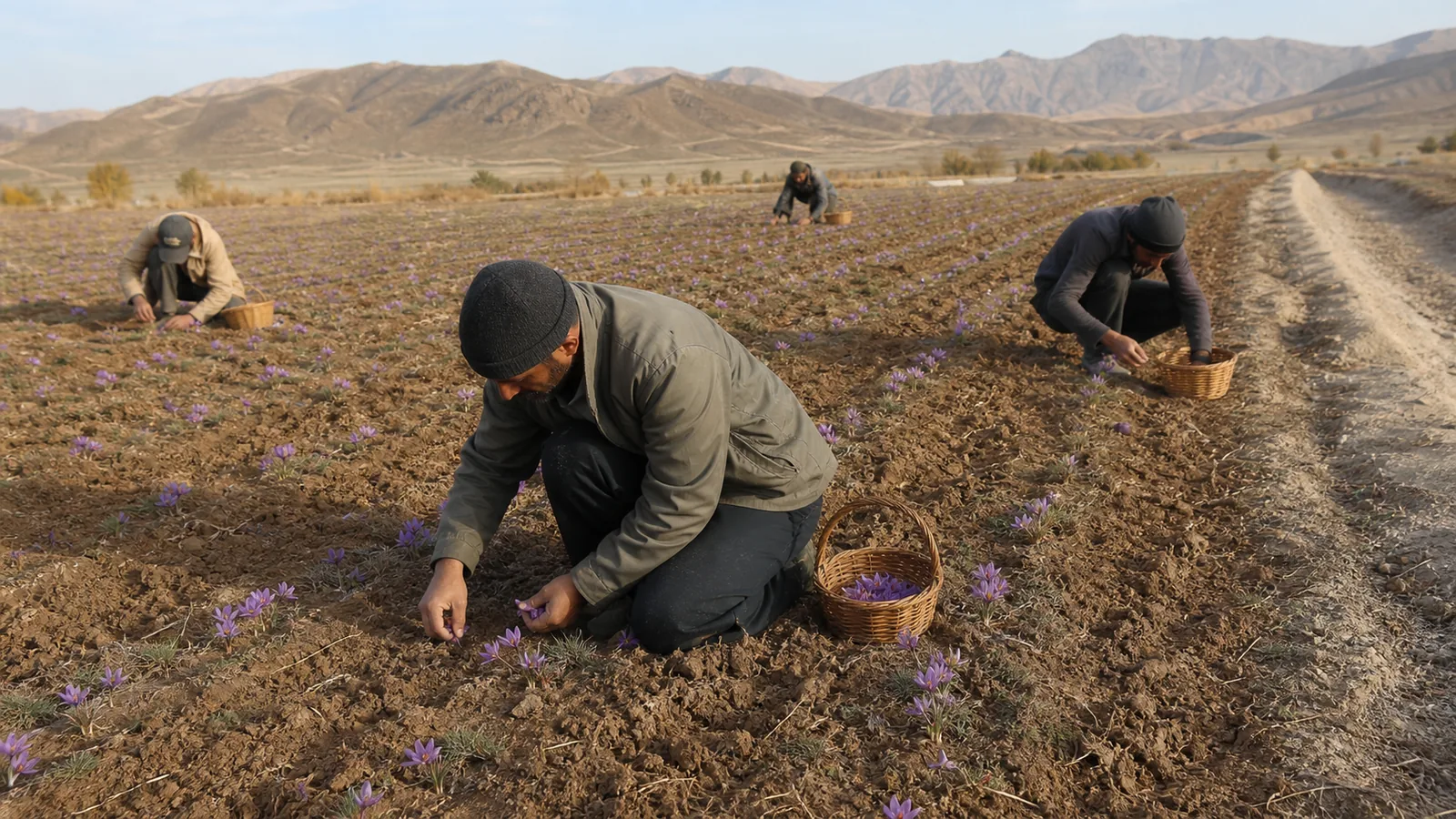
Saffron production in Torbat Heydarieh was reported to have fallen by about 25% after low autumn and winter rainfall and unusually high summer temperatures. The reduction affected more than harvest weight. In a city where saffron supports growers, seasonal workers, processors and exporters, a weak flowering season moves through the entire local economy.
The figures in this article come from historical statements by local officials. They describe the reference harvests, not current production or employment.
Why production fell by 25%
Hamidreza Abbaspour, then director of the local agricultural administration, said Torbat Heydarieh had about 8,900 hectares of saffron fields and an initial production forecast near 38 tonnes. He linked the decline to insufficient rainfall in the preceding autumn and winter, followed by greater summer heat.
The source does not provide a final measured harvest. If the headline’s 25% reduction is applied to the 38-tonne forecast, the result would be approximately 28.5 tonnes. That calculation is useful for scale, but it should not be mistaken for an officially reported final total.
A separate statement by Governor Ali Rostami placed a more typical annual crop at about 32 tonnes of dried saffron. He reported local yields of roughly 3.8 to 4.1 kilograms per hectare, close to a four-kilogram provincial average, and likewise said declining precipitation had reduced output in recent years. The different totals can fit different years, areas or forecast methods; the reports do not supply enough detail to combine them into one series.
Employment depends on more than the farm owner
Rostami described saffron as Torbat Heydarieh’s leading source of agricultural income and employment. At a saffron conference, he said around 400,000 people were engaged across planting, field care and harvest.
That striking number needs careful interpretation. The report does not say whether it counts unique workers, seasonal work engagements, labour days or a wider regional chain. It should be cited as the governor’s estimate, not as a verified count of permanent jobs in the city.
The underlying point remains important. Saffron flowering is brief and labour-intensive. A weaker crop means fewer flowers to pick and separate, fewer lots to dry and grade, and less material moving through packing and trade. The effect reaches households that may rely on a short period of seasonal work even if they do not own saffron land.
Why some saffron was refused by the exchange
Growers criticised the local exchange for refusing some lots while prices were weak. Abbaspour responded that the exchange was privately operated and had to accept saffron meeting its defined standards. In his view, buyers elsewhere would trust exchange-traded product only if it had passed laboratory analysis and was free from defects.
That is a reasonable traceability principle, but it also means growers need clear specifications, accessible testing and a transparent appeal process. A rejected lot should come with an understandable reason, not simply a closed door. Our guide to Iranian saffron hygiene and export standards explains the distinction between product testing and regulatory paperwork.
Harvest-time selling and limited storage
Abbaspour said storage and exchange capacity in Torbat Heydarieh was limited. He also argued that large volumes offered immediately during harvest pushed prices down. Farmers, however, pointed out that production costs left them little choice but to sell.
The report described a bank arrangement intended to give growers short-term finance against saffron delivered to the exchange. Its translated monetary amounts and units are internally unreliable, so they should not be repeated as usable loan terms. The policy idea is clear: temporary credit could reduce forced selling, but only if its cost, collateral rules and access genuinely work for small growers.
A processing centre that had not yet opened
Rostami said a major saffron processing unit had been built in Torbat Heydarieh and described it as the largest in the Middle East, but it was still awaiting activation. The report provides no independent capacity comparison, so the regional superlative remains an attributed claim.
An operating plant could support cleaning, grading, packaging and more consistent market preparation near the farms. An idle building cannot. The distinction matters because local value comes from throughput, tested output and sales—not from the nominal size of a facility.
The proposed single-management consortium
The governor called for one consortium linking growers, packers, processors and exporters. His concern was that Iran’s high production share had not translated into a fair portion of saffron’s final turnover for farmers. He placed Iran at 94% of global saffron production in that reference period, but the statement did not identify a dataset and should not be treated as a current share.
A consortium could help only if it gives each participant a defined role and transparent return. Shared standards, consolidated lots, coordinated processing and market information may improve bargaining power. Central control without accountable governance could simply create another bottleneck.
What recovery requires
After a dry, hot season, recovery begins with the field: realistic water planning, healthy corms, soil-specific nutrition and monitoring of productive area and yield. It continues with affordable testing, working storage, finance that does not trap growers, and processing capacity that actually operates.
Torbat Heydarieh’s 25% decline therefore tells two stories. One is climatic—a crop responding to rainfall and heat. The other is structural—a major saffron centre trying to keep growers, seasonal workers and businesses viable when less product reaches the market. Solving only one side would leave the other exposed.

![Exporting Saffron to Turkey + Price Guide [Complete 0 to 100]](https://img.rowhanisaffron.com/20260827003933/saffron-export-turkey-quality-inspection.webp)



