


“99 Percentage of Iranian saffron is exported raw” was a warning from Saeed Ali Hosseini of Iran’s National Saffron Council, not a permanent trade statistic. He argued that nearly all Iranian saffron left the country with little domestic conversion into consumer-ready or derivative products. The original report did not publish a dataset or define its period, so the 99 percent figure should be read as his historical estimate rather than a verified current share.
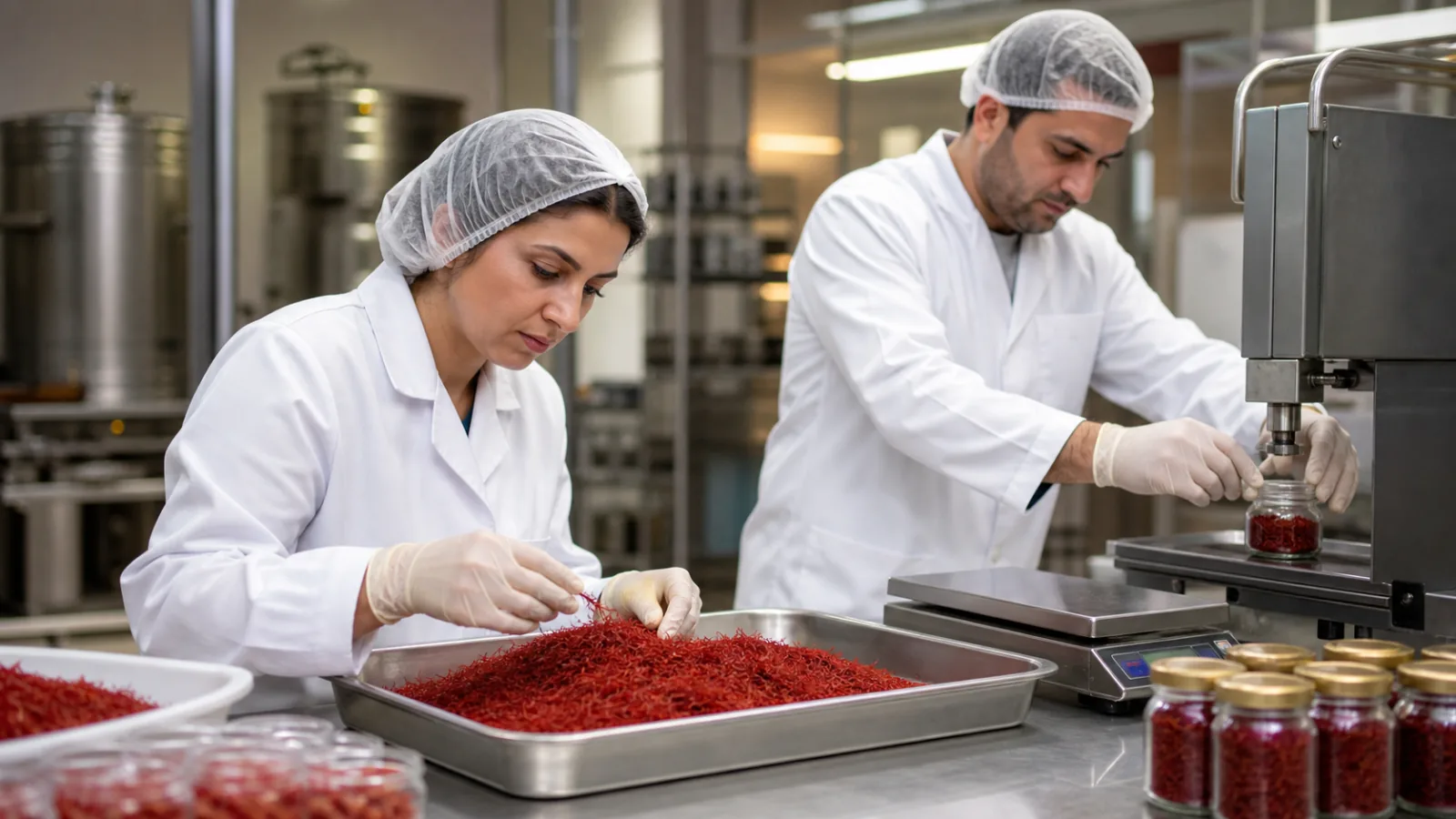
The concern behind it is still useful. Iran grows most of the world’s saffron, yet production volume alone does not decide how much value reaches its farmers and businesses. Cleaning, grading, authenticity testing, traceability, packaging, product design and dependable export service all affect what a buyer is willing to pay.
What “raw saffron” means in this export claim
Saffron threads are not raw in the same sense as flowers taken straight from a field. The stigmas have already been separated and dried, which is essential post-harvest processing. In this debate, “raw” meant saffron exported in bulk or as a lightly prepared commodity before another business handled the final branding, retail packaging or conversion.
Bulk export is not automatically a sign of poor quality. A professional buyer may need a large, well-tested lot for food manufacturing or for packing under its own brand. The loss occurs when an indistinct shipment is easy to replace, its Iranian origin disappears from the final presentation, or most of the commercial work is done elsewhere.
That is why a percentage by itself can mislead. The useful questions are how much saffron is exported in each package band, who performs the final processing, whether origin remains visible, and how much of the final sale value returns to the producer and exporter.
Iran saffron exports: production leadership and market value
The Food and Agriculture Organization reported in 2025 that Iran produces about 85–90 percent of the world’s saffron. This enormous production share gives the country deep experience and scale. It does not guarantee the same share of branded retail sales, extracts, ready-to-use formats or other finished products.
Hosseini’s historical comments anticipated greater production as cultivation spread to more than 20 Iranian provinces. He worried that supply could grow faster than the market. New acreage can increase total output, but a larger crop is helpful only when quality, demand and routes to market grow with it.
For figures that separate a dated export record from current evidence, see our guide to Iran saffron export statistics. Production, customs exports and final-country retail sales measure different stages of the chain and should not be substituted for one another.
Why raw saffron price is an incomplete measure
A raw saffron price normally refers to a specified bulk lot, not a universal daily rate. It changes with thread style, measurable quality, crop year, moisture, cleanliness, lot size, packaging, origin evidence, payment terms, destination costs and currency. A price without those details is difficult to compare.
The original speaker warned against relying on a high commodity price as the only strategy. If sellers raise an offer without giving buyers a reason to prefer that lot, competing origins or substitute suppliers gain room to enter. The stronger route is to make the comparison more precise: a traceable batch, agreed specifications, dependable testing and delivery performance can support value in ways that a vague premium cannot.
Value addition does not mean putting the same threads in a decorative box and charging more. Packaging can protect saffron from moisture, light, contamination and tampering, but it must serve the product and the customer. The commercial value comes from a combination of protection, credible information, convenient use and consistent quality.
Processing that genuinely adds value
Hosseini called for stronger “conversion industries.” Some translations use that term for processing businesses that turn an agricultural crop into a more usable or market-ready product. For saffron, worthwhile examples include:
- controlled separation and drying that protect aroma and colouring strength;
- cleaning, grading and lot segregation rather than mixing unlike material;
- laboratory testing connected to the same batch being sold;
- tamper-evident retail packs with clear origin, lot and net-weight details;
- pre-measured formats for repeatable cooking and food-service use;
- properly formulated food products whose saffron content and purpose are transparent.
FAO’s recent work in Iran follows much the same path. Its 2025 programme brought together farmers, processors, cooperatives, traders and researchers to improve post-harvest handling, safety, traceability and modern marketing. It also discussed ready-to-use formats, including pre-dosed packaging and dispensing systems, as responses to how customers now use saffron.
Not every derivative will create a durable market. It needs a real customer, a stable formulation, lawful labelling and quality that survives storage. Turning saffron into an unnecessary novelty can consume the spice without improving either trust or farmer income.
Laboratories support the product; they do not replace good handling
The historical report noted that Iranian saffron companies had modern laboratories and should be supported as more than packing operations. Laboratory capacity matters because colour, aroma and appearance alone cannot establish authenticity or identify every adulterant.
Testing is most useful when the sample, result and shipment remain linked. A certificate copied from a different lot adds little confidence. Strong traceability records who supplied the crop, how it was dried and stored, which lot was sampled, what method was used and which sealed goods the result covers.
FAO’s current authenticity work with Iran combines improved laboratory methods with practical post-harvest guidance. That pairing is important. A good test can describe the sample received by the laboratory; disciplined handling is what protects the rest of the lot before and after that moment.
Farm productivity needs context
Hosseini contrasted a goal of one gram of saffron per square metre with a reported 400 milligrams. Converted to the more familiar hectare measure, those figures are 10 kilograms and 4 kilograms per hectare. They were presented as an argument for better farm management and training, not as a promise that every field should yield the same amount.
Field age, corm density and health, soil, climate, irrigation, disease pressure and harvest labour all affect yield. Raising the weight harvested from a square metre is not progress if rushed picking or poor drying lowers the usable grade. Training should connect field productivity with clean separation, timely drying and batch records.
Stable export conditions matter to contracts
The final point in the original statement was regulatory stability. An exporter may quote a buyer, agree a delivery window and arrange payment months before the shipment leaves. If a material rule or cost changes during that period, the contract can become difficult or impossible to perform.
No market can promise that laws, sanctions, customs requirements or exchange conditions will remain fixed. Exporters can still reduce uncertainty by checking the current rules for the product and destination, documenting which party handles each obligation, allowing for change-in-law risk and avoiding a quote that assumes yesterday’s procedure will last indefinitely.
Iranian saffron does not have to choose between bulk trade and finished products. Both can serve legitimate buyers. The better objective is a portfolio in which bulk lots remain identifiable and verifiable, while suitable consumer and food-industry products are developed around actual demand. That creates more ways to compete than simply selling another kilogram at the lowest raw saffron price.
Sources
- The historical statement by Saeed Ali Hosseini reproduced in the original version of this post.
- FAO: innovation and quality integrity in Iran’s saffron value chain.
- FAO: saffron harvesting, processing and packaging practices in Mashhad.
- FAO: development of saffron authenticity-testing methods.
- Codex Alimentarius official standards index, including CXS 351-2022 for dried saffron.

![Exporting Saffron to Turkey + Price Guide [Complete 0 to 100]](https://img.rowhanisaffron.com/20260827003933/saffron-export-turkey-quality-inspection.webp)



