


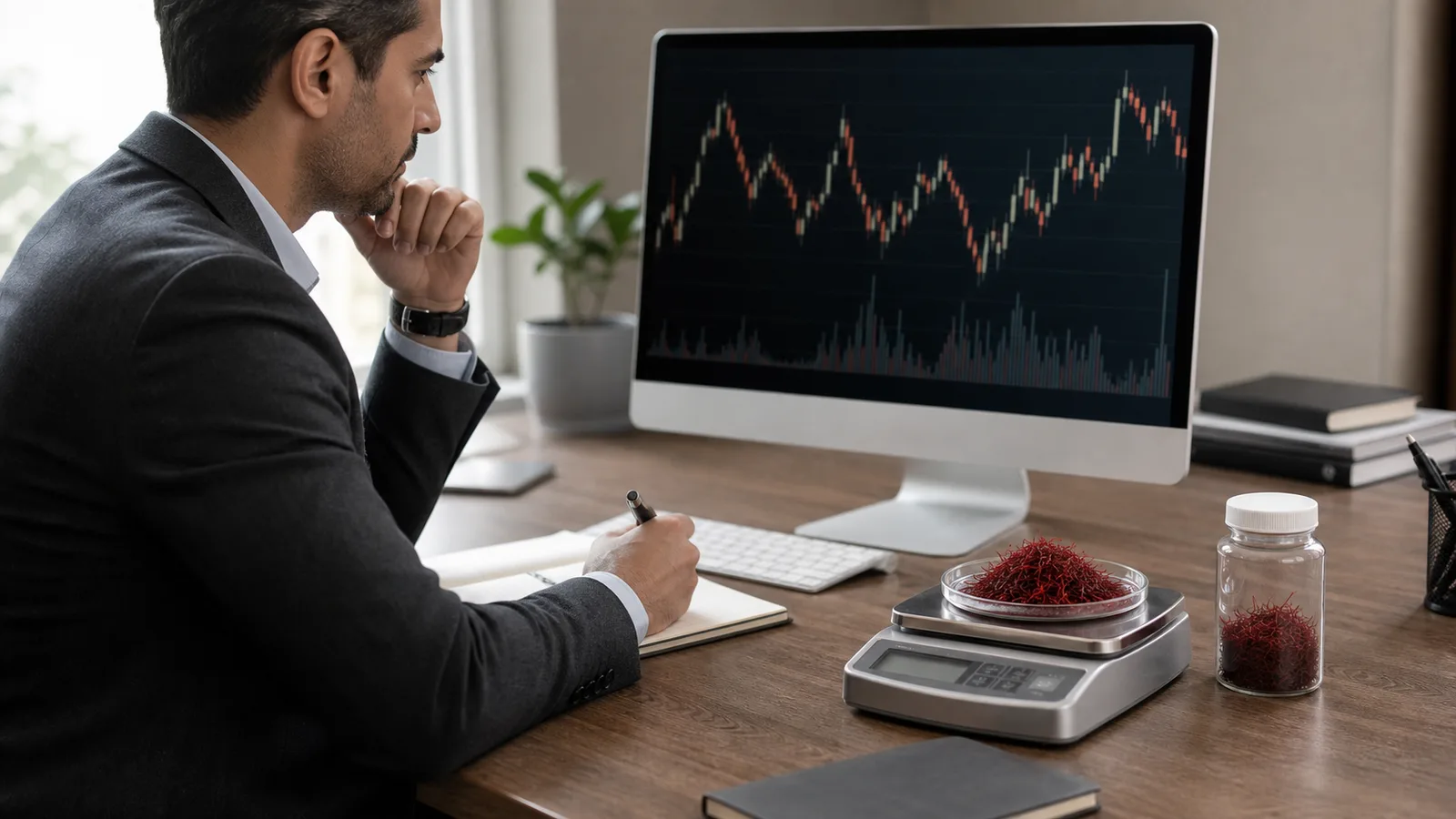
Launching Saffron’s Future Contract for May 2019 records an early stage in the development of saffron derivatives on the Iran Mercantile Exchange. The old English copy mixed Gregorian month names with Solar Hijri years and turned several dates into impossible combinations. The market structure it described is more useful than those damaged date conversions.
The notice concerned a Negin saffron futures contract in 1398, with a 100-gram contract size. It explained how the first trading session would discover an opening price, how normal trading would follow, and what would happen if no trade occurred in the opening auction.
What the 2019 saffron contract notice announced
The original report said the new contract would begin on a Wednesday with a 30-minute pre-opening period. A single-price auction was scheduled for 10:30, after which continuous trading and the ordinary daily price-movement limit would apply.
The opening auction mattered because the new delivery month did not yet have a previous settlement price. The price discovered in that auction would become the reference for the day’s permitted trading range. If the auction produced no transaction, the contract would remain stopped and the opening process would be repeated on the next working day.
The old translation rendered the launch as “March 22, 2013” and the last trading date as “May 18, 1398.” Those are not valid dates in one calendar. The surrounding market reports indicate that Persian dates were converted partly as month names and partly left as Persian years. Without the original exchange circular, it would be misleading to manufacture exact Gregorian equivalents. The reliable historical identifiers are the 1398 contract, Negin saffron and the delivery/last-trading schedule specified by the exchange at the time.
How the opening session worked
A pre-opening period lets buyers and sellers enter or change orders before continuous trading begins. The exchange then uses eligible orders to establish one auction price. This mechanism can create an orderly starting point when a contract month has no prior settlement history.
After that auction, ordinary matching begins. The original article said the daily fluctuation limit was plus or minus 3% relative to the previous settlement price. That figure belongs to the historical contract specification; it should not be assumed to be a current rule for every saffron contract.
The difference is important when someone researches the saffron price in 2019. A futures quotation is not automatically the farm-gate, wholesale, export or retail price of saffron. It is the exchange price for a defined grade, quantity, delivery month and contract terms at a particular moment.
What a 100-gram Negin saffron contract represented
The base asset was described as 100 grams of premium-cut Negin saffron. Negin is a commercial style made from separated red stigmas with little or no yellow style visible. Exchange delivery requires a more precise specification than a marketing name alone, including quality, approved storage and documentation rules.
The 100-gram size made the contract value far smaller than a one-kilogram wholesale quotation. To compare prices correctly, a reader needs to know whether the screen displays a price per gram, per contract or in another quoted unit, as well as whether the currency is rial or toman.
For example, multiplying a per-gram quote by 100 produces the nominal value of the saffron represented by one contract, but not necessarily the cash a trader must deposit. Futures normally use margin: both sides provide collateral and gains and losses are settled as prices move.
A futures contract is not an ordinary saffron purchase
A retail customer buying saffron receives a packaged product. A futures trader takes a contractual position tied to a later settlement or delivery process. The position may be closed before the last trading day, or it may proceed according to the exchange’s delivery rules.
That creates several risks:
- Price risk: the market can move against either buyer or seller.
- Margin risk: an adverse move can require additional funds on short notice.
- Liquidity risk: it may be difficult to close a position at the expected price.
- Basis risk: a local physical saffron price may not move exactly like the exchange contract.
- Delivery risk: open positions near expiry must follow current quality, warehouse and settlement procedures.
The old page said that futures and options activity helped keep commodity-market traders engaged after another futures market closed. That was commentary on the market environment, not proof that saffron derivatives were suitable for every grower or investor.
Why producers and buyers use saffron futures
A grower, cooperative or merchant expecting saffron to sell later may use a futures position to reduce exposure to a price decline. A buyer who expects to need standardised saffron may use the market to reduce exposure to a price rise. Traders may also participate without intending to handle the physical crop.
Hedging is not the same as guaranteeing profit. The quantity and quality covered by the contract may differ from the user’s physical saffron. Margin calls can create cash-flow pressure, and closing a futures position does not itself sell a farmer’s actual crop.
Anyone interpreting a historical position should keep the contract month attached to it. A June-delivery quotation and a September-delivery quotation can differ because of expected harvests, storage costs, financing, available stocks and market expectations.
The earlier launch of Iran’s saffron futures market
The last paragraph of the old article also suffered from date corruption. Contemporaneous reporting places the first Iran Mercantile Exchange saffron futures launch on 2 Khordad 1397, corresponding to May 2018, for Negin saffron delivery in Shahrivar 1397. It used the same 100-gram contract concept and a 3% daily movement limit reported for the early market.
Within its first trading days, the market recorded thousands of contracts and multiple brokerage firms. Those figures show early participation, but volume alone does not establish whether futures improved every producer’s realised price. That requires comparing who could access the market, how physical delivery worked and whether hedges matched farmers’ actual exposure.
How to read a historical saffron futures quote
Before using a number from this page or another 2019 report, record:
- the exact contract symbol and delivery month;
- the saffron grade and contract size;
- the quoted unit and currency;
- whether the figure is an opening, last, highest, lowest or settlement price;
- the trading date and calendar used;
- volume, open interest and whether an actual trade occurred; and
- the exchange rules that were in force on that date.
This avoids comparing an exchange settlement for 100 grams of eligible Negin saffron with a retail jar or an export quote that includes different quality, packaging and logistics. For broader context, our article on the saffron commodity exchange explains the role of standardisation and organised trading.
What this 2019 notice tells us now
The lasting value of the announcement is procedural. A new saffron futures month began with an uncapped price-discovery auction, then moved into ordinary trading under a daily limit. If no opening trade occurred, price discovery was deferred instead of forcing an artificial reference price.
Its dates, limits and specifications are historical, not instructions for trading today. Anyone considering a current contract must read the latest Iran Mercantile Exchange circular and work through an authorised broker. Rules, symbols, margins, delivery procedures and active contract months can change.
Sources
- The original 2019 market notice preserved in the previous version of this page; exact Gregorian date conversions remain unverified because the English text mixed calendar systems.
- Contemporaneous report on the first days of Iran’s saffron futures market (Persian).
- Later Iran Mercantile Exchange launch notice showing the same opening-auction structure (Persian).

![Exporting Saffron to Turkey + Price Guide [Complete 0 to 100]](https://img.rowhanisaffron.com/20260827003933/saffron-export-turkey-quality-inspection.webp)



