


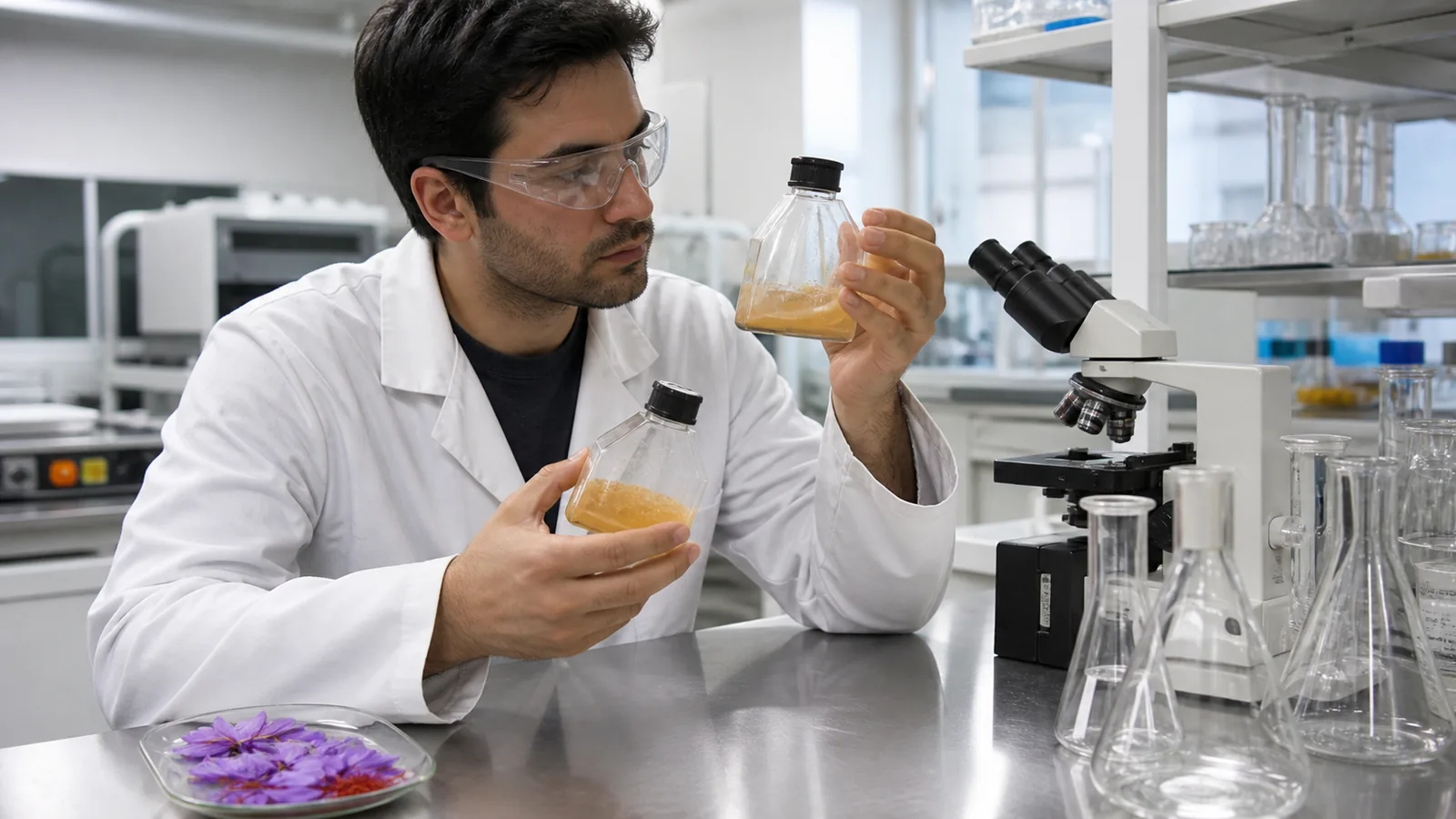
Producing saffron crocin by cell culture means growing plant cells under controlled laboratory conditions and encouraging them to make the pigment outside a flowering field. An Iranian food-science research team reported a laboratory-scale result using this approach, with the longer-term aim of developing a consistent and economical source of crocin for industry.
Crocin is not the whole spice. It is a group of water-soluble carotenoid-derived compounds responsible for much of saffron’s characteristic colour. Separating that compound from the agricultural product matters: a cell culture may produce crocin, but it does not automatically reproduce saffron’s full aroma, flavour or composition.
What the Iranian cell-culture project reported
Dr Seyed Mehdi Ziaratnia, then a faculty member at Iran’s Food Science and Technology Research Institute, announced what he described as the country’s first laboratory-scale production of saffron crocin through cell culture. The project’s stated objective was to move toward larger, lower-cost production for food, pharmaceutical, cosmetic and related industrial research.
The announcement said the method avoids growing and harvesting a conventional saffron crop because the cells are maintained under controlled conditions. That could reduce exposure to weather and the labour needed to pick flowers and separate stigmas. It did not publish a yield, purity result, process design or cost comparison, however. The claim that cell culture would be cheaper at scale therefore remained a project goal, not a demonstrated commercial outcome.
How crocin can be produced in plant cell culture
Plant-cell work usually begins with a small piece of tissue grown into an undifferentiated mass called callus. Researchers can transfer those cells to a liquid suspension, adjust the culture medium and control light, temperature, nutrients and growth regulators. The scientific task is to find conditions that produce both enough cell material and enough of the desired compound.
This is an established research direction rather than a purely theoretical proposal. A peer-reviewed study of two-stage culture of Crocus sativus callus reported 0.43 grams of crocin per litre under its experimental conditions, three times the one-stage result. A later saffron cell-suspension study used salicylic acid as an elicitor and measured increased crocin production and release from the cultured cells.
Those experiments support the biological feasibility of the method. They do not by themselves prove that a process is economical, approved for food use or ready for industrial manufacture. Scale-up still requires a stable cell line, controlled bioreactors, repeatable batches, efficient extraction and purification, and testing for identity and contaminants.
Cell culture is different from recombinant production
Searches for crocin production often also refer to recombinant methods and patents. The two approaches are related but not identical. Saffron cell culture uses plant cells derived from saffron tissue. Recombinant production transfers selected biosynthetic genes into another organism so that it can build crocin or its precursors.
For example, a peer-reviewed study engineering Escherichia coli constructed a pathway that produced crocetin and a crocin derivative. That work provides a foundation for microbial production, but its organism, pathway and output differ from growing saffron callus. A patent or laboratory pathway should not be described as a commercial saffron substitute unless the actual product, purity, regulatory status and manufacturing scale support that conclusion.
What crocin research does—and does not—show
Crocin is widely studied as a colour compound and as a candidate bioactive molecule. Laboratory and cell studies have explored many biological effects, including work involving cancer cell lines and cardiovascular mechanisms. Such experiments are useful for forming research questions, but they are not evidence that cell-cultured crocin prevents or treats disease in people.
The original article’s broad medical wording has therefore not been carried forward as a consumer health claim. A laboratory ingredient is not a medicine simply because early-stage studies are promising. Any therapeutic product would require defined composition, dosing, safety evidence, human clinical data and the relevant regulatory approval.
Quality control for saffron and crocin products
A related historical statement from Iran’s Food and Drug Administration described its licensing role for saffron production and packaging units. At that time, an agency specialist said about 17 preparation and packing units held HACCP certificates and around three had received a health-and-safety mark. Those counts are dated and should not be treated as the number of certified businesses today.
The same statement warned that unlicensed operations were associated with artificial colour, unrelated plant material, dirt and other foreign matter. Buyers were advised to check the production or supervisory licence identifier, production and expiry dates, producer address, brand and package details. Those checks help establish traceability, but a convincing package cannot prove chemical purity on its own.
Laboratory standards provide the stronger test. The current ISO 3632-1:2025 specification applies to dried saffron in filaments, cut filaments and powder. ISO also explains that analytical methods can assess colour, aroma, flavour-related characteristics, moisture and foreign matter. Powder deserves particular care because added material is harder to see.
Cell-cultured crocin needs its own precise identity and purity documentation; dried saffron needs saffron-specific testing and traceability. Keeping those two product categories clear protects buyers and lets the science be judged on what was actually produced.
From laboratory result to useful production
The Iranian project identified a credible technical direction: make a valuable saffron compound in controlled culture, then investigate whether the process can be scaled. The next questions are quantitative. How much crocin does each litre produce? How pure is it after extraction? Are batches consistent? What energy, water and material inputs are required? Does the finished ingredient meet the rules for its intended use?
Until those results are available, saffron crocin cell culture is best understood as a promising production platform under development. It complements field cultivation and recombinant research; it does not yet erase the distinctions between a laboratory compound, an approved industrial ingredient and authentic dried saffron.

![Exporting Saffron to Turkey + Price Guide [Complete 0 to 100]](https://img.rowhanisaffron.com/20260827003933/saffron-export-turkey-quality-inspection.webp)



