


Saffron export challenges become especially serious when a buyer cannot trust what is inside the package or where it came from. For Iran, the fight against smuggling and counterfeit saffron is therefore a quality-control problem, a customs problem and a reputation problem at the same time.
Why counterfeit saffron harms legitimate exports
Counterfeit saffron is not simply a lower commercial grade. It may contain dyed plant fibres, unrelated material or genuine saffron altered to increase its apparent weight. A cheaper, correctly labelled grade can still be authentic; a product sold with a false identity or composition is not.
The distinction matters beyond one disappointing purchase. A buyer who receives adulterated material under an Iranian origin claim may become wary of other Iranian suppliers, including exporters who handled their crop properly. Price comparisons also lose meaning when authentic threads are placed beside mixtures that cost less because they are not equivalent products.
ISO has long described saffron as vulnerable to adulteration because of its high value. Its current ISO 3632-1:2025 specification applies to dried saffron in filament, cut-filament and powder forms. The standard is useful for defining the product and its quality requirements, while laboratory methods provide evidence that appearance alone cannot.
Iran’s production lead does not guarantee market trust
The Food and Agriculture Organization said in September 2025 that Iran produces more than 90% of the world’s saffron. That explains the familiar description of saffron as Iranian “red gold,” but production share and control of the final retail market are different things.
Once bulk saffron leaves the producer, its value can depend on testing, packaging, documentation, branding and the relationship with the overseas buyer. Weakness at any of those stages can allow an intermediary or dishonest seller to obscure the origin. Iran can lead in the field while receiving less recognition at the shelf.
What customs can and cannot verify
A customs declaration establishes a legal record of the shipment. It does not, by itself, prove every quality characteristic inside each package. Effective control joins customs data with traceable batches, tamper-evident packaging and testing by competent laboratories. Inspectors also need a way to escalate suspicious shipments without holding every compliant consignment indefinitely.
Industry commentary behind the original version of this article contrasted strict checks in Khorasan, the principal saffron-producing region, with less consistent enforcement through Tehran, Isfahan and Shiraz. We could not locate a current public customs dataset that measures those cities on a comparable basis. It would therefore be misleading to present that regional comparison as a verified ranking.
The useful point is national consistency. A shipment should not become easier to misdescribe merely because it leaves through a different customs office. Shared documentation rules, risk-based inspection and access to the same qualified testing procedures would make enforcement more predictable for honest exporters.
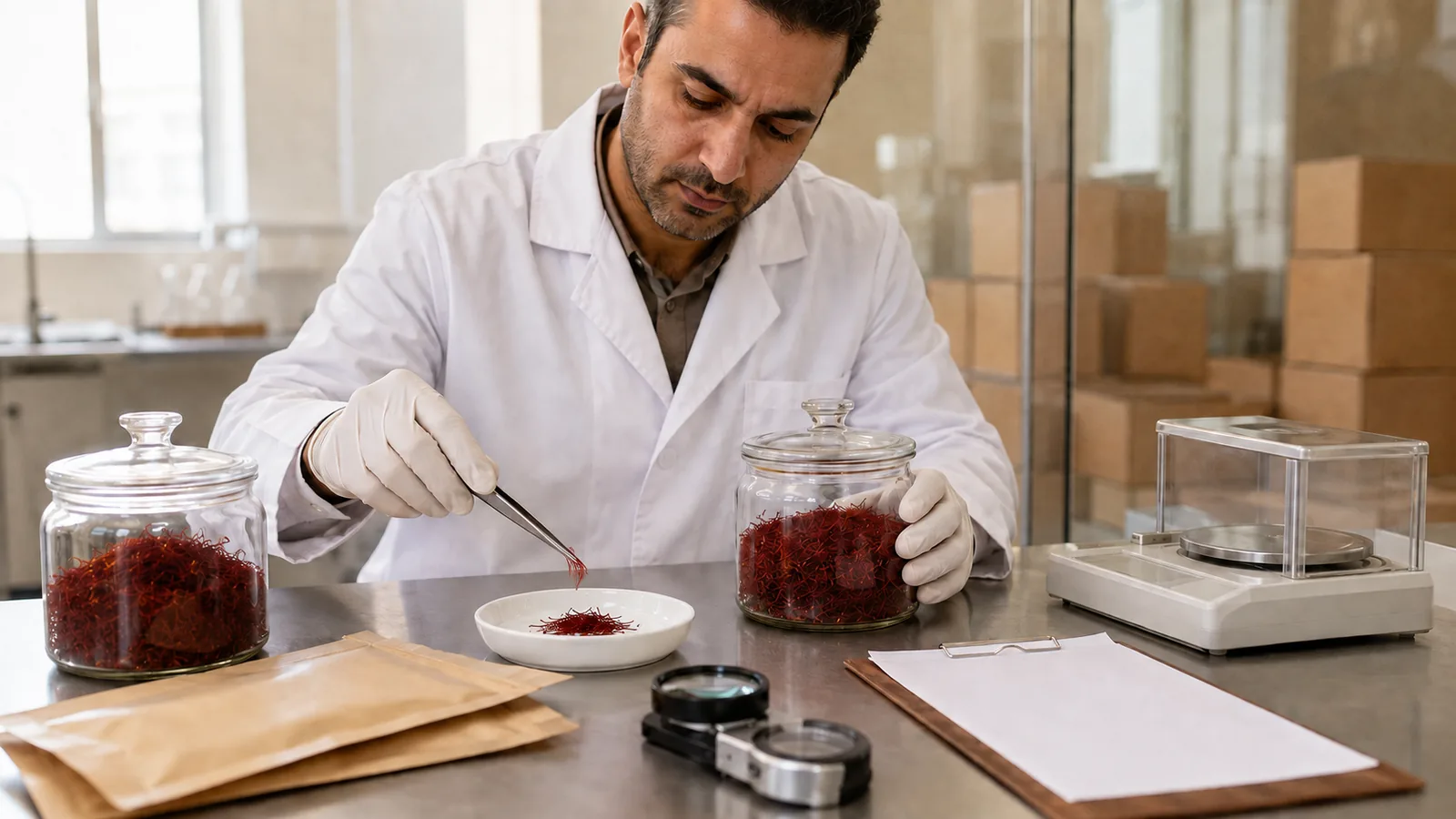
How counterfeit saffron is detected
Whole threads reveal more visual information than powder, but visual inspection is only a screen. ISO’s explanation of saffron fraud notes that powder is especially open to substitution and that excess moisture can also increase apparent weight. The standard addresses characteristics connected with colour, aroma, flavour and moisture rather than relying on a single home test.
FAO’s current work with Mashhad University goes further, using a high-resolution chemical fingerprint centred on crocin, picrocrocin and safranal. It also considers post-harvest handling, because authentic saffron can still lose quality when drying, storage or transport is poor.
For a commercial shipment, a sensible evidence chain includes:
- a batch or lot identifier that follows the saffron through packing;
- a representative laboratory sample and a dated report tied to that batch;
- consistent net-weight records and sealed packaging;
- documents that identify the exporter, declared origin and destination;
- storage and transport conditions suited to protecting colour, aroma and flavour.
Consumers can notice obvious warning signs, but a cup-of-water demonstration does not replace laboratory analysis. Our article on why authentic Iranian saffron and counterfeit material can move in opposite directions gives further market context.
The scale of saffron smuggling
In January 2024, Gholamreza Miri estimated that at least 10 tonnes of saffron were smuggled out of Iran each month. This figure remains an industry estimate, not a count of intercepted shipments. It is best used to show the claimed scale of the problem, not as a precise monthly series.
Smuggled saffron is also not automatically counterfeit. Genuine saffron can cross a border illegally, while counterfeit or adulterated saffron can enter a supply chain under apparently formal paperwork. The risks overlap when an undocumented route removes traceability and makes the product easier to relabel or mix.
Why exporters may leave the formal route
Contemporary industry reports linked informal trade to sanctions, customs duties, market restrictions, bureaucratic delays and rules for returning foreign-currency earnings. A gap between an official settlement rate and a fair market rate can make a legal transaction harder to price. High route-specific duties can also redirect trade through intermediaries.
These pressures help explain behaviour; they do not excuse smuggling. A durable response needs both credible enforcement and a formal route that compliant businesses can realistically use. Penalties alone cannot fix unclear procedures, while easier procedures without inspection would do little to protect authenticity.
Is saffron illegal?
Saffron itself is a culinary spice, not an inherently illegal product. The United States eCFR, for example, lists saffron among spices generally recognized as safe for their intended use.
A particular shipment may still be illegal if it is undeclared, mislabelled, adulterated or sent contrary to customs, sanctions, food-safety or import rules. Requirements differ between destinations and can change. Exporters and buyers should check the rules for the actual route instead of treating a general statement about saffron as legal advice for a consignment.
How to reduce smuggling without weakening quality control
The strongest measures support legal trade and make dishonest trade easier to detect:
- Predictable currency procedures: exporters should know how earnings will be settled before agreeing a price.
- Consistent customs practice: the same core evidence should be expected at every export point, with risk-based escalation for unusual consignments.
- Batch-level traceability: test reports and origin records must point to the material actually shipped.
- Protective packaging: sealed packs reduce opportunities for substitution after testing.
- Direct buyer relationships: an overseas customer who knows the producer, grade and batch history has less reason to rely on an anonymous intermediary.
- Honest promotion: global exhibitions and trade events help only when claims about grade, origin and certification can be documented.
What buyers should ask an exporter
A serious buyer does not need a ceremonial folder of certificates. They need a short chain of evidence that makes sense. Ask which saffron form and grade the quotation covers, who sampled the lot, which test method was used, how the report maps to the package, and whether the offered weight is net of packaging. Confirm the named exporter and the actual country of origin as separate fields.
If the seller makes a purity or certification claim, request the document before shipment and check its date, issuing laboratory and batch reference. Be cautious when a certificate appears generic enough to accompany any product. Extremely low pricing is a reason to investigate, not proof by itself.
Reading Iran saffron export news carefully
Iran saffron export news often compresses different problems into the word “smuggling.” When reading a report, note whether it describes an industry estimate, an enforcement seizure or official customs totals. Also separate authentic but undeclared saffron from adulterated material; the remedy is not identical.
Iran’s position as the world’s largest saffron producer and a major exporter gives it an extraordinary place in the market. Protecting that position requires more than repeating the production share. It requires consistent inspection, usable legal export channels and evidence that lets a buyer connect every package to an authentic, well-handled batch.

![Exporting Saffron to Turkey + Price Guide [Complete 0 to 100]](https://img.rowhanisaffron.com/20260827003933/saffron-export-turkey-quality-inspection.webp)



